Researchers Fit Quantum Circuits Into a 30 Billion-Parameter AI Model
Researchers demonstrated a hybrid quantum‑classical module that replaces part of a 30‑billion‑parameter language model, achieving similar prediction quality but with far slower runtime.
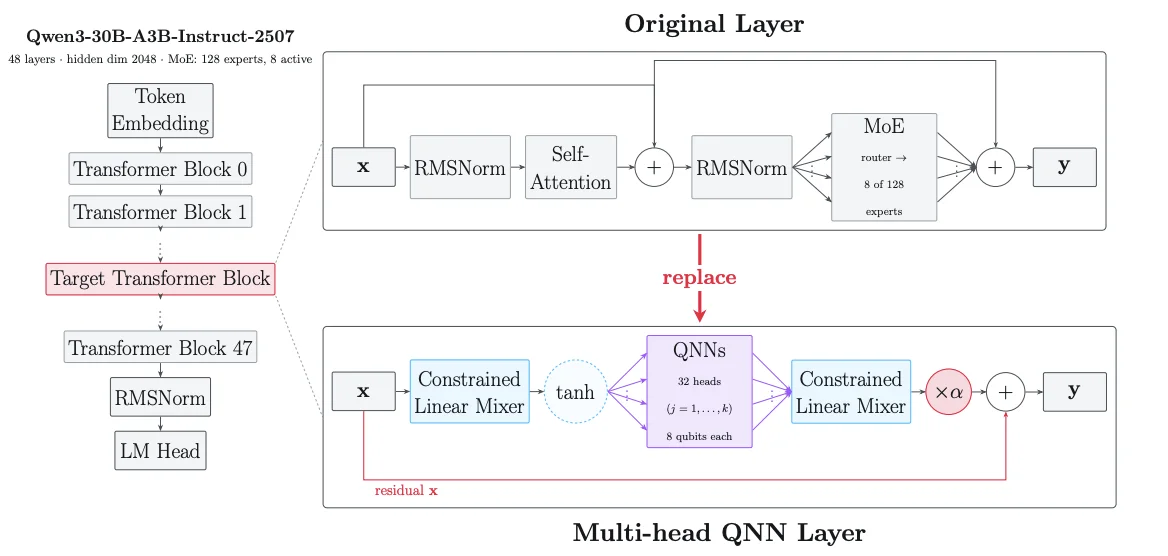
Quantum Modules Meet Large Language Models
A team from Multiverse Computing and the University of Toronto explored how a small quantum processor could take over a slice of a massive language model. By swapping eight consecutive layers of Alibaba Cloud’s 30.5‑billion‑parameter Qwen‑3 model with a quantum‑enabled module of just 145 k trainable parameters, they reduced the active parameter count by roughly 16 % while keeping perplexity within about 1 % of the original on two English test sets.
How the Hybrid Replacement Works
The Qwen‑3 model represents each token with 2,048 numbers. Loading all of these into a single quantum circuit would exceed current hardware limits, so the researchers split the vector into 32 groups of 64 numbers. Each group was processed by an eight‑qubit circuit on IBM’s 156‑qubit Heron processor. The 32 circuits were run in three batches, allowing the quantum hardware to handle 14 circuits simultaneously. Training of the quantum module was performed on classical simulators, first to mimic the original layers and then to fine‑tune predictions within the full model.
Performance and Limitations
- Prediction quality – In simulation, the hybrid model’s perplexity was only 0.9 % worse on WikiText‑2 and indistinguishable on a C4 sample. When the quantum module was actually run on hardware, the top‑prediction matched the original model for all 15 tokens of one prompt and 13 of 15 for another short prompt.
- Speed – Running the quantum portion required about 90 seconds of processor time per token, roughly a minute and a half for a single token when accounting for repeated circuit executions needed for statistical accuracy. By contrast, a conventional neural network of comparable size completed the same work orders of magnitude faster.
- Hardware errors – Real‑world runs exhibited larger error rates than the simulated noise models, highlighting the need for more robust error mitigation before scaling up.
What Comes Next?
The authors note several avenues for improvement:
- Better integration with attention mechanisms – The current quantum module processes tokens independently, leaving the model’s core attention layers untouched.
- Comparison with state‑of‑the‑art compression – Existing model‑pruning and quantisation techniques can achieve similar parameter reductions with far less overhead.
- Error mitigation and scaling – Reducing the number of circuit repetitions and improving qubit fidelity are essential for practical deployment.
While the study shows that quantum circuits can be embedded in a production‑scale transformer, the speed penalty and modest accuracy gains mean that quantum hardware is not yet a competitive partner for large‑language‑model inference. Nonetheless, the work provides a concrete proof‑of‑concept for hybrid quantum‑AI architectures and points to concrete research directions.
--- For a deeper technical dive, see the authors’ arXiv pre‑print (link provided in the source article).
Hype check
PartlyThe preprint shows a modest hybrid integration with comparable accuracy but far slower runtime; no peer‑reviewed validation or independent replication is provided.
- Peer-reviewed paper, or press release only?Press release only — Result posted as an arXiv preprint, not a peer‑reviewed paper
- Error-corrected (logical) qubits, or physical qubits only?Physical only — Uses 156‑qubit IBM Heron processor, physical qubits only
- A new milestone, or a rebrand / restatement?New — First demonstration of quantum circuits replacing layers in a 30‑billion‑parameter LLM
- Independent confirmation?Not yet — No external confirmation or replication mentioned
- Does the headline claim match what the source shows?Matches — Headline accurately reflects the described hybrid replacement experiment
An editorial assessment of the claim as reported, not a judgment of the company or researchers. How we rate hype →
Source
Read original sourceWhy we picked this
Accepted from curated QuantumUnzipped source (relevance scoring disabled).