Researchers Measure Entanglement on 12-Qubit System Via Resets
Stochastic resets in a 12‑qubit superconducting processor create measurable ‘reset memory’, linking Holevo information to entanglement entropy and revealing differing sensitivities of entanglement diagnostics.
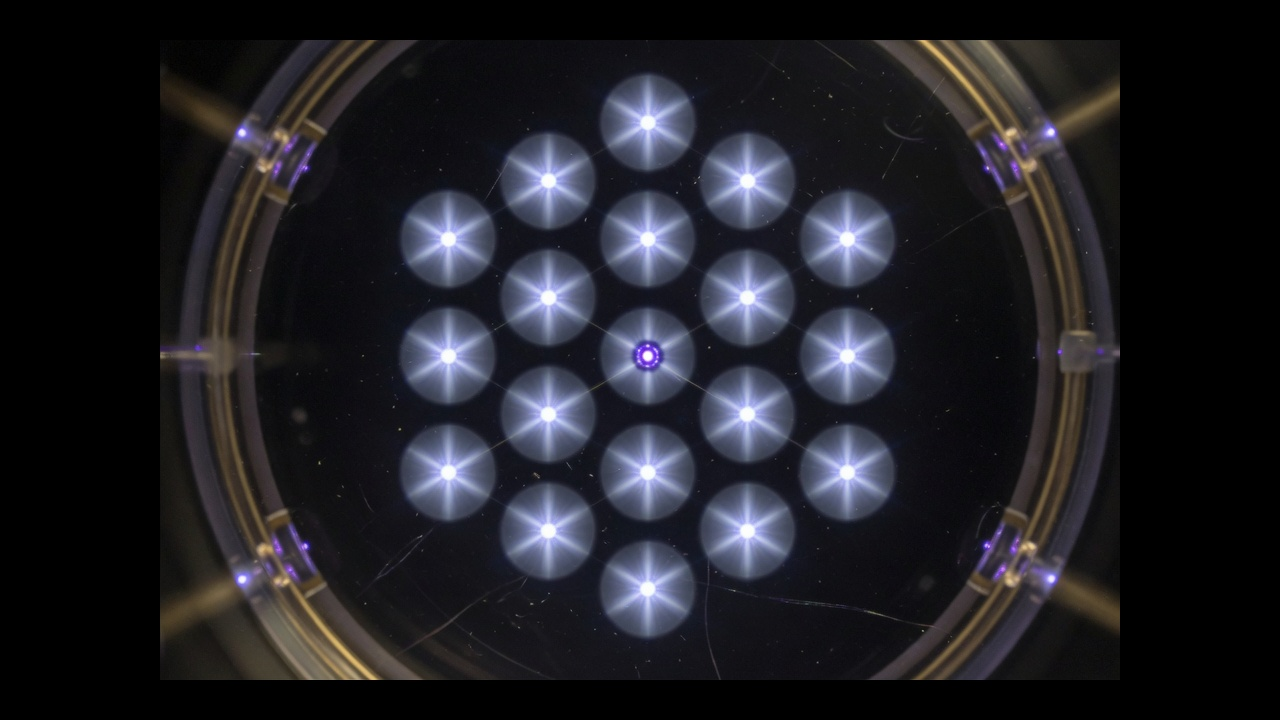
Measuring Entanglement via Stochastic Resets on a 12‑Qubit Processor
Researchers at the Research Institute CODE (University of the Bundeswehr Munich) have demonstrated a direct experimental connection between a quantum system’s reset history and its entanglement properties. By repeatedly applying a Bell‑state reset to a superconducting qubit chain—effectively returning each qubit to a known state during operation—they observed that the Holevo information (the amount of classical information the system retains about the timing of the last reset) grows steadily with the number of qubits, up to the 12‑qubit chains they tested.
---
1. From Reset Memory to Entanglement Entropy
- Holevo information as a memory metric – The researchers define the difference between two entanglement‑entropy measures as the Holevo information about the most recent reset. This provides a concrete, experimentally accessible way to quantify how much “history” a quantum system remembers.
- Scaling with system size – Across transverse‑field Ising chains of 4, 8, and 12 qubits, the measured Holevo information increased monotonically, showing no sign of saturation. The result suggests that larger quantum processors could retain proportionally more reset‑related information, a promising sign for future error‑mitigation strategies.
---
2. Experimental Platform and Diagnostics
- Superconducting processor – The team used a state‑of‑the‑art superconducting circuit without any post‑measurement calibration tweaks, ensuring that the observed trends stem from the physics of the reset protocol rather than fine‑tuned fitting.
- Entanglement measures – Two complementary diagnostics were employed:
Entanglement entropy (von Neumann and Rényi variants) – these global measures matched theoretical predictions closely, confirming that the stochastic resetting creates the expected nonequilibrium stationary states. Concurrence – a pairwise correlation metric – consistently fell short of the entropy‑based expectations. A simple depolarizing model with a single adjustable parameter captured this suppression, highlighting that different diagnostics probe distinct aspects of the reconstructed quantum state.
---
3. Implications for Quantum Error Management
- Stochastic resetting as a stabiliser – Periodically resetting qubits prevents error accumulation, effectively “refreshing” the processor. The observed link between reset timing and entanglement suggests that such resets embed a useful memory that can be harnessed for diagnostics or adaptive control.
- Noise‑sensitive diagnostics – The discrepancy between entropy‑based and concurrence‑based readings underscores the need to choose entanglement metrics wisely, especially on noisy superconducting hardware. Entropy appears more robust to depolarizing noise, while concurrence is more sensitive to local error channels.
---
4. Outlook: Scaling and Applications
The experimental confirmation that Holevo information scales with chain length opens several avenues:
- Larger‑scale processors – Extending the protocol to 20‑qubit or beyond systems will test whether the linear growth persists or eventually saturates due to decoherence or hardware constraints.
- Adaptive reset schedules – By monitoring entropy‑derived Holevo information in real time, a quantum controller could decide when to trigger a reset, balancing coherence preservation against the need for fresh computational states.
- Benchmarking tools – The entropy‑concurrence gap provides a diagnostic fingerprint for hardware noise characteristics, potentially serving as a standard benchmark for superconducting platforms.
---
Closing Thoughts
The study bridges a conceptual gap between abstract information‑theoretic quantities and concrete experimental observables. By showing that stochastic resets imprint a quantifiable memory—captured by Holevo information—onto the entanglement structure of a 12‑qubit system, the work not only validates theoretical predictions but also equips quantum engineers with a new tool for characterising and stabilising noisy processors. As quantum devices continue to scale, such reset‑based diagnostics may become integral to reliable, high‑fidelity quantum computation.
Source
Read original sourceWhy we picked this
Accepted from curated QuantumUnzipped source (relevance scoring disabled).