Researchers measure ‘magic’ in quantum states using just a few copies
A new moment‑based criterion lets researchers certify quantum “magic” from only a few copies of a state, avoiding full tomography.
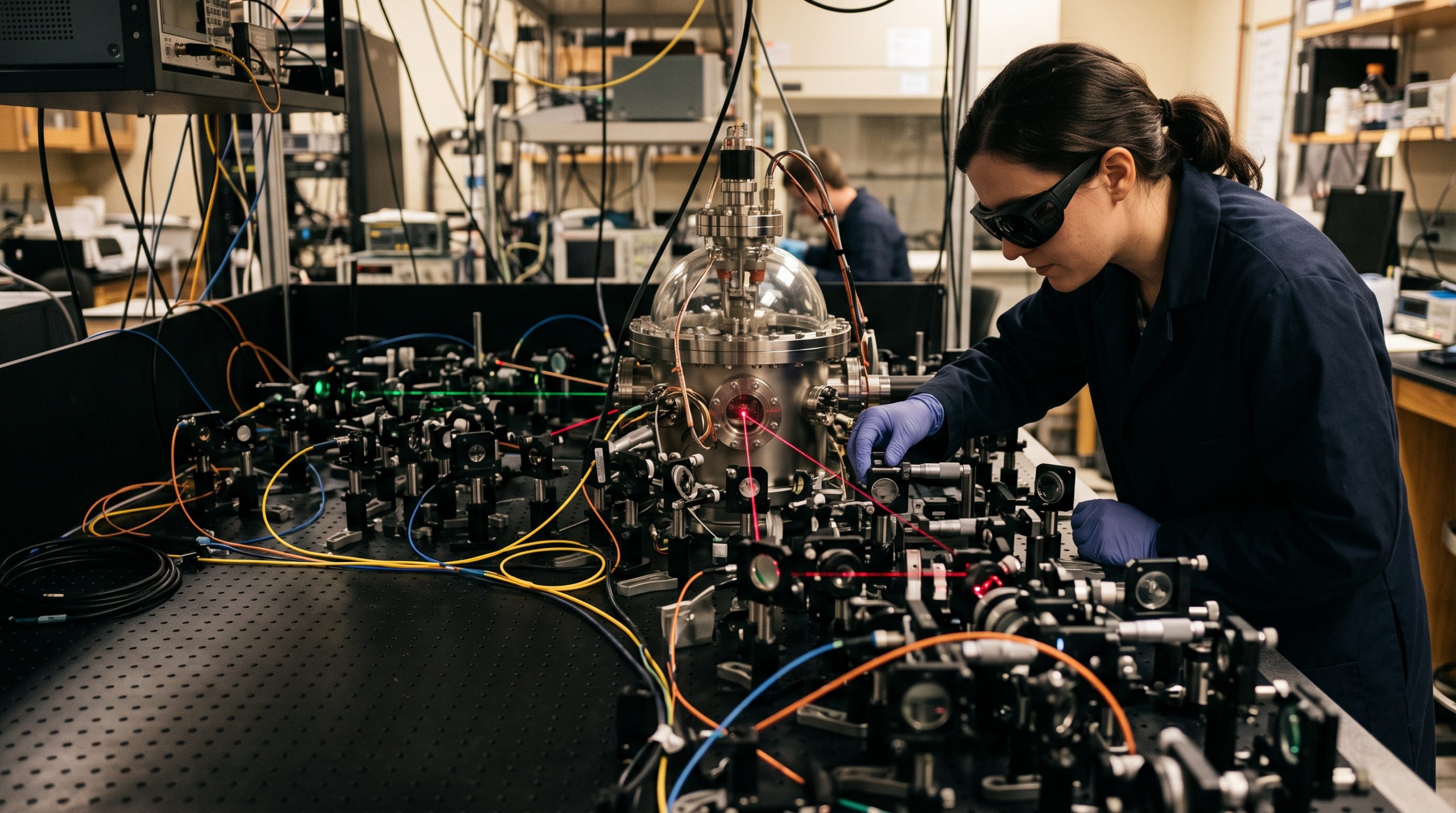
Measuring Quantum Magic with Minimal Data
Quantum computers derive their power from non‑stabilizer states—often called magic—that cannot be efficiently simulated on classical machines. Traditionally, quantifying this resource required full state tomography, an effort that scales exponentially with the number of qudits. A team led by Kunal Sharma at the Indian Institute of Technology Goa has introduced a moment‑based criterion that extracts the same information from just a handful of measurable moments of the discrete Wigner function.
A Simple Third‑Moment Test for Pure States
For pure states of any number of odd‑prime‑dimensional qudits, the authors prove that the third‑order Wigner moment alone provides a necessary and sufficient condition for non‑stabilizerness. In practice, this means measuring the expectation value of a two‑outcome observable in a constant‑depth Clifford circuit—operations that are experimentally straightforward and whose required number of repetitions does not grow with system size.
Extending to Mixed States with a Hierarchy of Moments
Mixed states are more subtle because a non‑negative Wigner function does not guarantee stabilizer status. The paper constructs a hierarchy of higher‑order moment inequalities that converge on the exact negativity threshold. Even the lowest‑order inequality already yields useful lower bounds on sum negativity and mana, two quantitative measures of magic. These bounds translate directly into estimates of the sampling overhead needed for quasiprobability simulations of Clifford circuits with magic‑state inputs.
Practical Implications
- Scalability: The number of circuit rounds required to estimate each moment is independent of the number of qudits, making the method viable for large‑scale platforms.
- Resource Estimation: By linking measurable moments to mana, experimentalists can gauge how much “magic” a prepared state supplies for fault‑tolerant algorithms.
- Reduced Overhead: Compared with full tomography, the moment‑based approach dramatically cuts down the number of copies needed, easing the burden on quantum hardware and readout electronics.
Looking Ahead
The authors illustrate their technique with examples such as a noisy “strange state” and a ququint mixture, showing that the third‑moment witness correctly identifies the onset of Wigner negativity. While the results are currently reported in an arXiv preprint (arXiv:2611.34668v1), the framework offers a clear experimental pathway for quantifying magic in near‑term devices. Future work will likely focus on extending the method to even‑dimensional systems and on benchmarking the approach against full‑state reconstruction in real hardware.
The ability to certify and quantify quantum magic with only a few copies could become a standard diagnostic tool as quantum processors scale up, helping researchers allocate error‑correction resources more efficiently and bringing practical quantum advantage a step closer.
Hype check
PartlyThe paper presents a concrete, verifiable method, but it is only on arXiv and lacks peer review or independent replication.
- Peer-reviewed paper, or press release only?Press release only — Result is reported in an arXiv preprint only
- Error-corrected (logical) qubits, or physical qubits only?Logical / not a qubit claim — Not a qubit‑count claim
- A new milestone, or a rebrand / restatement?New — Introduces a novel moment‑based certification method
- Independent confirmation?Not yet — No external confirmation mentioned
- Does the headline claim match what the source shows?Matches — Headline accurately reflects the paper's claim
An editorial assessment of the claim as reported, not a judgment of the company or researchers. How we rate hype →
Source
Read original sourceWhy we picked this
Accepted from curated QuantumUnzipped source (relevance scoring disabled).