Researchers Propose Fault-Tolerant Quantum Processor Architecture Controlled by 20 or Fewer External Wires
A new theoretical design promises fault‑tolerant quantum processors that need only 20 external control wires, regardless of qubit count.
Minimal‑Control Fault‑Tolerant Quantum Processor
A collaborative team from the Simons Institute, Stanford, Google Quantum AI, Caltech and Oratomic has released a paper outlining a bold architectural concept for quantum computing. The proposal replaces the traditional per‑qubit control wiring with a fixed, clocked planar array that can be operated through no more than 20 external wires. By doing so, the design aims to simplify hardware scaling while preserving full fault‑tolerance.
How the Architecture Works
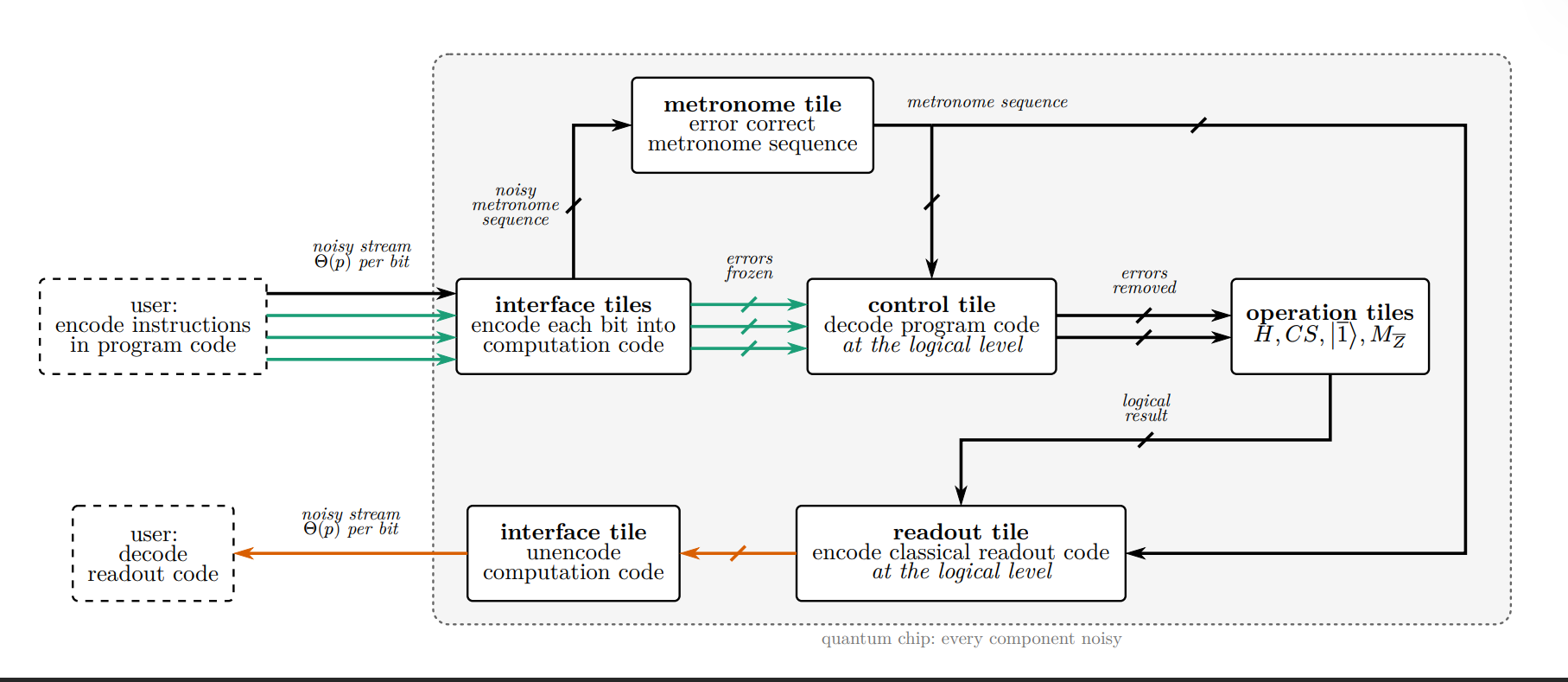
The core idea is to treat the quantum chip like a classical CPU. All physical qubits sit on a 2‑D square lattice and execute the same three‑layer periodic circuit on every clock tick: two swap‑transport layers followed by a gate layer. Only a small set of “interface qubits” connects to the outside world via the limited external wires. All other qubits remain isolated from direct control, reducing the wiring overhead that has long hampered large‑scale quantum devices.
To keep the system error‑free, the authors combine a concatenated 1‑D measurement‑free error‑correcting code with a rate‑1/4 classical expander code. The expander code protects the classical instruction stream, while a majority‑voted metronome signal tracks codeword boundaries, ensuring that noise on the narrow wire bundle does not corrupt quantum operations.
Scaling Claims
Two theorems in the paper describe the theoretical performance:
- All‑Quantum Scaling (Theorem 5.7) – Logical qubits scale as \(n/\text{polylog}(n/\epsilon)\) with a gate time of \(n\cdot\text{polylog}(n/\epsilon)\), where \(n\) is the number of physical qubits and \(\epsilon\) the logical error rate.
- Classical‑Wire RAQM Variant (Theorem 6.4) – By adding a unit‑density classical broadcast network and teleportation‑based memory cells, the per‑gate time improves to \(\text{polylog}(n/\epsilon)\).
These results suggest that, in principle, a processor could host millions of logical qubits while keeping control wiring modest and gate times sub‑linear.
Potential Physical Realizations
The authors point to two promising platforms:
- Semiconductor spin‑qubit shuttling arrays co‑integrated with cryogenic CMOS electronics.
- Merged‑element transmons paired with single‑flux‑quantum (SFQ) logic.
Both approaches already support dense 2‑D layouts and could accommodate the fixed‑function tile architecture described in the paper.
What This Means for the Field
If realized, the proposal could dramatically lower the engineering burden of wiring and interconnects, two of the biggest bottlenecks in scaling quantum processors. By shifting complexity from the cryogenic hardware to on‑chip classical processing, the design aligns with broader trends toward cryogenic control electronics and modular quantum architectures.
However, the work remains entirely theoretical. No experimental prototype or benchmark data are presented, and the feasibility of the required on‑chip classical decoding and teleportation infrastructure is still an open question. Future work will need to address fabrication tolerances, timing synchronization, and the overhead of the concatenated codes in realistic noise environments.
Bottom Line
The paper offers a compelling vision of a quantum processor that can be driven by a handful of wires, potentially unlocking new pathways to large‑scale, fault‑tolerant quantum computers. The next step will be to translate these ideas into hardware and demonstrate that the promised scaling holds up under real‑world conditions.
Hype check
PartlyThe paper presents a theoretical architecture with no experimental validation; the claim is plausible but unproven.
- Peer-reviewed paper, or press release only?Press release only — Only an arXiv preprint is mentioned, no peer‑reviewed venue.
- Error-corrected (logical) qubits, or physical qubits only?Logical / not a qubit claim — The claim is about architecture, not a specific qubit count.
- A new milestone, or a rebrand / restatement?Restatement — It is a proposal, not a demonstrated breakthrough.
- Independent confirmation?Not yet — No external confirmation or replication cited.
- Does the headline claim match what the source shows?Matches — Headline accurately reflects the paper's proposal.
An editorial assessment of the claim as reported, not a judgment of the company or researchers. How we rate hype →
Source
Read original sourceWhy we picked this
Accepted from curated QuantumUnzipped source (relevance scoring disabled).