RIKEN and Quantinuum Demonstrate Heterogeneous Multi-QPU Workflows on Fugaku
RIKEN and Quantinuum used Fugaku to orchestrate a hybrid workflow across a 156‑qubit superconducting and a 20‑qubit trapped‑ion processor, achieving lower energy error on a 16‑site Ising model.
Heterogeneous Multi‑QPU Workflows on Fugaku
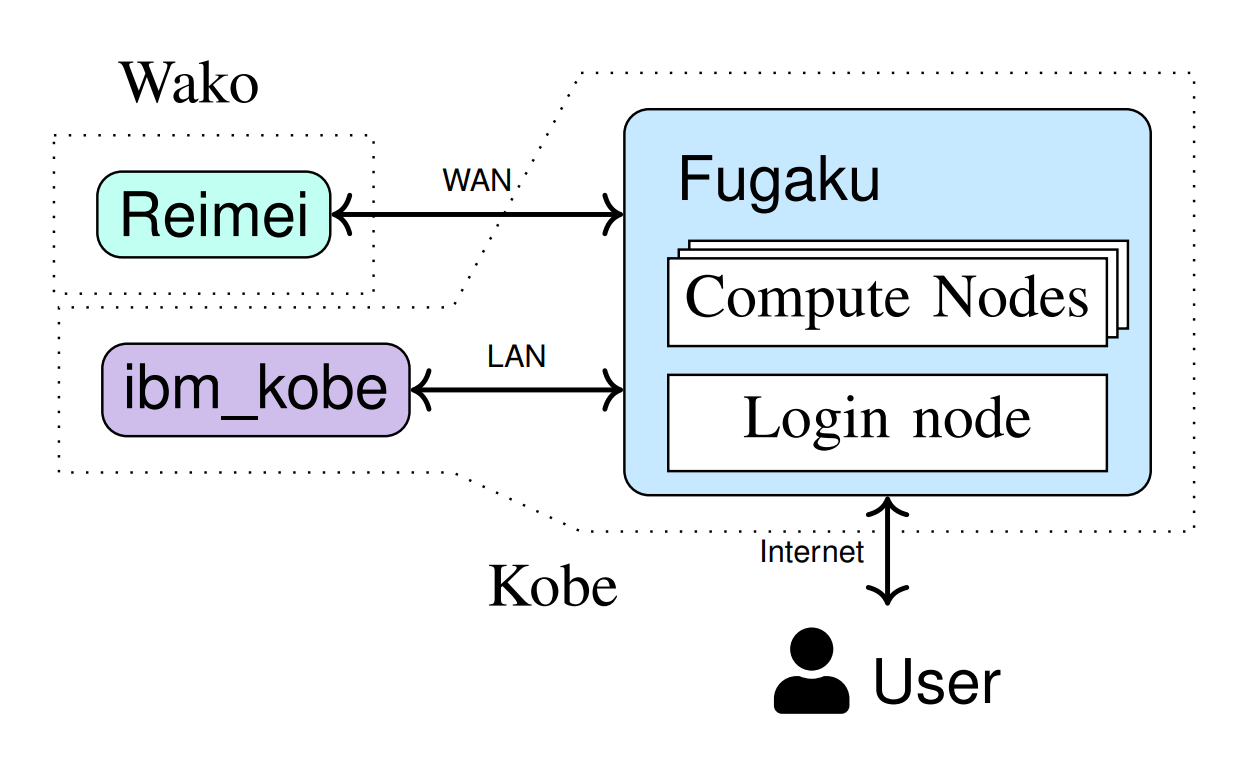
Researchers from Quantinuum, the University of Tsukuba, and RIKEN’s Center for Computational Science have shown that a traditional supercomputer can act as the central orchestrator for quantum‑classical workloads that span physically separate quantum processors. The demonstration links Fujitsu’s Fugaku with two distinct QPUs: the ibm_kobe superconducting chip (156 physical qubits) located on‑site in Kobe, and the Quantinuum Reimei trapped‑ion system (20 physical qubits) housed about 500 km away in Wako.
Architecture and Middleware
Fugaku runs native batch jobs through its pjsub scheduler and communicates with the QPUs via dedicated virtual LANs and low‑latency gRPC services (sqcsub). The team extended the open‑source Tierkreis data‑flow framework to understand these interfaces, allowing directed‑acyclic‑graph (DAG) workflows to span CPU nodes and quantum coprocessors without manual glue code. Tierkreis’s executors translate Fugaku’s job specifications into quantum‑specific submission calls, preserving task state and enabling asynchronous execution.
Benchmark: 16‑Site Transverse‑Field Ising Model
The primary case study targets a 4 × 4 lattice transverse‑field Ising model (TFIM). The workflow splits the algorithm to exploit each processor’s strength:
- ibm_kobe (superconducting) – runs a Variational Quantum Eigensolver (VQE) for rapid parameter optimization. 500 VQE iterations were performed, each with 20 000 shots, to generate an approximate ground‑state wavefunction.
- Reimei (trapped‑ion) – receives the optimized parameters and executes a high‑fidelity Quantum Phase Estimation (QPE) routine using all‑to‑all connectivity. The QPE run involved 300 shots across 16 system qubits, one ancilla, and three leakage‑detection qubits.
By “warm‑starting” the deep QPE circuit with the VQE‑derived state, the combined workflow reduced the normalized energy error from 2.47 ± 0.10 (stand‑alone VQE) to 0.61 ± 0.36 on physical hardware, a clear improvement over both the quantum‑only and classical baselines.
Secondary Case Study: Quantum Chemistry
A second demonstration applied the same orchestration to a biomolecular excited‑state workflow (subtractive ONIOM and TE‑QSCI). Tierkreis automated roughly 80 % of the runtime coordination between classical chemistry packages and quantum circuit generation, showing that the approach scales beyond condensed‑matter models to realistic chemistry problems.
Implications
This work proves that heterogeneous quantum resources can be coordinated by a conventional HPC system without requiring a quantum interconnect. By leveraging the low‑latency, high‑throughput capabilities of a supercomputer, researchers can combine the speed of superconducting qubits with the fidelity and connectivity of trapped‑ion devices, opening a path toward more flexible, production‑grade quantum‑classical pipelines.
---
The full technical details are available in the IEEE SC26 conference paper and the accompanying preprint, and the Tierkreis codebase is open source.
Hype check
RealThe article describes a concrete, reproducible multi‑QPU workflow with benchmark results, backed by a conference paper; the evidence matches the headline claim.
- Peer-reviewed paper, or press release only?Paper — IEEE conference paper for SC26 cited
- Error-corrected (logical) qubits, or physical qubits only?Physical only — qubit counts refer to physical qubits only
- A new milestone, or a rebrand / restatement?New — first demonstrated heterogeneous multi‑QPU workflow on Fugaku
- Independent confirmation?Not yet — no external replication mentioned in the input
- Does the headline claim match what the source shows?Matches — headline accurately reflects described demonstration
An editorial assessment of the claim as reported, not a judgment of the company or researchers. How we rate hype →
Source
Read original sourceWhy we picked this
Accepted from curated QuantumUnzipped source (relevance scoring disabled).