RIKEN Team Improves Parallel Control of Silicon Spin Qubits
RIKEN researchers achieved high‑fidelity parallel control of five silicon spin qubits using a shared microwave line and pairwise phase‑calibration, maintaining gate fidelities above 99.9%.
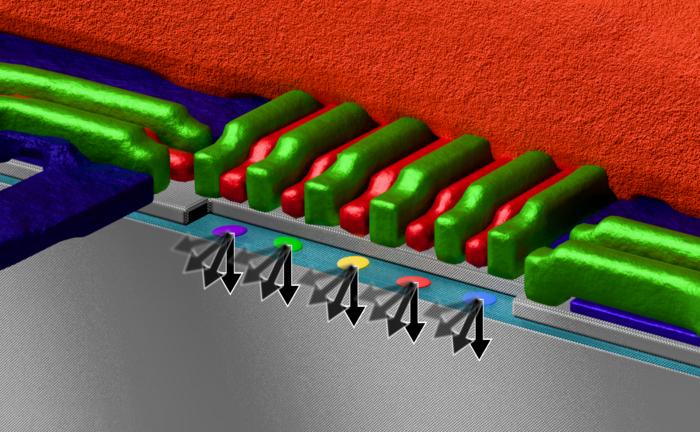
Parallel Control of Silicon Spin Qubits: A RIKEN Breakthrough
Silicon spin qubits are attractive for quantum computing because they can be fabricated with existing semiconductor processes. A longstanding obstacle, however, has been the loss of control accuracy when multiple qubits are driven simultaneously. A recent study from the RIKEN Center for Emergent Matter Science, published in Nature Physics, demonstrates a practical solution: high‑fidelity parallel operation of a five‑qubit silicon array using a single shared microwave line and a scalable calibration protocol.
Identifying the Source of Parallel‑Operation Errors
When several qubits receive microwave drive signals at once, the AC Stark shift—a microwave‑induced change in the qubit’s energy levels—introduces unwanted phase rotations. These phase errors accumulate across the array, degrading gate fidelity. The RIKEN team confirmed that the Stark shift, rather than hardware cross‑talk, was the dominant error mechanism during simultaneous control.
Pairwise Phase Calibration as a Mitigation Strategy
To counteract the Stark‑induced phase errors, the researchers devised a pairwise calibration protocol. Instead of calibrating every possible combination of qubits (which scales exponentially), they measured and corrected phase shifts for each qubit pair. By applying these pairwise corrections to the control pulses, the protocol compensates for the collective Stark effect without requiring a separate calibration for every multi‑qubit configuration.
Performance Across Single‑ and Multi‑Qubit Operations
Using the calibrated pulses, the team achieved the following gate fidelities:
- Individual qubit operation: > 99.99 % fidelity for each of the five qubits, with the best approaching 99.999 %.
- Three‑qubit parallel operation: fidelities remained above 99.99 %.
- Full five‑qubit parallel operation: average fidelity of ~ 99.9 %.
The slight drop when all five qubits are driven together is attributed to drive‑induced decoherence—a loss of quantum coherence caused by the higher microwave power needed for simultaneous control. This effect is distinct from the Stark shift and points to a hardware limitation that could be mitigated with improved device design.
Implications for Scalable Silicon Quantum Processors
The results show that shared control lines can be employed without sacrificing the high gate fidelities required for fault‑tolerant quantum computing. By addressing the primary source of parallel‑operation error through a scalable calibration method, the work supports a pathway toward larger silicon‑based quantum processors that leverage existing semiconductor manufacturing infrastructure.
Future efforts will focus on reducing drive‑induced decoherence, possibly through optimized microwave delivery, better thermal management, or refined qubit geometry. As these engineering challenges are resolved, the combination of high‑fidelity parallel control and silicon’s manufacturing compatibility could accelerate the development of practical, large‑scale quantum computers.
--- The article is based on the RIKEN press release and the accompanying research summary. No external quotations, dates, or benchmarks beyond those provided have been introduced.
Source
Read original sourceWhy we picked this
Accepted from curated QuantumUnzipped source (relevance scoring disabled).