Riverlane Demonstrates Data-Driven DEM Augmentation to Reduce Surface-Code Logical Errors
Riverlane’s data‑driven augmentation of detector error models extracts hidden correlated noise from syndrome data, cutting surface‑code logical errors by up to 75% in simulation and 14% on superconducting hardware.
Introduction
Riverlane has unveiled a practical, data‑driven technique for improving surface‑code error correction. By extending standard Detector Error Models (DEMs) with correlated noise mechanisms discovered directly from syndrome measurements, the company reports substantial reductions in logical error rates—up to 75 % in numerical simulations and 14 % on real superconducting devices. The approach preserves compatibility with fast graph‑based decoders such as PyMatching, making it a realistic addition to existing quantum‑error‑correction stacks.
How the DEM Augmentation Works
The method starts with a baseline DEM that captures known single‑qubit and two‑qubit error channels. Riverlane then searches for higher‑order hyperedges—combinations of existing error mechanisms that jointly trigger syndrome events more often than expected. The pipeline follows three key steps:
- Pairwise Correlation Screening – It evaluates every pair of baseline mechanisms for statistically significant co‑occurrence in the syndrome data.
- Higher‑Order Validation – Candidate hyperedges are tested using joint‑detection inversion to confirm that their combined effect matches observed error patterns.
- Logical Assignment & Decomposition – Each discovered hyperedge receives an explicit logical operator (XOR of its constituents) and is decomposed back into graph edges, ensuring that downstream decoders can incorporate the new prior without redesign.
By restricting the search to combinations of known mechanisms, the search space stays tractable and every added term has a clear physical and logical interpretation.
Benchmark Results
Simulated Surface‑Code Performance
- Code distance: d = 15 (benchmark range d = 7–15)
- Noise model: SI1000 plus correlated two‑qubit XX crosstalk (p_corr = 3 × 10⁻⁴)
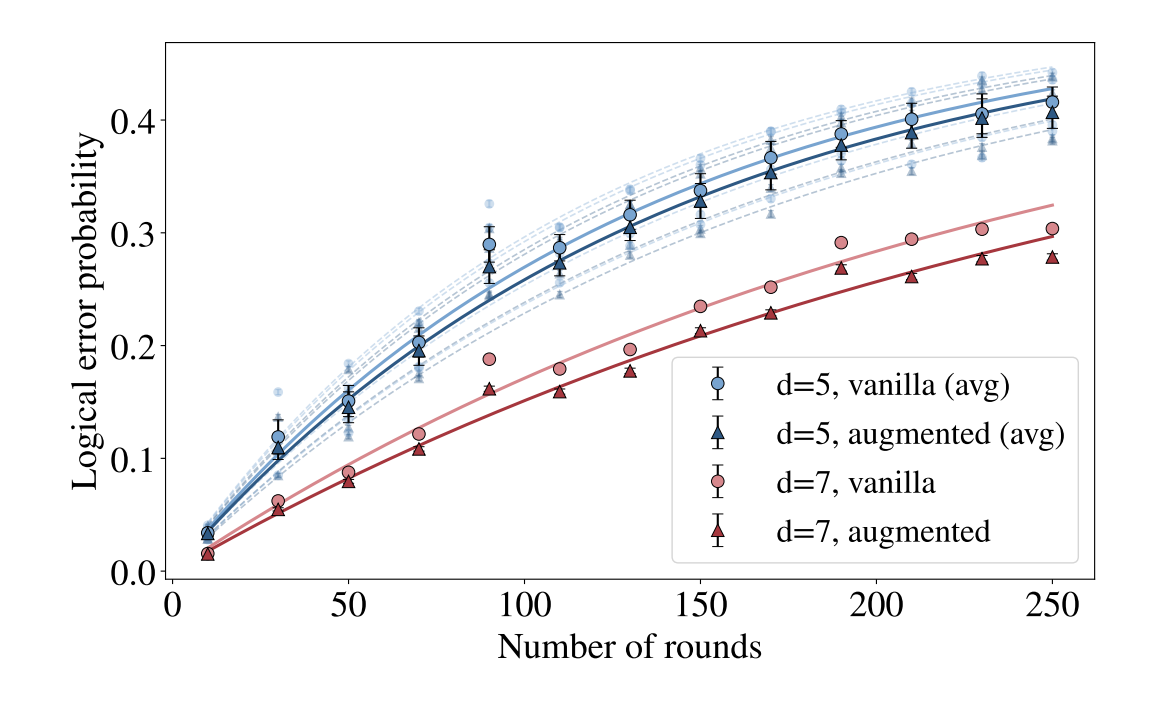
- Outcome: Logical error rate reduced by 75 % at d = 15; error‑suppression factor Λ improved from 1.71 ± 0.01 to 2.06 ± 0.01 (≈20 % increase).
Physical Hardware Test
- Device: Google’s below‑threshold superconducting processor (public surface‑code dataset)
- Code distance: d = 7 (benchmark range d = 5–7)
- Outcome: Logical error rate lowered by 14 %; Λ rose from 1.93 ± 0.06 to 2.02 ± 0.06 (≈9 % improvement).
These figures demonstrate that the augmented DEM not only excels in idealized simulations but also translates into measurable gains on real hardware.
Practical Implications for Quantum Teams
- Decoder Compatibility: Because the hyperedges are decomposed into standard graph edges, existing two‑pass decoders (e.g., PyMatching) can ingest the augmented priors without code changes.
- Parameter Overhead: The aggregation step merges identical mechanisms across rounds, keeping the total number of model parameters modest.
- Scalability: The pairwise‑first search strategy scales quadratically with the number of baseline mechanisms, a manageable cost for typical DEMs used in surface‑code stacks.
- Roadmap Integration: Teams can embed the augmentation pipeline into routine calibration cycles, continuously refining DEMs as new syndrome data become available.
Conclusion
Riverlane’s data‑driven DEM augmentation offers a concrete path to bridge the gap between idealized noise models and the complex, correlated errors observed in today’s quantum processors. By automatically extracting hidden error correlations and feeding them back into graph‑based decoders, the technique delivers measurable logical‑error reductions while remaining compatible with existing software stacks. For organizations seeking incremental yet impactful improvements to surface‑code performance, integrating this augmentation pipeline into regular calibration workflows represents a low‑risk, high‑reward strategy.
Source
Read original sourceWhy we picked this
Accepted from curated QuantumUnzipped source (relevance scoring disabled).