Rotonium Unveils a Quantum Computer That Operates at Room Temperature
Rotonium has demonstrated a four‑qubit photonic quantum processor that runs entirely at room temperature.
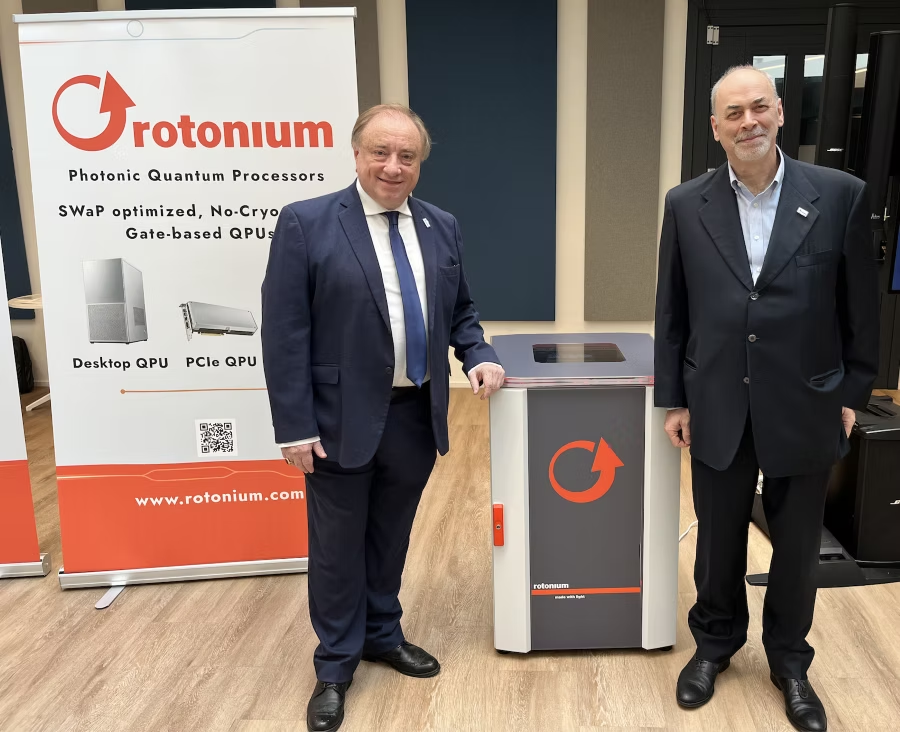
Rotonium’s Room‑Temperature Photonic Quantum Prototype
Rotonium announced a prototype photonic quantum processor that operates without any cryogenic cooling. The chip, measuring just 18 × 4 mm, encodes four “effective” qubits by exploiting multiple degrees of freedom of a single photon. The company frames the device as the first step toward compact, edge‑focused quantum accelerators for robots, autonomous vehicles and satellites.
How the prototype works
The processor uses silicon‑photonic waveguides to generate, manipulate and detect single photons at ambient conditions. By encoding information in properties such as polarization, time‑bin and path, a single photon can carry several qubits simultaneously. Rotonium calls these “effective qubits” – qubits that can be used together in a verified computation under the test conditions described in the press release.
Why room‑temperature matters
Traditional superconducting and trapped‑ion platforms require dilution refrigerators or ultra‑high vacuum, which adds bulk, power consumption and cost. A room‑temperature system could be integrated directly into existing electronic hardware, opening possibilities for on‑board quantum acceleration in environments where size, weight and power are at a premium.
The roadmap ahead
Rotonium’s public roadmap outlines a gradual scaling plan:
- 2028: A 16‑qubit desktop system.
- 2029: A 32‑qubit PCI‑Express accelerator card.
- 2030: A 96‑qubit system‑on‑module.
- 2035: Targeting thousands of effective qubits.
The company emphasizes compatibility with standard silicon‑photonic manufacturing, suggesting that the scaling path relies on existing foundry processes rather than bespoke cryogenic infrastructure.
Practical considerations
While the prototype is a noteworthy engineering achievement, several caveats remain:
- Qubit quality: The announcement does not provide error rates, gate fidelities or coherence times, making it hard to gauge computational usefulness.
- Logical vs. physical qubits: The four effective qubits are physical; no error‑correction or logical qubit layer is demonstrated.
- Independent verification: No external labs or peer‑reviewed publications have confirmed the results.
For readers interested in the near‑term impact, the prototype should be viewed as a proof‑of‑concept rather than a ready‑to‑run quantum computer. Its true value will emerge as Rotonium moves from a four‑qubit demonstrator to the larger systems promised in its roadmap, and as the broader community validates performance metrics.
Bottom line
Rotonium’s room‑temperature photonic processor showcases a potential path toward compact quantum hardware, but the current four‑qubit device is still an early step. Continued transparency, independent benchmarking, and detailed error‑rate reporting will be essential to determine whether the technology can deliver on its promise of “industrial quantum utility.”
Hype check
PartlyThe press release shows a 4‑qubit room‑temperature prototype, but lacks peer‑review, error‑rate data and independent verification, so the claim exceeds the available evidence.
- Peer-reviewed paper, or press release only?Press release only — Only a press release is provided, no paper or preprint cited
- Error-corrected (logical) qubits, or physical qubits only?Physical only — The four effective qubits are physical, not error‑corrected logical qubits
- A new milestone, or a rebrand / restatement?New — First room‑temperature photonic prototype announced
- Independent confirmation?Not yet — No external confirmation or replication mentioned
- Does the headline claim match what the source shows?Matches — Headline accurately reflects the room‑temperature operation described
An editorial assessment of the claim as reported, not a judgment of the company or researchers. How we rate hype →
Source
Read original sourceWhy we picked this
Accepted from curated QuantumUnzipped source (relevance scoring disabled).