Scalable photonic quantum computer provides new insights into the fundamentals that shape its performance
Paderborn University’s programmable photonic sampler reveals how squeezed light, photon statistics and entanglement drive performance in Gaussian boson sampling.
Programmable Photonic Sampler Sheds Light on Quantum Performance
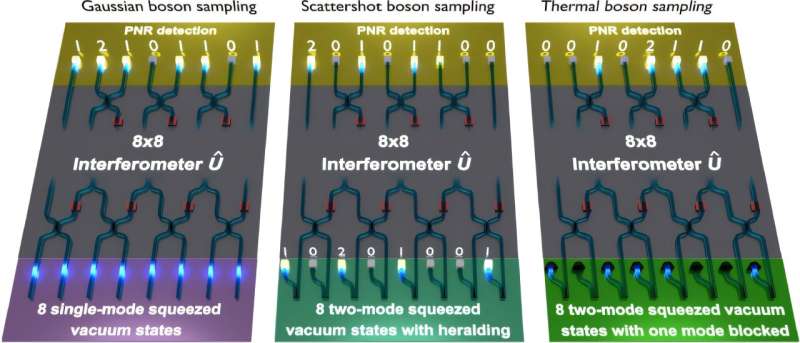
A team at Paderborn University has built Germany’s first scalable photonic quantum computer – the Paderborn Quantum Sampler (PaQS) – and used it to dissect which quantum resources actually matter for computational power. Their findings, published in PRX Quantum, go beyond simply scaling up photon‑based hardware; they provide a systematic way to benchmark the roles of squeezed light, photon‑number statistics and entanglement in Gaussian boson sampling (GBS).
---
A Flexible Platform for Photonic Experiments
PaQS is a Gaussian boson sampler that measures where photons exit a reconfigurable photonic network. By routing light through an integrated waveguide mesh, researchers can program the interferometer to implement a wide variety of sampling tasks. This full programmability turns the device from a single‑purpose demonstrator into a versatile research tool, allowing the team to test different input states—both Gaussian (e.g., squeezed vacuum) and non‑Gaussian—and to vary the network complexity.
The hardware combines on‑chip sources of squeezed light, low‑loss waveguides, and high‑efficiency detectors. While the exact photon count is not disclosed, the authors emphasize that simulating PaQS’s output on a classical supercomputer would take thousands of years, underscoring the system’s scale.
---
New Methods for Resource Benchmarking
Beyond the hardware, the researchers introduced hybrid sampling metrics that separate the contribution of three key quantum resources:
- Squeezed‑light strength – quantifies how much quantum noise reduction is injected into the system.
- Photon‑statistics purity – measures deviations from ideal Poissonian behavior.
- Entanglement depth – captures multi‑mode correlations across the photonic network.
By systematically varying each parameter while keeping the others fixed, the team demonstrated that performance does not scale linearly with photon number alone. Instead, a balanced combination of strong squeezing, high‑quality photon statistics, and robust entanglement yields the most computationally demanding sampling distributions.
---
Implications for Future Photonic Quantum Computing
The study highlights that hardware scaling must be accompanied by precise control of quantum resources. For photonic platforms aiming at practical advantage—such as chemistry simulations or optimization problems—engineers will need to co‑design sources, interferometers and detection schemes that preserve these resources.
PaQS also serves as a testbed for emerging algorithms that exploit non‑Gaussian inputs, opening a pathway to explore computational regimes beyond standard GBS. As the system is expanded to larger interferometers, the benchmarking framework can guide incremental improvements and help compare photonic approaches with other qubit technologies.
---
Looking Ahead
The authors plan to extend PaQS with more complex networks and to integrate error‑mitigation techniques that protect squeezing and entanglement from loss. Their work establishes a roadmap for evaluating photonic quantum advantage that is grounded in measurable physical properties rather than raw photon counts.
In a field where headlines often focus on sheer size, this research reminds us that understanding the quality of quantum resources is equally, if not more, important for building useful quantum computers.
---
For a deeper dive, see Michael Stefszky et al., “Benchmarking Gaussian and Non‑Gaussian Input States with a Hybrid Sampling Platform,” PRX Quantum (2026).
Hype check
RealThe article reports a peer‑reviewed experimental result with new benchmarking methods; the claim matches the published PRX Quantum paper and is not overstated.
- Peer-reviewed paper, or press release only?Paper — Published in PRX Quantum (2026) with DOI provided
- Error-corrected (logical) qubits, or physical qubits only?Logical / not a qubit claim — Not a qubit‑count claim; focuses on photonic resources
- A new milestone, or a rebrand / restatement?New — Introduces a programmable sampler and new analysis framework
- Independent confirmation?Not yet — No external replication or third‑party confirmation mentioned
- Does the headline claim match what the source shows?Matches — Headline accurately reflects the paper’s focus on performance fundamentals
An editorial assessment of the claim as reported, not a judgment of the company or researchers. Checked against: phys.org. How we rate hype →
Source
Read original sourceWhy we picked this
Accepted from curated QuantumUnzipped source (relevance scoring disabled).