Schism architecture achieves up to 4.9-7.3x speedup on 32 quantum processors
A new reconfigurable architecture called Schism claims 4.9‑7.3× speedup for distributed quantum workloads on 32 QPUs.
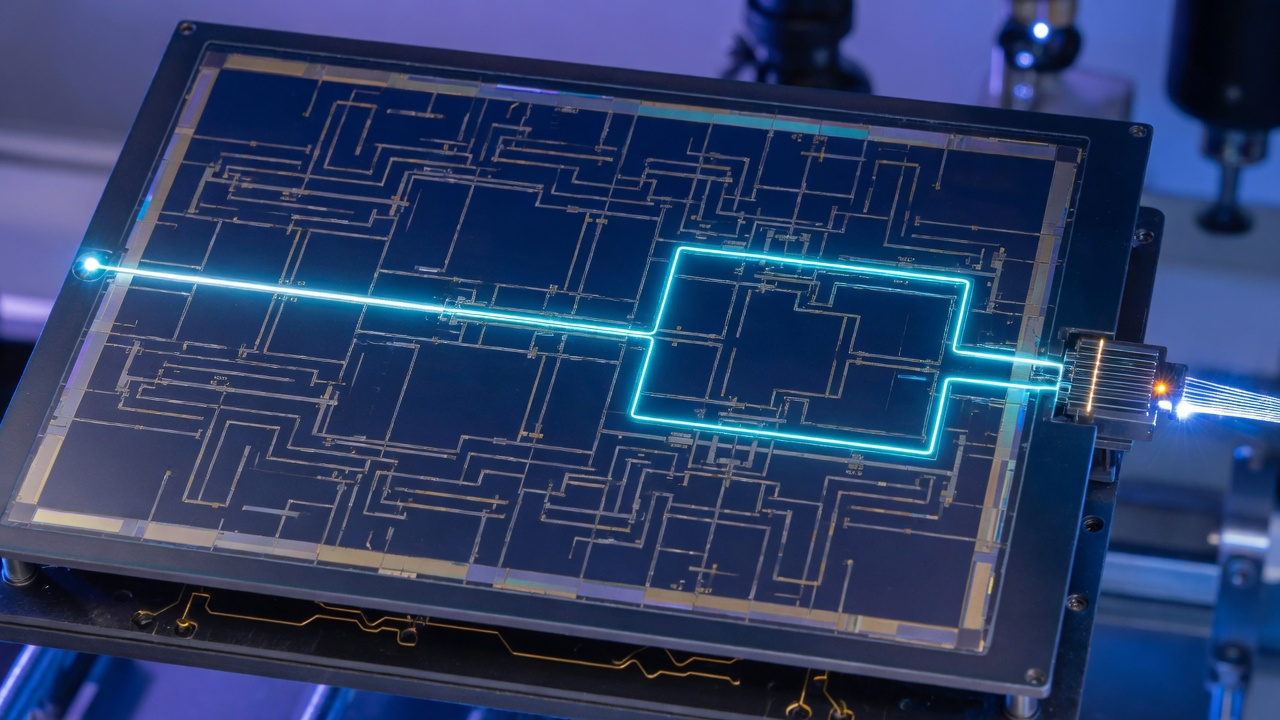
Reconfigurable Schism Architecture Shows Promising Speedups
Schism is a proposed photonic networking design for distributed quantum computers that dynamically reshapes how quantum processing units (QPUs) share Bell‑state measurement (BSM) pools. By placing BSM resources at aggregation switches and using quantum frequency converters only on core uplinks, the architecture aims to reduce optical loss and contention without physically moving QPUs or their quantum states.
Dynamic Resource Sharing Across Racks
Traditional designs such as SwitchQNet require wavelength conversion at every top‑of‑rack (ToR) switch, limiting inter‑rack communication. Schism instead establishes native‑wavelength paths that can span multiple racks, allowing a program to re‑group QPUs on‑the‑fly. The compiler evaluates photon‑path loss, BSM contention, and reconfiguration delay to select the most efficient grouping for each phase of a quantum circuit.
Reported Performance Gains
Simulation results in the accompanying paper show:
- Speedups of 4.9‑7.3× over fixed‑connectivity designs for 32‑QPUs across 11 benchmark workloads (QFT, QAOA, Grover, etc.).
- Up to 7.78× improvement on a 384‑qubit QAOA run using 64 QPUs.
- Mean speedup grows from 2.8× to 20× as optical loss per quantum frequency converter increases from 0.5 dB to 5 dB, highlighting resilience to realistic loss budgets.
These gains stem from better balancing of locality and BSM contention, with reconfiguration overhead accounting for only about 2.5 % of total communication time.
Implications for Large‑Scale Quantum Datacenters
If realized in hardware, Schism could enable more flexible scaling of quantum datacenters beyond a single rack, mitigating the need for extensive wavelength conversion and reducing signal degradation. The architecture’s emphasis on decoupling physical rack placement from BSM access opens new avenues for optimizing distributed quantum algorithms, especially those sensitive to communication latency.
Practical Outlook
The work is currently limited to simulation studies and an arXiv pre‑print (no peer‑reviewed publication yet). Real‑world validation will require building photonic switches, integrating QFCs, and testing with actual QPUs. Nonetheless, the reported speedups suggest that dynamic reconfiguration of quantum networking resources is a promising direction for future quantum hardware deployments.
--- The article is based on the arXiv pre‑print titled “Schism: Reconfigurable Scale‑Up Domains for Distributed Quantum Computing” (http://arxiv.org/abs/2611.31193v1).
Hype check
PartlyThe paper provides simulation‑based speedup numbers but lacks peer‑review and experimental verification; the claim is plausible yet not fully substantiated.
- Peer-reviewed paper, or press release only?Press release only — Only an arXiv preprint is cited
- Error-corrected (logical) qubits, or physical qubits only?Logical / not a qubit claim — Claim is about architecture performance, not qubit counts
- A new milestone, or a rebrand / restatement?New — Introduces a novel reconfigurable networking design with reported speedups
- Independent confirmation?Not yet — No external replication or confirmation mentioned
- Does the headline claim match what the source shows?Matches — Headline speedup range aligns with reported 4.9‑7.3× figures
An editorial assessment of the claim as reported, not a judgment of the company or researchers. How we rate hype →
Source
Read original sourceWhy we picked this
Accepted from curated QuantumUnzipped source (relevance scoring disabled).