Scottish artist marks 100 years of Schrödinger equation with new installation
Scottish artist Gregor Harvie’s kinetic installation “Superposition” uses spinning perforated panels to give visitors a tangible glimpse of quantum superposition and entanglement on the centenary of Schrödinger’s equation.
Introduction
To celebrate the 100th anniversary of Erwin Schrödinger’s seminal wave‑equation, Scottish artist Gregor Harvie has turned the abstract language of quantum mechanics into a kinetic visual experience. Titled Superposition, the installation will be on view at the University of Strathclyde’s Technology and Innovation Centre in Glasgow from 20 – 29 October 2026. In collaboration with the quantum theory group at the University of Glasgow, Harvie translates two cornerstone concepts—superposition and entanglement—into a set of rotating aluminium panels that challenge the viewer’s perception of reality.
How the artwork works
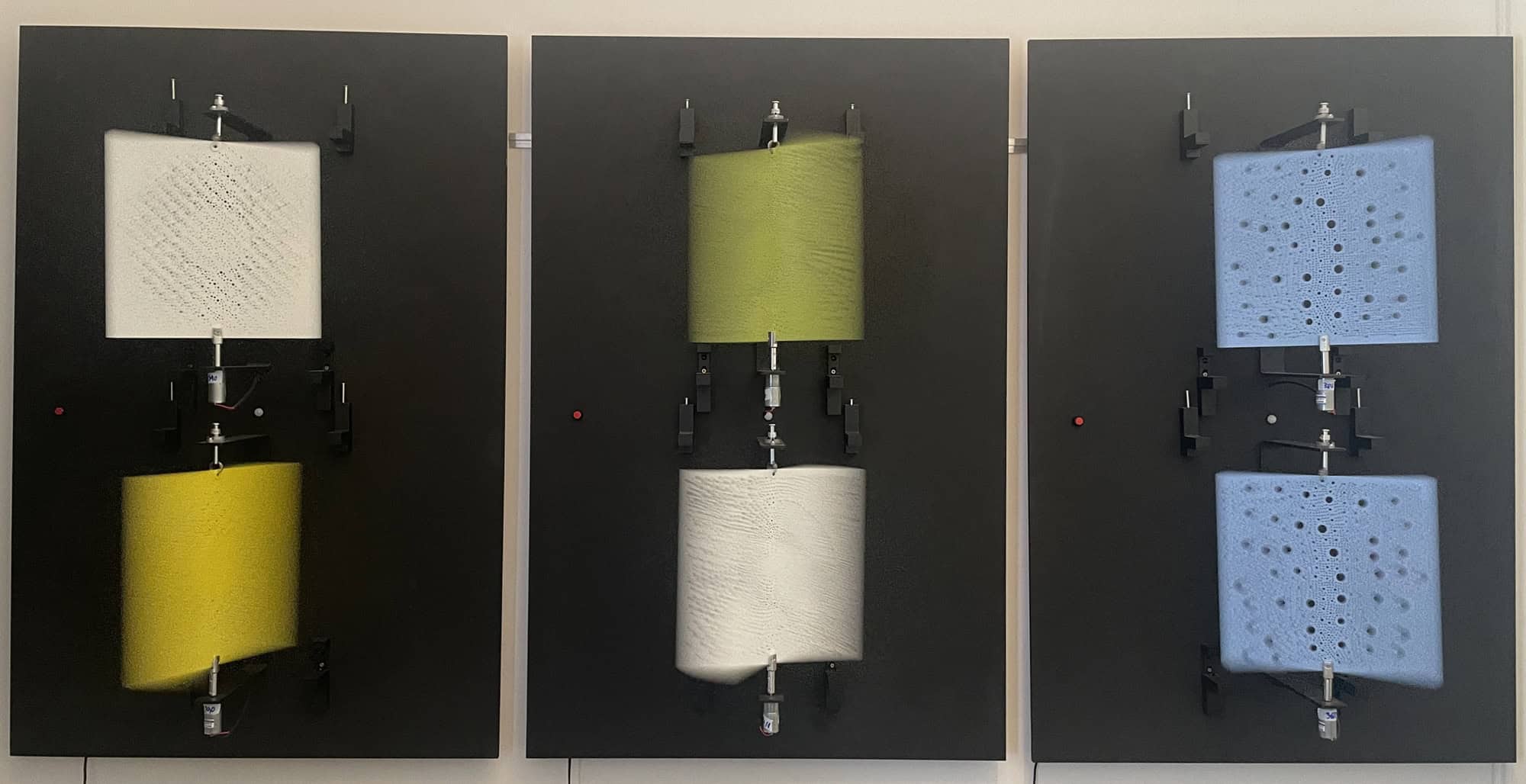
Superposition consists of 16 aluminium panels, each perforated with hundreds of precisely drilled holes that form intricate patterns. The panels are mounted in eight pairs; one side of every panel is white, the opposite side is coloured. When a visitor approaches, the panels spin at 400 rpm, creating a shimmering, three‑dimensional illusion that appears to dissolve and re‑form depending on the viewer’s angle.
The motion of the panels encodes quantum ideas:
- Superposition – For seven of the eight pairs, the panels stop in random orientations, but over many trials each panel shows the same side as its partner roughly 50 % of the time. This mirrors the probabilistic collapse of a quantum wavefunction, where a system can be in multiple states until measured.
- Entanglement – The eighth pair behaves differently. While each panel still appears random when viewed alone, the two together display the same side 75 % of the time. This statistical correlation is an analogue of quantum entanglement, where the state of one particle instantaneously influences its partner, regardless of distance.
The installation’s physicality—holes that are “nothing there” yet produce striking visual effects when spun—embodies Harvie’s desire to place the audience inside a “quantum universe” where observation shapes reality.
Artistic and scientific context
Harvie brings a unique interdisciplinary background to the project. Holding a PhD in computational fluid dynamics, he has previously explored scientific milestones in works such as Beyond Absolute Zero, which marked the bicentenary of Lord Kelvin’s birth in 2024. In Superposition, his technical expertise informs the precise engineering required for the high‑speed rotation and the statistical design of the panel pairs.
The collaboration with the University of Glasgow’s quantum theory group adds scientific credibility. Theoretical physicist Stephen Barnett notes that the piece “allows everyone to experience the ‘strangeness’ of quantum mechanics and to question what they are seeing.” By turning abstract equations into kinetic art, the installation bridges the gap between research labs and the public, offering an intuitive, sensory entry point to concepts that are otherwise confined to mathematics.
Visiting the installation
Superposition will be displayed weekdays throughout the ten‑day run. The Technology and Innovation Centre provides a spacious, controlled environment where the panels can spin safely at high speed while visitors move around the work. No prior knowledge of quantum physics is required; the visual dynamics invite curiosity and conversation, making it an ideal stop for students, researchers, and anyone interested in the intersection of art and science.
Closing thoughts
By marrying precise engineering with poetic visual language, Gregor Harvie’s Superposition transforms the centenary of Schrödinger’s equation into a public, immersive experience. The work demonstrates how art can make the counter‑intuitive world of quantum mechanics accessible, reminding us that the boundaries between scientific discovery and creative expression are often more porous than they appear. Whether you leave pondering the nature of reality or simply marvel at the spinning patterns, the installation offers a memorable glimpse into the strange yet beautiful fabric of the quantum world.
Source
Read original sourceWhy we picked this
Accepted from curated QuantumUnzipped source (relevance scoring disabled).