SEAFOOD Puts OCTOPUS and Quantum Computers on the Same Menu
University of Osaka unveiled SEAFOOD, a platform that links its OCTOPUS supercomputer with a superconducting quantum processor for hybrid quantum‑classical calculations.
Hybrid Computing Takes Off at Osaka University
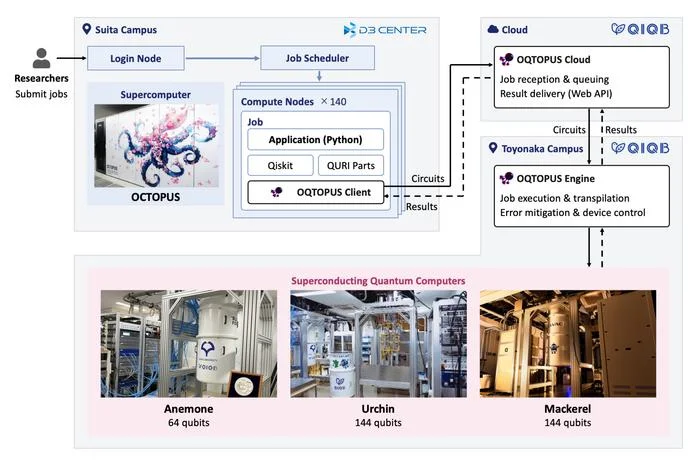
University of Osaka researchers have announced SEAFOOD, a new computing platform that couples the campus‑wide OCTOPUS supercomputer with a superconducting quantum processor developed by the Center for Quantum Information and Quantum Biology (QIQB). The integration enables a single workflow where classical and quantum resources share tasks, opening a practical route for quantum‑enhanced simulations in chemistry, materials science, and beyond.
---
How SEAFOOD Works
SEAFOOD builds on the open‑source OQTOPUS middleware, which provides standard interfaces for sending jobs from OCTOPUS to the quantum hardware and retrieving results. In the demonstrated workflow, the quantum computer performs a quantum‑selected configuration interaction (QSCI) step: it measures a subset of electron configurations that are most relevant to the target molecular system. OCTOPUS then takes those configurations and carries out the heavy linear‑algebraic matrix calculations needed to evaluate the ground‑state energy.
The proof‑of‑concept calculation involved a simple hydrogen‑chain model (four hydrogen atoms). The hybrid run produced a ground‑state energy that matched a conventional reference calculation, confirming that the two machines can cooperate without loss of accuracy.
---
Why Hybrid Computing Matters
Even the most powerful classical supercomputers struggle with exact quantum‑chemical simulations because the required computational resources scale exponentially with the number of electrons. Quantum computers, in principle, can represent many‑electron wavefunctions more efficiently, but current devices are limited by qubit count, coherence times, and error rates. By delegating only the most quantum‑intensive sub‑tasks to a quantum processor, researchers can exploit the strengths of both platforms while sidestepping their individual weaknesses.
SEAFOOD’s architecture is deliberately modular: the quantum hardware lives on a separate campus, yet the software stack makes the distance invisible to the end user. This design could be replicated by other institutions that already operate large‑scale classical clusters and are beginning to acquire quantum processors.
---
Looking Ahead
The platform is slated to go live in December 2026. In the fiscal year 2027, a limited number of university research teams will receive trial access through a proposal‑based program run by the D3 Center. Early adopters are expected to explore algorithmic refinements, job‑scheduling optimizations, and broader scientific applications.
Beyond the immediate test case, the developers see SEAFOOD as a stepping stone toward more ambitious hybrid simulations—such as larger molecular systems, solid‑state materials, and quantum dynamics—where the quantum component could provide decisive speed‑ups.
---
Practical Takeaways
- Integration, not replacement – SEAFOOD demonstrates that quantum processors can be added to existing HPC ecosystems without overhauling workflows.
- Open‑source tooling – The use of OQTOPUS lowers the barrier for other labs to adopt similar hybrid setups.
- Early validation – Matching a conventional reference calculation for a four‑atom system shows functional correctness, though larger‑scale benchmarks are still needed.
- Access roadmap – Trial access in 2027 gives the research community a chance to experiment and provide feedback before broader deployment.
SEAFOOD may not yet deliver quantum advantage for real‑world problems, but it provides a concrete, reproducible example of how hybrid computing can be operationalized today. As more institutions explore this model, the collective experience will shape the next generation of scientific computing.
---
For readers interested in trying out hybrid workflows, keep an eye on the D3 Center’s announcement channels for the 2027 proposal call.
Hype check
PartlyThe platform shows a successful hybrid demo, but the claim lacks peer‑reviewed data and independent verification, limiting confidence in its broader impact.
- Peer-reviewed paper, or press release only?Press release only — Only a press release is mentioned; no paper or preprint cited.
- Error-corrected (logical) qubits, or physical qubits only?Physical only — The quantum processor is superconducting and not described as error‑corrected logical qubits.
- A new milestone, or a rebrand / restatement?New — First integration of a domestic quantum computer with a supercomputer at a Japanese university.
- Independent confirmation?Not yet — No external labs or reviewers are reported to have confirmed the result.
- Does the headline claim match what the source shows?Matches — Headline accurately reflects the integration of OCTOPUS and quantum computers.
An editorial assessment of the claim as reported, not a judgment of the company or researchers. How we rate hype →
Source
Read original sourceWhy we picked this
Accepted from curated QuantumUnzipped source (relevance scoring disabled).