Secretary of Energy Chris Wright visits Fermilab
Secretary Wright toured Fermilab’s accelerator, quantum, and superconducting facilities, underscoring the lab’s leadership in neutrino science, AI‑driven research, and quantum computing while highlighting future upgrades and the DOE’s commitment to basic science and energy innovation.
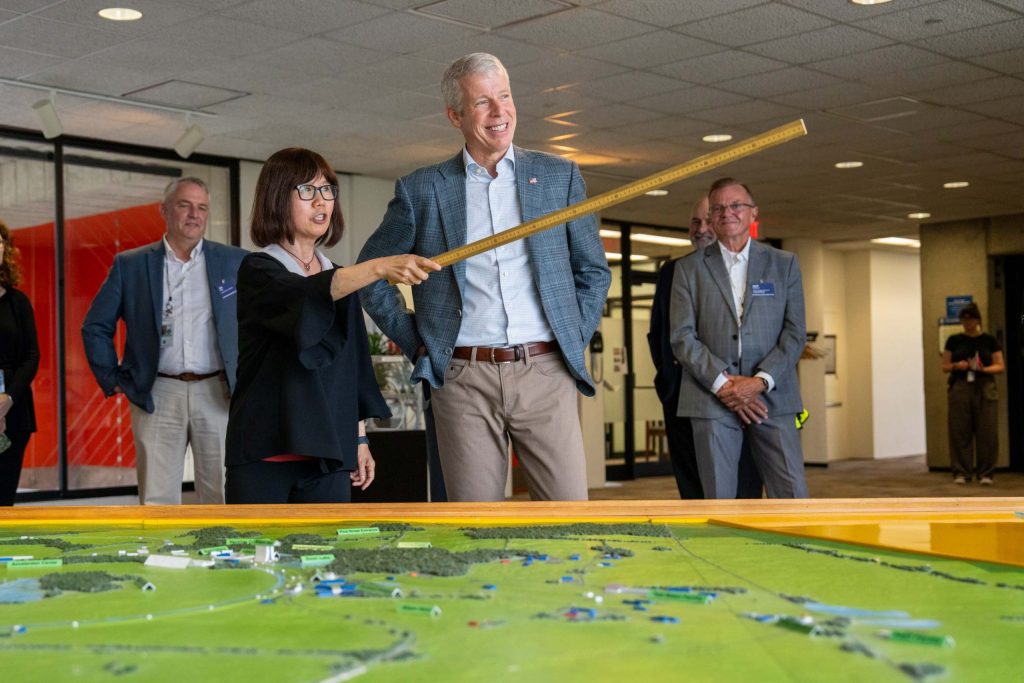
Secretary of Energy Chris Wright visits Fermilab
On July 18, 2025, U.S. Secretary of Energy Chris Wright toured Fermilab, the nation’s flagship laboratory for particle physics and accelerator research. The visit highlighted the lab’s leadership in neutrino science, quantum computing, and accelerator technology, and underscored the Department of Energy’s commitment to sustaining American innovation in fundamental science.
Seeing the heart of the accelerator complex
Wright’s first stop was the Main Injector, one of Fermilab’s five particle accelerators. The Main Injector produces the world’s most powerful high‑energy neutrino beam, a key ingredient for the Deep Underground Neutrino Experiment (DUNE). During the tour, the Secretary viewed the accelerator’s superconducting magnets and learned how the Proton Improvement Plan‑II (PIP‑II) will deliver an unprecedented stream of protons to feed the neutrino beam. In a symbolic gesture, Wright signed a PIP‑II cryomodule—a critical component that will send a neutrino beam 800 miles through the Earth to the far detectors in Lead, South Dakota.
The visit also included a walk through the underground laboratory where a prototype DUNE detector is being tested. Researchers use artificial intelligence to analyze neutrino interactions in liquid‑argon detectors, a technique that will be central to DUNE’s mission of probing the Standard Model and the matter‑antimatter asymmetry of the universe.
Quantum computing and superconducting technology
Beyond particle physics, Fermilab is a national hub for quantum information science. Wright toured the Superconducting Quantum Materials and Systems (SQMS) Center, a collaboration of 36 institutions that is part of the Department of Energy’s five National Quantum Information Science Research Centers. Here, scientists are developing superconducting qubits and cryogenic infrastructure that could transform computation, simulation, and sensing.
The Applied Physics and Superconducting Technology Division (APST‑D) was also on display. APST‑D’s work on superconducting radio‑frequency cavities and high‑field magnets is essential not only for future accelerators—such as the high‑luminosity upgrade to CERN’s Large Hadron Collider—but also for advancing quantum hardware.
Bridging basic science and energy innovation
In a keynote address to a packed auditorium, Wright emphasized the dual role of national laboratories: advancing basic science while driving energy technology. He highlighted nuclear and fusion research, noting that AI and the expertise of scientists at Fermilab could accelerate breakthroughs in clean energy. The Secretary reiterated that the laboratory’s fundamental discoveries—such as the Higgs boson confirmation at CMS—are integral to America’s scientific leadership.
Practical takeaways for the research community
- Accelerator upgrades are on the horizon. The PIP‑II project will increase proton beam intensity, benefiting not only DUNE but also other experiments that rely on high‑energy neutrinos.
- AI is becoming indispensable. From neutrino event classification to quantum error correction, artificial intelligence is a cross‑cutting tool that will shape future research.
- Quantum computing infrastructure is expanding. Fermilab’s SQMS Center is building the hardware foundation that could enable quantum simulations of complex materials and fundamental physics.
- Collaboration remains key. The visit coincided with the annual Fermilab Users and Affiliates Meeting, illustrating how national labs, universities, and industry partners solve scientific challenges together.
Looking ahead
Secretary Wright’s visit reaffirmed the Department of Energy’s support for Fermilab’s mission to push the frontiers of particle physics and quantum science. As the lab prepares for the next generation of experiments—DUNE, the LHC upgrade, and quantum computing initiatives—researchers can expect continued investment in infrastructure, AI integration, and cross‑disciplinary collaboration.
For more information about Fermilab’s programs and upcoming events, visit www.fnal.gov or follow the lab on social media.
TL;DR
Secretary Wright toured Fermilab’s accelerator, quantum, and superconducting facilities, underscoring the lab’s leadership in neutrino science, AI‑driven research, and quantum computing while highlighting future upgrades and the DOE’s commitment to basic science and energy innovation.
Source
Read original sourceWhy we picked this
Accepted from curated QuantumUnzipped source (relevance scoring disabled).