Solid-state quantum storage breaks 90% efficiency, a key milestone for networks
Guo Guangcan’s team demonstrated a solid‑state quantum memory with over 90 % storage efficiency, a key step toward practical quantum networks.
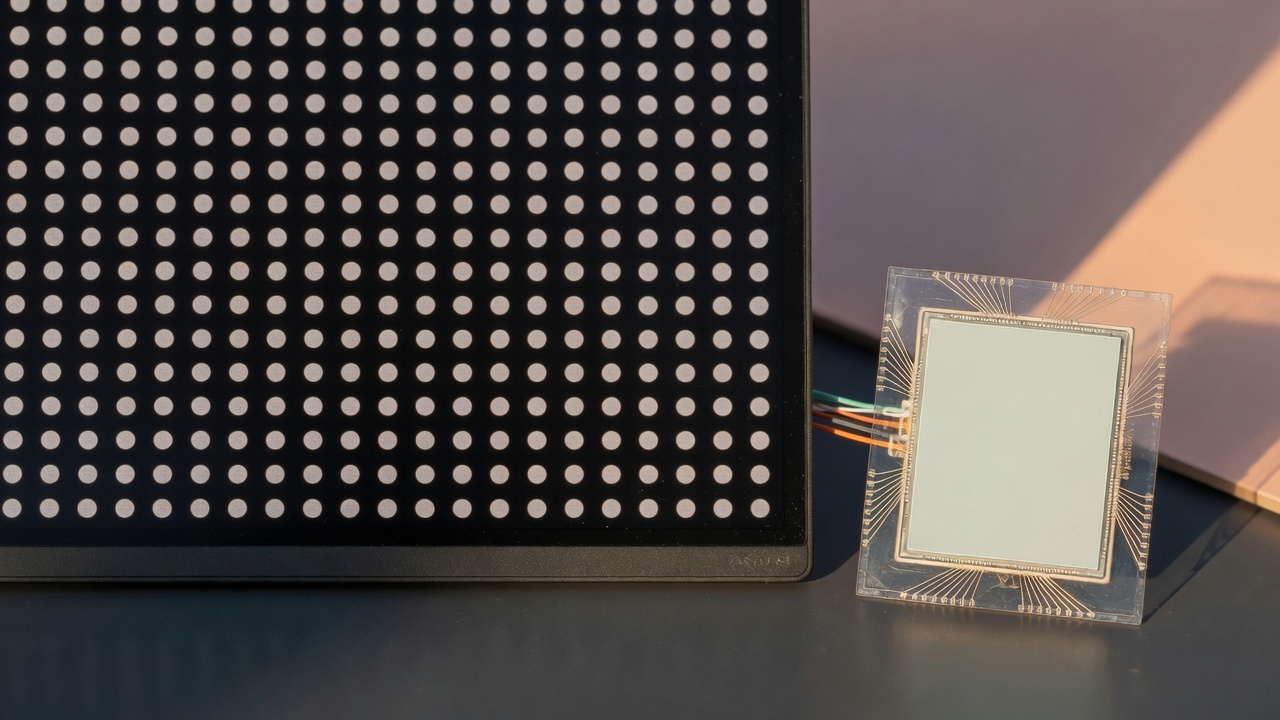
Integrated solid‑state quantum memory tops 90 % efficiency
A research group led by Guo Guangcan at the University of Science and Technology of China has reported a breakthrough in quantum storage: an integrated solid‑state device that stores and retrieves single photons with 90.2 % efficiency. The result, published in Physical Review Letters, marks the first time a chip‑scale memory surpasses the 90 % threshold that has long been a bottleneck for scalable quantum networking.
Why efficiency matters for quantum networks
Quantum repeaters and long‑distance entanglement distribution rely on repeatedly storing and releasing photons. Even a modest loss—dropping from 90 % to 89 %—can increase the total distribution time by more than ten percent, dramatically inflating the resources needed for a functional quantum internet. Achieving high efficiency in a compact, solid‑state platform therefore addresses two critical challenges: reducing physical footprint and minimizing loss.
Waveguide microcavity and time‑reversal optimization
The team combined a rare‑earth‑ion‑doped crystal with a waveguide microcavity, shrinking the storage volume to 1.2 × 10⁻³ mm³—about a thousand times smaller than comparable atomic‑gas setups. The key innovation was a time‑reversal waveform optimization protocol. Starting with an arbitrary square pulse, the researchers recorded the output after storage, time‑reversed that waveform, and fed it back as the next input. After four iterations, the input pulse converged on a shape that maximized absorption, lifting the efficiency from 84.2 % (with conventional Gaussian pulses) to 90.2 %.
Fidelity and future integration
Beyond efficiency, the memory preserved quantum information with a 99.3 % fidelity for time‑bin qubits, comfortably above the classical limit. The device uses a single species of rare‑earth ion, simplifying integration with spin‑wave storage techniques that promise longer storage times. The authors argue that this compatibility provides a “physical prerequisite for further realizing high‑efficiency and long‑lived quantum storage,” positioning the platform as a building block for future quantum repeaters.
Outlook
While the result is a laboratory demonstration, its solid‑state nature and compact size make it attractive for on‑chip integration with other quantum components such as sources, detectors, and processors. Scaling the approach to larger bandwidths and longer storage times will be the next milestones, but the 90 % efficiency benchmark establishes a clear performance target for the field.
The work underscores how engineering‑level advances—optimizing pulse shapes and leveraging material properties—can unlock practical quantum technologies that were previously limited to bulky, laboratory‑scale apparatus.
Hype check
RealThe claim is backed by a peer‑reviewed PRL paper showing 90.2 % efficiency; the headline accurately reflects the reported result.
- Peer-reviewed paper, or press release only?Paper — Physical Review Letters article cited
- Error-corrected (logical) qubits, or physical qubits only?Logical / not a qubit claim — Not a qubit‑count claim
- A new milestone, or a rebrand / restatement?New — First integrated solid‑state memory >90 % efficiency
- Independent confirmation?Not yet — No external replication mentioned
- Does the headline claim match what the source shows?Matches — Headline aligns with 90.2 % efficiency result
An editorial assessment of the claim as reported, not a judgment of the company or researchers. How we rate hype →
Source
Read original sourceWhy we picked this
Accepted from curated QuantumUnzipped source (relevance scoring disabled).