Sorbonne Université and Qubit Pharmaceuticals Introduce VULCAN Hybrid Framework for Scalable Quantum Chemistry
Sorbonne Université and Qubit Pharmaceuticals unveil VULCAN, a hybrid quantum‑classical framework that cuts measurement costs and qubit requirements for quantum chemistry simulations.
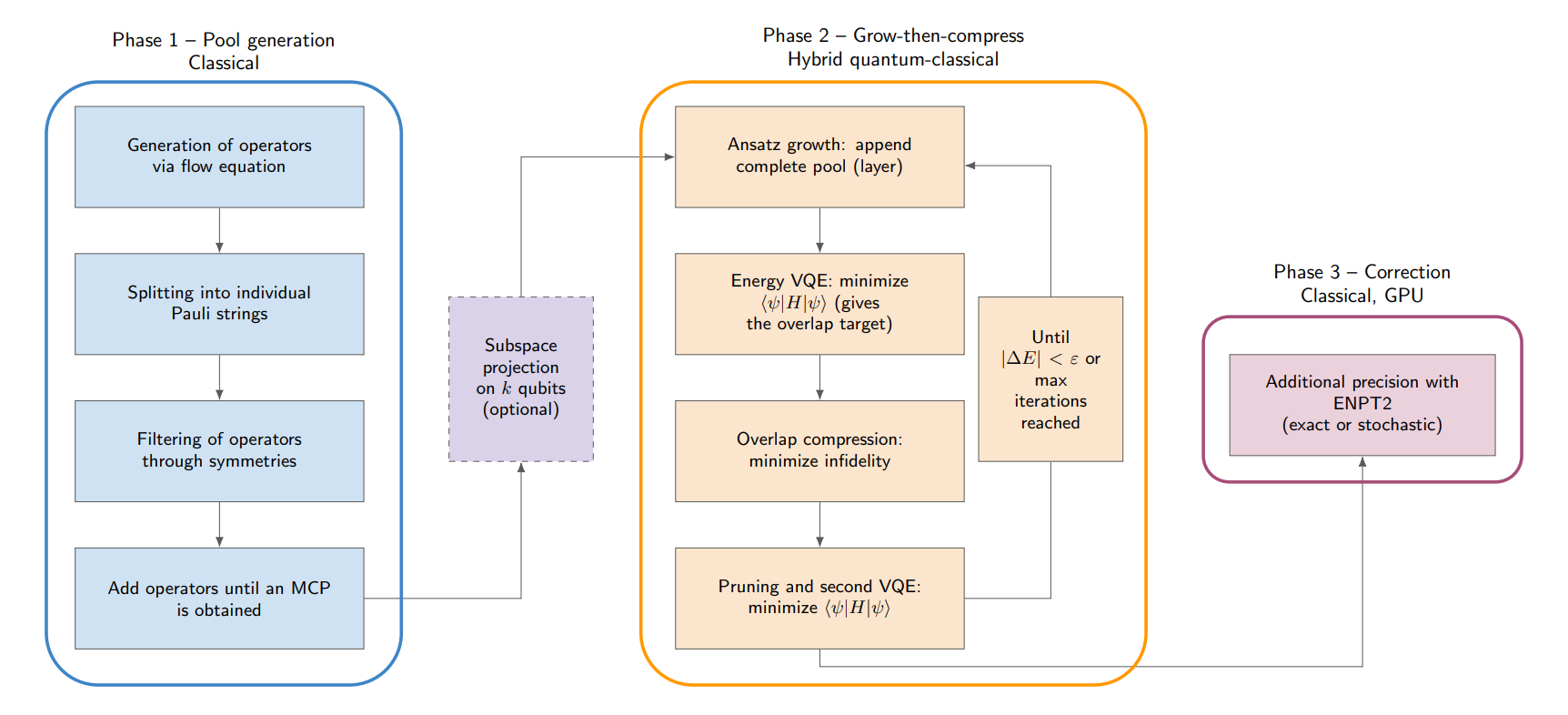
VULCAN: A Hybrid Leap for Quantum Chemistry
Researchers from Sorbonne Université’s CNRS Laboratory of Theoretical Chemistry and Qubit Pharmaceuticals have announced VULCAN (Variational Upbuilding, Layered Compression, Adaptive N‑body Perturbation), a new hybrid quantum‑classical workflow aimed at making quantum‑chemical calculations more scalable. The work, described in a recent arXiv preprint, tackles the notorious measurement bottleneck of adaptive variational quantum eigensolvers (ADAPT‑VQE) by combining several algorithmic tricks that reduce both quantum‑hardware demands and classical post‑processing effort.
---
1. How VULCAN Works
VULCAN’s pipeline stitches together four key ideas:
- Dynamic Lie‑algebraic pool generation – Using a Variational Double Bracket Flow (VDBF) commutator, the method builds a compact operator pool in seconds, avoiding the costly energy‑gradient screening that ADAPT‑VQE normally performs.
- State‑overlap circuit compression – A single‑measurement overlap metric ranks operators, allowing the removal of low‑impact gates and shrinking CNOT counts.
- Active‑subspace projection – By projecting the Hamiltonian onto the most significant determinants, VULCAN trims the required qubit register by up to half and slashes Pauli‑term counts.
- GPU‑accelerated second‑order perturbation (ENPT2) – Classical GPUs evaluate a stochastic Epstein‑Nesbet correction, enabling early termination of the quantum VQE while still reaching chemical accuracy.
These steps are applied layer‑by‑layer, so a full quantum circuit can be built in a single growth phase rather than iteratively adding one operator at a time.
---
2. Benchmark Highlights
The authors benchmarked VULCAN on state‑vector simulations up to 32 qubits and compared it against a batched ADAPT‑VQE baseline across several molecules (hydrogen chains, BeH₂, H₂O, and C₃H₆). Key take‑aways include:
- Operator pool size: 4–25× smaller than conventional QEB pools (e.g., 1,480 vs. 36,456 operators for a 32‑qubit C₃H₆ case).
- Measurement reduction: Chemical accuracy achieved with only 5 %–20 % of the measurement budget required by ADAPT‑VQE.
- Circuit depth: CNOT counts reduced to 0.14× the baseline on a stretched H₁₀ chain.
- Qubit savings: Register size cut by 23 %–50 % (e.g., 26 → 20 qubits for H₂O).
- Hardware proof‑of‑concept: A single‑layer VULCAN run on a Quantinuum System Model H2 trapped‑ion processor reproduced the ground‑state energy of molecular hydrogen within 1.7 × 10⁻³ Ha of the exact value.
These results suggest that VULCAN can reach the same chemical‑accuracy targets as ADAPT‑VQE while demanding far fewer quantum resources—a crucial step toward practical quantum chemistry on near‑term devices.
---
3. Practical Implications
For quantum‑chemistry practitioners, VULCAN offers a more resource‑efficient pathway:
- Lower qubit counts mean existing hardware (e.g., 20‑30 qubit trapped‑ion or superconducting systems) can tackle larger molecules than before.
- Reduced measurement overhead shortens experiment time, making runs feasible within coherence windows.
- Hybrid nature lets users lean on classical GPUs for the perturbative correction, leveraging mature high‑performance computing infrastructure.
The framework is presented as a modular pipeline, so developers can adopt individual components (e.g., the VDBF pool generator) without committing to the full stack.
---
4. Looking Ahead
While the preprint demonstrates promising simulation and a single‑hardware validation, broader adoption will require:
- Peer‑reviewed validation to confirm reproducibility across different hardware platforms.
- Integration with existing quantum‑software stacks (e.g., Qiskit, Cirq) to lower the barrier for chemists.
- Scaling studies on noisy intermediate‑scale quantum (NISQ) devices to assess robustness against realistic error rates.
If these steps bear out, VULCAN could become a standard tool for early‑stage quantum‑chemical discovery, accelerating the transition from proof‑of‑concept to practical applications in drug design and materials science.
---
In short, VULCAN represents a thoughtful blend of algorithmic compression and classical perturbation that trims both qubit and measurement demands, bringing scalable quantum chemistry a step closer to reality.
Hype check
PartlyThe preprint provides detailed benchmarks and a hardware demo, but it is not peer‑reviewed and lacks independent verification, so the claim is promising yet not fully validated.
- Peer-reviewed paper, or press release only?Press release only — Only a preprint on arXiv is mentioned
- Error-corrected (logical) qubits, or physical qubits only?Logical / not a qubit claim — The claim is about algorithmic performance, not qubit counts
- A new milestone, or a rebrand / restatement?New — Introduces a novel hybrid framework with benchmark results
- Independent confirmation?Not yet — No external replication or third‑party confirmation cited
- Does the headline claim match what the source shows?Matches — Headline accurately reflects the introduction of VULCAN
An editorial assessment of the claim as reported, not a judgment of the company or researchers. How we rate hype →
Source
Read original sourceWhy we picked this
Accepted from curated QuantumUnzipped source (relevance scoring disabled).