Spin qubits maintain rotation angle to 0.3 degrees for ten days
University of Pennsylvania researchers kept silicon spin‑qubit rotation angles within 0.3° for ten days using drift‑resilient control pulses.
Stable Spin‑Qubit Control Over Ten Days
Silicon spin qubits are a leading candidate for scalable quantum processors, but their performance has been hampered by the need for frequent recalibration of microwave control pulses. A team at the University of Pennsylvania has now demonstrated that two specially designed pulse families—BIR‑4 and CORPSE—can keep a qubit’s rotation angle stable to within 0.3 degrees for ten consecutive days without any retuning.
---
Why Recalibration Is a Bottleneck
In conventional spin‑qubit operation, the amplitude and frequency of resonant microwave pulses must be precisely set. Small drifts in device temperature, charge noise, or control electronics cause the qubit’s resonance to shift, forcing engineers to recalibrate every few hours. As processors grow beyond a handful of qubits, this manual tuning becomes impractical and threatens overall system uptime.
---
Drift‑Insensitive Pulse Designs
The researchers replaced the standard square pulses with two alternatives:
- BIR‑4 (Broadband Inversion‑Refocusing) – an adiabatic pulse that tolerates large variations in drive power. In tests it kept 99 % Clifford fidelity even when the drive power was doubled.
- CORPSE (Compensation for Off‑Resonance with a Pulse Sequence) – a composite pulse that remains high‑fidelity across a ±0.9 MHz frequency offset. When fully calibrated, it achieved 99.97 % gate fidelity, matching conventional pulses while offering far greater drift tolerance.
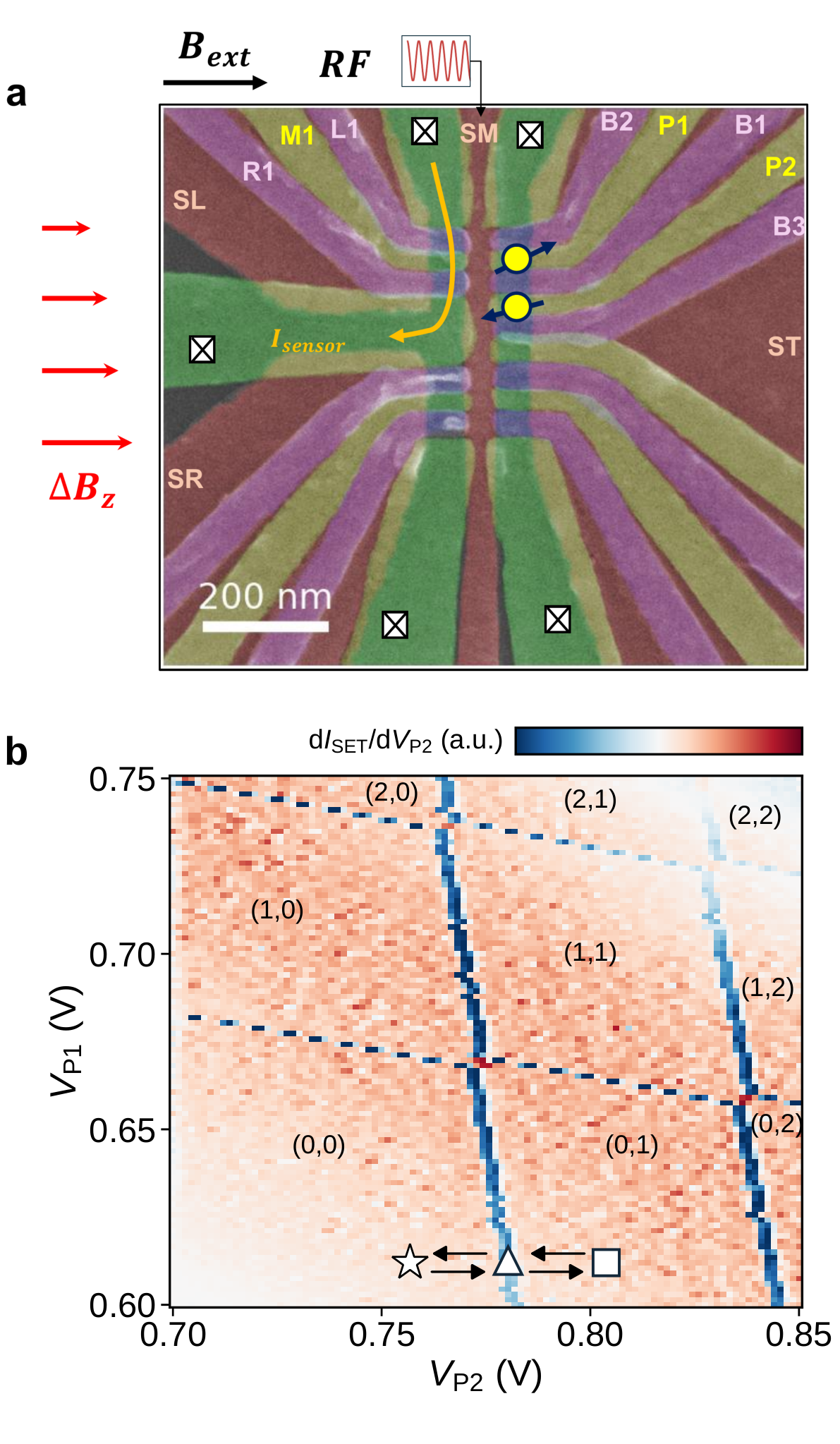
Both pulse families were benchmarked on a silicon double‑quantum‑dot device using gate‑set tomography. Over the ten‑day period the qubit’s rotation angle never deviated more than 0.3°, even when the Larmor frequency jumped by 1.3 MHz.
---
Implications for Scalable Quantum Processors
The ability to run a qubit for days without retuning directly addresses a key scalability challenge. It reduces the overhead of continuous calibration, freeing up control hardware and simplifying error‑correction cycles. Moreover, the approach is compatible with existing silicon‑foundry processes, meaning it could be adopted in larger arrays without major redesign.
While the study focuses on a single qubit, the authors note that the same pulse families can be applied across multiple qubits, provided the underlying hardware supports the required microwave bandwidth. Future work will explore multi‑qubit extensions and integration with automated calibration pipelines.
---
Looking Ahead
The ten‑day stability result is a concrete step toward fault‑tolerant silicon spin‑qubit processors. It shows that clever pulse engineering can mitigate one of the most persistent sources of error—drift in control parameters—without sacrificing gate fidelity. As the community moves toward larger spin‑qubit arrays, techniques like BIR‑4 and CORPSE will likely become standard tools in the quantum‑control toolbox.
For a deeper dive, see the pre‑print by Pushp et al. on arXiv (https://arxiv.org/html/2611.30931v1).
Hype check
PartlyThe pre‑print provides experimental data showing ten‑day stability, but the result is not yet peer‑reviewed and lacks independent replication.
- Peer-reviewed paper, or press release only?Press release only — Result is reported only in an arXiv pre‑print.
- Error-corrected (logical) qubits, or physical qubits only?Logical / not a qubit claim — Claim does not involve qubit‑count or logical‑vs‑physical distinction.
- A new milestone, or a rebrand / restatement?New — First demonstration of 0.3° rotation stability over ten days.
- Independent confirmation?Not yet — No external confirmation or replication mentioned.
- Does the headline claim match what the source shows?Matches — Headline accurately reflects the ten‑day, 0.3° stability claim.
An editorial assessment of the claim as reported, not a judgment of the company or researchers. Checked against: arxiv.org. How we rate hype →
Source
Read original sourceWhy we picked this
Accepted from curated QuantumUnzipped source (relevance scoring disabled).