Spiraling spins bring coordinated quantum motion to diamond sensors
Researchers have demonstrated coordinated spiral motion of nitrogen‑vacancy spins in diamond at room temperature, enabling finer magnetic imaging.
Coordinated Spin Spirals Boost Diamond Quantum Sensors
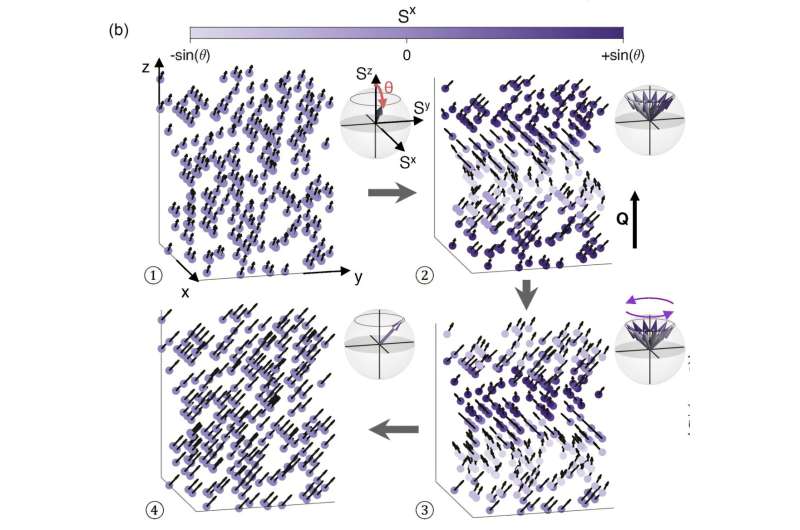
Diamond‑based nitrogen‑vacancy (NV) centers are already prized for their ability to detect minute magnetic fields, but their full potential has been limited by the random placement of spins and rapid decoherence. A new study published in Physical Review X shows that by applying nanoscale magnetic gradients and carefully timed microwave pulses, a team led by Piotr Put at Harvard can coax thousands of randomly distributed NV spins into synchronized spiral patterns that persist longer than natural interactions allow.
From Random Spins to Spirals
In a bulk diamond sensor, NV centers are scattered throughout the crystal lattice. At room temperature, each spin feels the magnetic influence of its neighbors, causing rapid dephasing. The researchers first aligned all spins with a laser pulse, then introduced a spatially varying magnetic field that wound the spin orientations into nanometer‑scale spirals. Subsequent microwave pulses reshaped the interaction Hamiltonian, balancing strong pairwise couplings and protecting the collective motion from premature decay.
Imaging and Characterisation
Using a custom‑built chip for precise field control and nanoscale magnetic imaging, the team mapped the evolving spin texture with better than 20 nm resolution. The observed dynamics matched simulations of a “one‑axis‑twisting” interaction, a well‑known mechanism for generating spin‑squeezed states that can reduce measurement noise.
Implications for Quantum Sensing
The ability to sustain coordinated spin motion opens two immediate avenues:
- Enhanced Sensitivity – Collective spin squeezing can amplify weak magnetic signals, potentially improving the detection limits of NV‑based magnetometers.
- Nanoscale Imaging – The fine‑grained mapping of spin patterns could support magnetic resonance imaging of materials and biological specimens at unprecedented spatial resolution.
Future work will test whether the technique scales to larger ensembles and whether genuine entanglement can be verified, a step that would further cement diamond’s role in quantum metrology.
A Practical Outlook
While the experiment remains at the laboratory stage, its room‑temperature operation and reliance on standard laser and microwave tools make it attractive for near‑term sensor development. Engineers could integrate the gradient‑field chip into existing diamond sensor platforms, offering a pathway to commercial devices that leverage collective quantum effects without the overhead of cryogenic cooling.
---
The study, “Collective Many‑Body Dynamics in a Solid‑State Quantum Sensor Controlled through Nanoscale Magnetic Gradients,” appears in Physical Review X (2026).
Hype check
RealThe paper provides experimental data on coordinated spin spirals and matches the headline; it is peer‑reviewed and presents a genuine new result, though external replication is not reported.
- Peer-reviewed paper, or press release only?Paper — Published in Physical Review X
- Error-corrected (logical) qubits, or physical qubits only?Logical / not a qubit claim — Not a qubit‑count claim
- A new milestone, or a rebrand / restatement?New — First demonstration of room‑temperature coordinated NV spin spirals
- Independent confirmation?Not yet — No external confirmation mentioned
- Does the headline claim match what the source shows?Matches — Headline accurately reflects the paper's findings
An editorial assessment of the claim as reported, not a judgment of the company or researchers. Checked against: phys.org. How we rate hype →
Source
Read original sourceWhy we picked this
Accepted from curated QuantumUnzipped source (relevance scoring disabled).