Symmetry defects and gauging for quantum states with matrix product unitary symmetries
The paper develops a framework for defining, manipulating, and gauging symmetry defects associated with matrix product unitary (MPU) symmetries in one‑dimensional quantum states.
Symmetry Defects and Gauging for Matrix Product Unitary Symmetries
Introduction
One‑dimensional quantum spin chains are often described by matrix product states (MPS), a class of tensor network wavefunctions that capture ground‑state properties of gapped systems. When a global symmetry acts on an MPS in an on‑site fashion, the symmetry can be pushed onto the virtual bonds, giving rise to virtual symmetry defects that are well understood and play a central role in classifying symmetry‑protected topological (SPT) phases. The recent work of Franco‑Rubio, Bochniak, and Cirac extends this picture to matrix product unitary (MPU) symmetries, which are symmetries implemented by a finite‑depth quantum circuit that respects the MPS structure. Their study introduces site‑localized defect tensors, explores how these defects can be created, moved, and fused, and uses the formalism to address the gauging of MPU symmetries.
---
1. From On‑Site to MPU Symmetries
In the on‑site case, a symmetry operator (U(g)=\bigotimesi ui(g)\) can be represented on an MPS by inserting a virtual operator (V(g)) on each bond, satisfying a pull‑through condition that links the physical and virtual actions. This leads to a simple description of symmetry defects as insertions of (V(g)) on a single bond, which behave like particle‑like excitations.
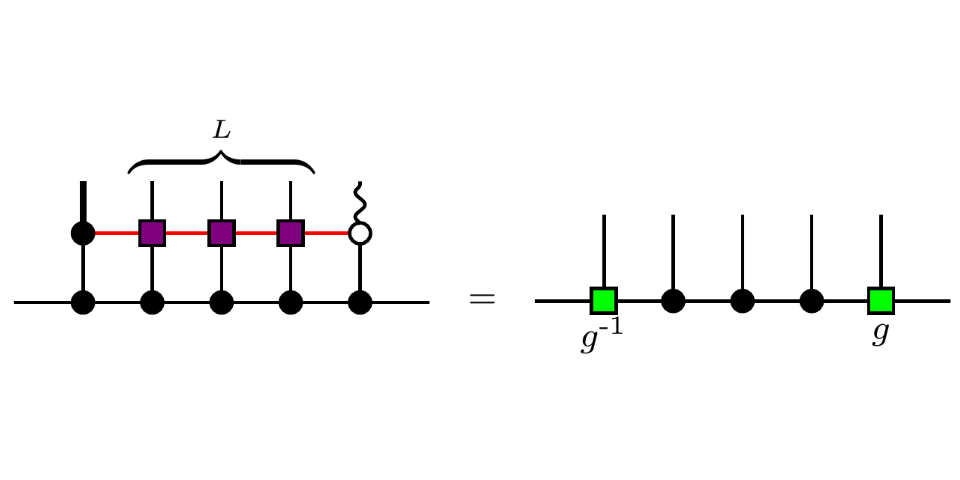
MPU symmetries replace the on‑site unitary (u_i(g)) with a matrix product unitary (\mathcal{U}(g)\) that has a finite bond dimension and acts non‑trivially across neighboring sites. The authors show that the pull‑through condition still holds, but now the symmetry defect is no longer a bond operator; instead it is a defect tensor attached to a lattice site. This tensor modifies the local MPS tensor in a controlled way, preserving the overall wavefunction up to a global phase.
---
2. Defect Tensors: Creation, Motion, and Fusion
The paper defines a defect tensor \(D(g)\) that, when inserted at site \(i\), implements the action of the MPU symmetry on a semi‑infinite interval to the left of \(i\). By applying local unitary operators that act on a few adjacent sites, one can:
- Create a pair of defects \(D(g)\) and \(D(g^{-1})\) at the endpoints of a finite interval.
- Move a defect along the chain by successive local unitaries, analogous to dragging a particle.
- Fuse two defects \(D(g)\) and \(D(h)\) into a single defect \(D(gh)\), reflecting the group multiplication of the underlying symmetry.
These operations obey associativity and locality, providing a concrete lattice realization of defect algebra that mirrors the categorical description of symmetry defects in higher‑dimensional topological phases.
---
3. Gauging MPU Symmetries
Gauging a global symmetry means promoting the symmetry to a local one by introducing gauge degrees of freedom that enforce the symmetry on each site. For on‑site symmetries, this procedure is straightforward: one attaches a gauge variable to each bond and imposes commuting gauge constraints.
For MPU symmetries, the authors identify a block‑independence condition. When the MPU representation decomposes into independent blocks that do not mix under the symmetry action, the defects can be promoted to gauge variables without increasing the MPS bond dimension. The resulting gauged MPS retains the original bond dimension and exhibits a set of commuting local gauge constraints, effectively realizing a locally symmetric state.
If block‑independence fails—typically when the MPU representation is anomalous—the straightforward gauging breaks down. The authors then propose a state‑level gauging method: defects are still promoted to gauge variables, but the resulting gauge constraints no longer commute across different sites. This non‑commuting structure captures the obstruction caused by the anomaly and still yields a locally symmetric MPS, albeit with a more intricate gauge algebra.
---
4. Implications and Outlook
The framework unifies several strands of recent research:
- It extends the well‑known virtual‑defect picture of on‑site symmetries to the richer class of MPU symmetries, which include many physically relevant non‑on‑site actions such as lattice translations combined with internal rotations.
- The defect algebra provides a concrete lattice toolkit for studying symmetry fractionalization and anomaly detection in one dimension, complementing field‑theoretic approaches.
- The gauging constructions open a pathway to engineer new quantum phases by converting global MPU symmetries into local gauge structures, potentially leading to novel SPT and intrinsically topological states.
Future work may explore higher‑dimensional generalizations, connections to categorical symmetry frameworks, and practical implementations in quantum simulators where MPU symmetries arise naturally from finite‑depth circuits.
---
Practical Takeaway
For researchers working with tensor‑network models, the paper offers a recipe:
- Identify the MPU symmetry of your MPS and verify block‑independence.
- Construct defect tensors \(D(g)\) using the pull‑through condition.
- Use local unitaries to create, move, and fuse defects as needed.
- Apply the appropriate gauging scheme (standard or state‑level) to obtain a locally symmetric MPS without increasing computational cost.
By following these steps, one can systematically explore the landscape of quantum spin chains enriched by non‑on‑site symmetries and their gauged counterparts.
Source
Read original sourceWhy we picked this
Accepted from curated QuantumUnzipped source (relevance scoring disabled).