Testing Einstein's laws from the bottom of the Mediterranean Sea
KM3NeT/ORCA’s analysis of 5,828 atmospheric neutrinos finds no Lorentz‑invariance violation, setting new limits—especially on muon‑tau neutrino differences—while demonstrating the deep‑sea detector’s potential for fundamental physics.
Probing Einstein’s Core Principle from the Deep Sea
Lorentz invariance, the idea that the laws of physics are the same for all observers regardless of their motion, underpins Einstein’s theory of relativity. Some quantum‑gravity models suggest this symmetry could break down at extremely small scales, prompting experimental tests that push the limits of precision. The KM3NeT collaboration has taken this quest to the bottom of the Mediterranean Sea, using the ORCA neutrino telescope to examine whether neutrinos betray any sign of such a violation.
Why Neutrinos Are Ideal Test Particles
Neutrinos interact only weakly with matter, allowing them to traverse the Earth unimpeded and retain information about their original state. As they travel, they oscillate between three "flavors"—electron, muon, and tau—according to well‑understood quantum mechanics. Any deviation from the predicted oscillation pattern could indicate new physics, including possible Lorentz‑invariance violation (LIV). By measuring the energy and arrival direction of atmospheric neutrinos, researchers can compare observations with the precise expectations of the Standard Model.
The ORCA Measurement
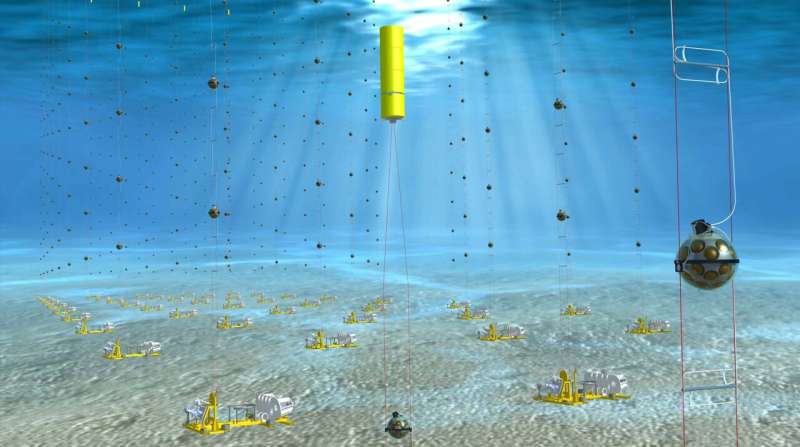
The study analyzed 5,828 atmospheric neutrino candidates collected over 1.4 years with the first six detection units of KM3NeT/ORCA. These units consist of strings of optical modules anchored deep beneath the sea surface, detecting the faint Cherenkov light produced when a neutrino interacts with water. The data were fitted to models that incorporate potential LIV terms, allowing the team to extract limits on how large such effects could be without contradicting the observations.
Key Findings
- No evidence of LIV: The observed neutrino oscillation patterns match the Standard Model predictions within statistical uncertainties.
- New experimental limits: The analysis sets tighter constraints on several LIV coefficients, including the first direct bounds on differences affecting muon‑ and tau‑neutrino oscillations.
- Competitive performance: Despite using only a partial detector configuration, the limits are comparable to those from long‑running experiments such as IceCube and Super‑Kamiokande.
Looking Ahead: Bigger Detectors, Higher Energies
ORCA is still under construction, with additional detection units slated for deployment. A larger instrument will collect more neutrino events, sharpening the sensitivity to even subtler LIV effects. Moreover, the sister detector KM3NeT/ARCA, optimized for high‑energy astrophysical neutrinos, promises to probe LIV at energies and baselines where potential violations could be amplified.
The recent Nobel Prize awarded for high‑energy neutrino astronomy underscores the growing relevance of neutrino observatories in fundamental physics. As KM3NeT expands, it will join a global network of detectors that together can test the deepest assumptions of relativity across a wide range of energies and distances.
Practical Takeaway
The ORCA results reinforce the robustness of Lorentz invariance while highlighting the power of deep‑sea neutrino telescopes to explore frontier physics. Continued data collection and detector upgrades will enable even more stringent tests, keeping the search for quantum‑gravity signatures firmly anchored—literally—in the Mediterranean depths.
Source
Read original sourceWhy we picked this
Accepted from curated QuantumUnzipped source (relevance scoring disabled).