The secret of 'strange metals' may lie in quantum statistics, not collisions
New calculations show that Planckian resistance in strange metals stems from quantum statistical response rather than electron collisions.
Strange Metals: A Quantum‑Statistical Explanation
In conventional metals, electrons behave like well‑defined particles that scatter off impurities and lattice vibrations. By contrast, "strange" or "bad" metals—most famously the copper‑oxide (cuprate) superconductors—exhibit a linear increase of electrical resistance with temperature over a remarkably wide range, reaching the so‑called Planckian limit. The underlying mechanism has been debated for decades.
A New Computational Study
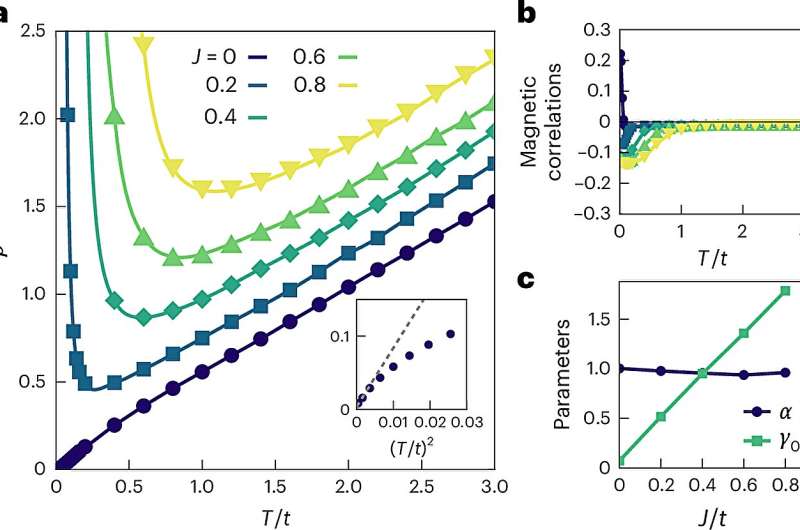
A team led by Simone Fratini at Institut Néel (CNRS/Université Grenoble Alpes), together with Arnaud Ralko, Ivan Duchemin, and Sergio Ciuchi, tackled the problem using the t‑J model, a standard lattice description of strongly interacting electrons in cuprates. By applying improved numerical techniques, they were able to compute the model’s electrical properties down to temperatures equivalent to about 40 K in real materials—significantly lower than previous simulations and beyond the reach of current cold‑atom analogues.
Key Findings
- Planckian resistance reproduced: The calculated resistivity grows linearly with temperature at exactly the Planckian rate across a broad doping range, matching experimental observations.
- No need for a fine‑tuned quantum critical point: The behavior appears whenever magnetic order is suppressed, suggesting it is a generic feature of the bad‑metal regime.
- Charge transport is independent: Conductivity scales simply with the number of mobile charges; each charge moves through a fluctuating magnetic background without collective scattering.
- Optical response explained: The strange optical absorption seen in cuprates, which deviates from the Drude model, emerges naturally from the calculations.
A Paradigm Shift
The authors argue that the Planckian timescale does not arise from how often electrons collide. Instead, it originates from the quantum detailed balance factor that links current fluctuations to the measured conductivity. In other words, the quantum statistical nature of the electrons’ response to an electric field sets the observed linear‑in‑temperature resistivity.
"In bad metals, Planckian behavior is not a property of how charge carriers scatter, but of the quantum statistical nature of their response to electric fields," the authors write.
Looking Ahead
The study opens a clear experimental direction: testing the predicted quantum‑statistical signature in transport and optical measurements. Fratini notes that verification work is already underway, promising further insight into the enigmatic physics of high‑temperature superconductors.
---
This article is based on the Nature Physics paper Strange metal behaviour from underlying bad metallicity (2026) and the accompanying press release on Phys.org.
Hype check
RealThe claim is backed by a peer‑reviewed Nature Physics paper with clear computational results; no independent replication is cited but the evidence matches the headline.
- Peer-reviewed paper, or press release only?Paper — Nature Physics 2026 paper cited
- Error-corrected (logical) qubits, or physical qubits only?Logical / not a qubit claim — Not a qubit‑count claim
- A new milestone, or a rebrand / restatement?New — Provides a new mechanism for Planckian behavior
- Independent confirmation?Not yet — No external confirmation mentioned
- Does the headline claim match what the source shows?Matches — Headline reflects the paper's conclusion
An editorial assessment of the claim as reported, not a judgment of the company or researchers. Checked against: phys.org. How we rate hype →
Source
Read original sourceWhy we picked this
Accepted from curated QuantumUnzipped source (relevance scoring disabled).