The three kinds of three-qubit entanglement
Three-qubit pure states admit three ordered polynomial entanglement measures—bipartite concurrence, a new W‑entanglement polynomial, and the three‑tangle for GHZ‑type entanglement—providing a unified hierarchy of multipartite correlations.
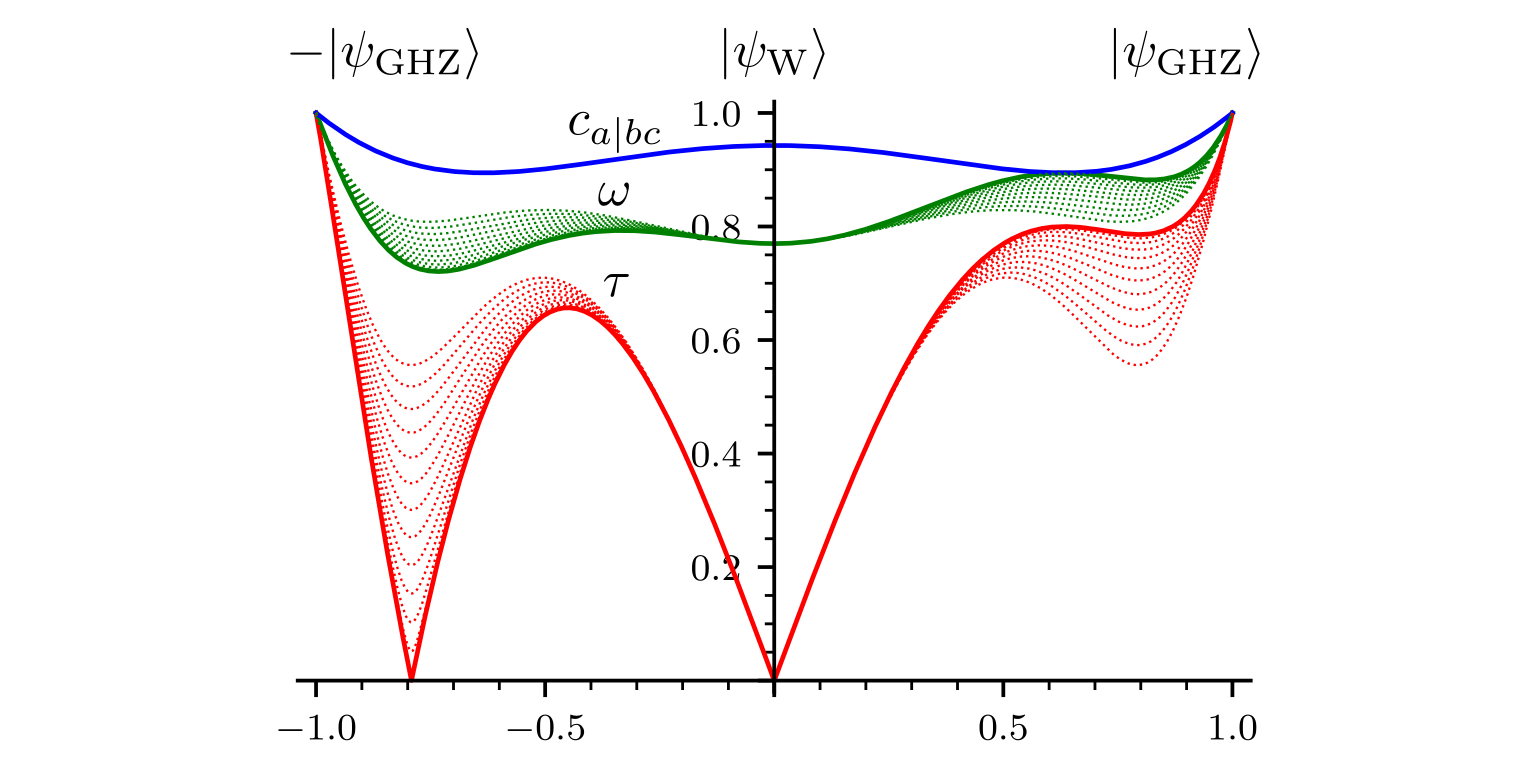
Understanding the Three Kinds of Three‑Qubit Entanglement
Entanglement among three qubits is richer than the simple pairwise correlations familiar from two‑qubit systems. While bipartite entanglement is captured by the concurrence, pure three‑qubit states fall into two inequivalent classes under stochastic local operations and classical communication (SLOCC): the GHZ class and the W class. Recent work introduces a polynomial measure for W‑type entanglement that sits naturally between the bipartite concurrence and the three‑tangle (the GHZ‑type polynomial), completing a three‑level hierarchy of entanglement measures.
---
1. Polynomial Measures for Pure Three‑Qubit States
- Bipartite concurrence – A degree‑2 invariant that quantifies the maximum entanglement that can be extracted between any two qubits when the third is traced out. It reduces to the familiar two‑qubit concurrence for reduced states.
- W‑entanglement polynomial – A newly constructed degree‑4 invariant that vanishes on GHZ‑type states but is non‑zero for genuine W‑type entanglement. It is symmetric under qubit permutations and respects the SLOCC classification.
- Three‑tangle (τ) – The classic degree‑4 invariant introduced by Coffman, Kundu, and Wootters, non‑zero only for GHZ‑type states and serving as a measure of genuine tripartite entanglement.
All three quantities are monotonic under local operations and convex for mixed states, making them bona‑fide entanglement monotones. Their polynomial nature ensures analytic tractability and direct connection to invariant theory.
---
2. Ordering the Measures: From Weak to Strong Correlations
A key result is the strict ordering
``` Concurrence ≥ W‑measure ≥ Three‑tangle ```
for any pure three‑qubit state. This ordering mirrors the inclusion hierarchy of the corresponding SLOCC classes:
- Bipartite‑dominant states – Any state can be reduced to a pair of entangled qubits; the concurrence captures the strongest possible two‑qubit correlation.
- W‑type states – Exhibit genuine multipartite entanglement that survives loss of any single qubit, but the amount of entanglement is bounded above by the bipartite concurrence.
- GHZ‑type states – Possess the most fragile form of tripartite entanglement; the three‑tangle quantifies this delicate correlation, which disappears entirely if any qubit is measured.
Graphically, one can picture the three measures as nested shells: the outer shell (concurrence) encloses the W‑shell, which in turn encloses the GHZ‑shell. Superpositions of GHZ and W states trace continuous paths across these shells, illustrating how the measures evolve smoothly as the state interpolates between the two classes.
---
3. Physical Implications and Applications
The hierarchy clarifies several practical questions:
- Entanglement distribution – When distributing entanglement across a network, the concurrence indicates the maximal pairwise resource, while the W‑measure tells how much of that resource remains genuinely multipartite after one node is lost.
- Quantum protocols – GHZ‑type entanglement is essential for tasks such as secret sharing, whereas W‑type entanglement is more robust for quantum metrology and certain error‑correcting schemes. Knowing the quantitative gap between the measures helps in protocol design.
- State conversion – The ordering implies that deterministic conversion from a higher‑measure state to a lower‑measure one is possible via local operations, but the reverse conversion requires probabilistic SLOCC transformations.
---
4. Towards a Unified Entanglement Theory
By placing bipartite concurrence, the W‑polynomial, and the three‑tangle on a common footing, the recent work bridges the gap between bipartite and multipartite entanglement theories. It suggests a broader program: constructing polynomial invariants for larger systems that respect the natural inclusion hierarchy of SLOCC classes. Such invariants could serve as benchmarks for multipartite quantum technologies, from quantum computers to distributed sensing networks.
---
Practical Takeaway
When working with three‑qubit pure states, evaluate the three polynomial measures to locate the state within the entanglement hierarchy. The concurrence gives the upper bound, the W‑measure refines the genuine tripartite content, and the three‑tangle pinpoints the GHZ‑type contribution. This ordered set of numbers provides a concise, quantitative fingerprint of any three‑qubit entangled resource.
Source
Read original sourceWhy we picked this
Accepted from curated QuantumUnzipped source (relevance scoring disabled).