Theoretical model describes a new type of atomic oscillation with cloverleaf symmetry in altermagnets
A new theoretical model predicts d‑wave chiral phonons with cloverleaf symmetry in altermagnets, offering a route to control spin‑phonon interactions.
New Theory Unveils Cloverleaf‑Shaped Atomic Oscillations in Altermagnets
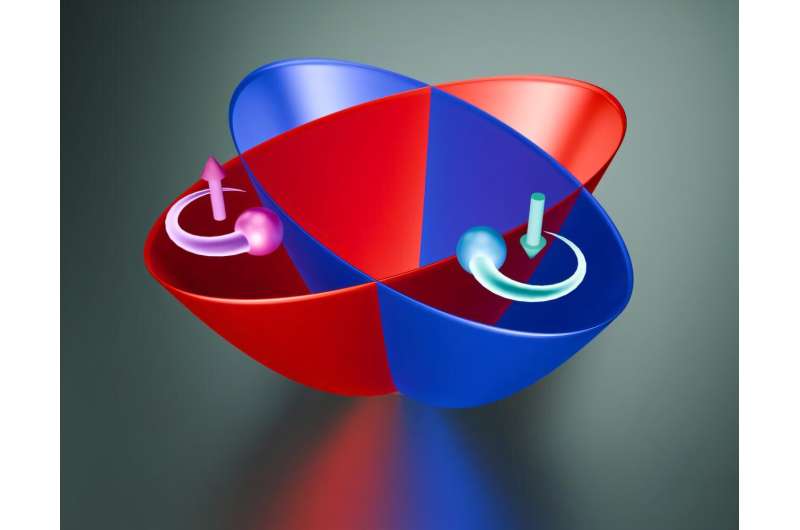
A collaborative team from Martin Luther University Halle‑Wittenberg and the University of Münster has introduced a theoretical framework that predicts a previously unknown class of lattice vibrations—d‑wave chiral phonons—in altermagnetic materials. Published in Physical Review Letters, the model describes how these phonons rotate in opposite directions depending on their propagation, forming a distinctive four‑fold, cloverleaf pattern.
From Linear Waves to Rotational Phonons
In ordinary solids, atoms vibrate in linear, sinusoidal patterns that propagate as phonons. Altermagnets, a magnetic class identified only recently (2019), already host chiral phonons that rotate around equilibrium positions. The new work extends this concept by showing that the rotation can switch handedness with the phonon’s wavevector, creating a d‑wave texture. This texture means the atomic motion reverses direction four times across a unit cell, giving the oscillation a cloverleaf‑like symmetry.
Coupling to Spin Waves
Spin waves—collective excitations of electron spins—are central to magnonic information processing. The authors demonstrate that right‑handed spin waves couple exclusively to right‑handed chiral phonons, and left‑handed spin waves to left‑handed phonons. This selective magnon‑phonon hybridization provides a mechanism to transfer angular momentum between the magnetic and lattice subsystems without charge flow, a key step toward low‑energy information carriers.
Practical Control Mechanisms
Two practical knobs emerge from the theory:
- Temperature‑Driven Sorting – A modest temperature change can bias the population of phonons toward one handedness, effectively acting as an angular‑momentum splitter.
- Magnetic‑Field Tuning – External magnetic fields can shift the spin‑wave spectrum, thereby steering the coupled phonon rotation direction.
These control strategies suggest experimental pathways to generate, manipulate, and detect the predicted d‑wave phonons.
Outlook and Potential Applications
While the model remains theoretical, its implications are broad. By harnessing phonons instead of electrons, future devices could transmit signals with dramatically reduced Joule heating. Moreover, the ability to separate phonons by angular momentum may enable phononic logic gates or spin‑phonon transducers for hybrid quantum technologies.
The research team plans to collaborate with experimental groups to verify the predictions using neutron scattering or ultrafast spectroscopy. Success would open a new subfield—orbitronics of lattice vibrations—where the rotational degree of freedom of atoms becomes a functional resource.
--- The study, “D‑Wave Phonon Angular Momentum Texture in Altermagnets by Magnon‑Phonon Hybridization,” appears in Physical Review Letters (2026).
Hype check
RealThe claim is backed by a peer‑reviewed PRL paper presenting a concrete theoretical model; no external validation yet but the evidence matches the headline.
- Peer-reviewed paper, or press release only?Paper — Published in Physical Review Letters
- Error-corrected (logical) qubits, or physical qubits only?Logical / not a qubit claim — Not a qubit‑count claim
- A new milestone, or a rebrand / restatement?New — First description of d‑wave chiral phonons
- Independent confirmation?Not yet — No external confirmation mentioned
- Does the headline claim match what the source shows?Matches — Headline accurately reflects the paper's prediction
An editorial assessment of the claim as reported, not a judgment of the company or researchers. Checked against: phys.org. How we rate hype →
Source
Read original sourceWhy we picked this
Accepted from curated QuantumUnzipped source (relevance scoring disabled).