Triplet of ‘Ghostly’ Galaxies Hints at What Dark Matter Is — and Isn’t
A trio of dark‑matter‑deficient galaxies likely formed from a past collision that stripped away their dark matter, bolstering the case for dark matter as a physical substance and challenging modified‑gravity alternatives.
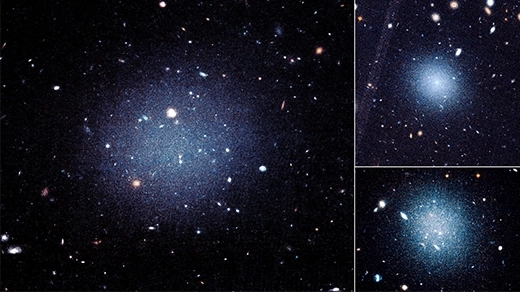
Ghostly Galaxies and the Dark Matter Puzzle
Three ultra‑diffuse galaxies—DF2, DF4, and DF9—located about 65 million light‑years away appear to contain almost no dark matter. Their faint, star‑poor appearance earned them the nickname “ghostly” galaxies. By measuring the motions of the few stars they host, astronomers have inferred that ordinary (baryonic) matter alone accounts for essentially all of their mass. This striking deviation from the norm, where dark matter dominates the gravitational budget of virtually every galaxy, offers a rare laboratory for testing the nature of dark matter and for probing alternative theories of gravity.
How Could Galaxies Lose Their Dark Matter?
The leading explanation, presented in a recent study, invokes a violent galactic collision. When two ordinary galaxies crash, their gas, dust, and stars interact strongly—colliding, shocking, and eventually coalescing into new, smaller systems. Dark matter, however, interacts only through gravity and passes through the encounter largely unaffected, like a ghost through a wall. The result is a pile‑up of baryonic material that can fragment into several dwarf‑sized galaxies, each left with a dramatically reduced dark‑matter halo. The spatial alignment of DF2, DF4, and DF9 suggests they are the remnants of such a collision, sharing a common origin and a common deficiency.
Implications for Dark Matter vs. Modified Gravity
The existence of galaxies that can form and retain stars without a substantial dark‑matter component is difficult to reconcile with theories that replace dark matter with a modification of Newtonian gravity (e.g., MOND). In modified‑gravity frameworks, the gravitational force itself is altered at low accelerations, allowing visible matter to hold galaxies together. If dark matter were merely a bookkeeping device for an altered force law, one would not expect a scenario where ordinary matter is completely stripped of its invisible counterpart yet still manages to form stars. The ghostly trio therefore acts as indirect evidence that dark matter behaves as a distinct, physical substance.
Remaining Questions and Future Directions
While the collision‑stripping scenario is compelling, it is not the only possible story. Some researchers propose that the galaxies passed through a massive group of neighboring galaxies, experiencing tidal forces that removed their dark halos without a head‑on merger. Others remain skeptical, noting that the observed structures lack the fluid, turbulent signatures typical of recent collisions. Resolving these debates will require deeper observations—high‑resolution spectroscopy to map stellar velocities, deeper imaging to search for faint tidal features, and perhaps direct measurements of any residual dark‑matter distribution via gravitational lensing.
Takeaway
The DF2–DF4–DF9 system provides a concrete, observable test case that challenges modified‑gravity explanations and supports the view of dark matter as a real, particle‑like component of the cosmos. As astronomers gather more data on these and similar ultra‑diffuse galaxies, the case for dark matter’s physical nature will become increasingly robust, while alternative gravity theories will face ever‑tighter constraints.
Source
Read original sourceWhy we picked this
Accepted from curated QuantumUnzipped source (relevance scoring disabled).