TU Delft Achieves Direct Single-Atom Nuclear Magnetic Resonance via Scanning Tunneling Microscope Probe
TU Delft used a scanning tunneling microscope to directly drive and read a single nuclear spin, demonstrating atomic‑scale NMR without electron‑nuclear hybridization.
Introduction
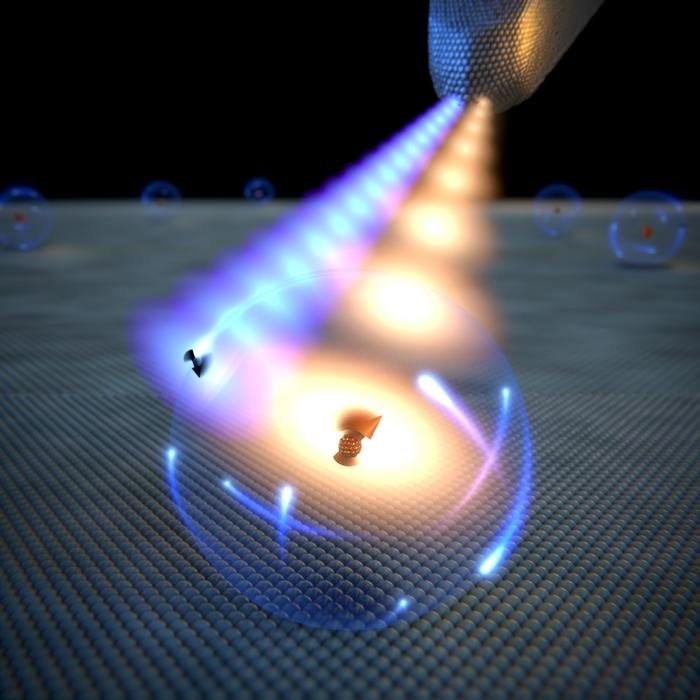
A research team at TU Delft’s Kavli Institute of Nanoscience has shown that a single nuclear spin can be addressed directly with a scanning tunneling microscope (STM). By integrating an electron‑nuclear double‑resonance (ENDOR) scheme into an ultra‑low‑temperature STM, the experiment achieves nuclear magnetic resonance (NMR) on an isolated surface atom, opening a path toward atomic‑scale quantum memories and high‑dimensional qudits.
How the experiment works
- Platform: A titanium‑47 atom is deposited on a bilayer MgO film grown on Ag(100). The atom hosts an electronic spin (S = ½) coupled to a nuclear spin (I = 5/2), giving a six‑level system.
- Measurement scheme: Dual‑frequency ENDOR combines a gigahertz‑range electron‑spin resonance (ESR) channel for readout with a megahertz‑range radio‑frequency (RF) drive that directly flips the nuclear spin. The STM tip supplies both the microwave and RF fields locally.
- Magnetic field regime: Experiments are performed at 0.4 K under magnetic fields of 0.2–1.4 T. At these fields the electronic Zeeman energy dominates, suppressing the usual electron‑nuclear hybridization that would otherwise mix the states.
- Selectivity: Quadrupole splitting (≈ ‑2.8 MHz) lifts the degeneracy of the nuclear sublevels, allowing independent addressing of each transition.
Why this matters
- Isolation from noise – Nuclear spins have magnetic moments three orders of magnitude smaller than electrons, making them intrinsically resistant to environmental fluctuations. The Delft results show surface‑relaxation times on the order of seconds, far longer than typical electron‑spin coherence times.
- Scalable architecture – Because the STM tip provides a local probe, the technique can be extended to engineered atom‑by‑atom lattices, enabling dense arrays of nuclear qubits or qudits.
- High‑field operation – Prior single‑atom NMR work relied on strong hyperfine mixing at low fields (< 100 mT). By operating up to 1.4 T, the Delft team demonstrates that direct nuclear driving remains viable even when the electron and nucleus are largely decoupled.
- Road to quantum gates – While the current study uses continuous‑wave RF driving, the demonstrated control bandwidth (50–85 MHz) suggests that pulsed sequences for coherent gate operations are within reach.
Outlook and practical implications
The ability to manipulate a single nuclear spin with an STM probe provides a new toolbox for quantum hardware developers. Potential next steps include:
- Pulsed ENDOR to realize coherent single‑qubit rotations and two‑qubit gates mediated by the electronic spin.
- Integration with surface‑fabricated spin chains to explore quantum simulation of many‑body physics using nuclear degrees of freedom.
- Benchmarking against other platforms such as donor spins in silicon or color‑center nuclei, focusing on coherence, addressability, and scalability.
In summary, TU Delft’s direct single‑atom NMR experiment showcases a clean, high‑field approach to nuclear spin control at the atomic scale, laying groundwork for ultra‑dense quantum registers that leverage the long‑lived nature of nuclear qubits.
Source
Read original sourceWhy we picked this
Accepted from curated QuantumUnzipped source (relevance scoring disabled).