TU Delft Demonstrates First Hybrid HPC-Quantum Workflow Linking DelftBlue Supercomputer and Tuna-17 Processor
TU Delft and QuTech have run the first hybrid HPC‑quantum benchmark, linking the DelftBlue supercomputer with the 17‑qubit Tuna‑17 processor.
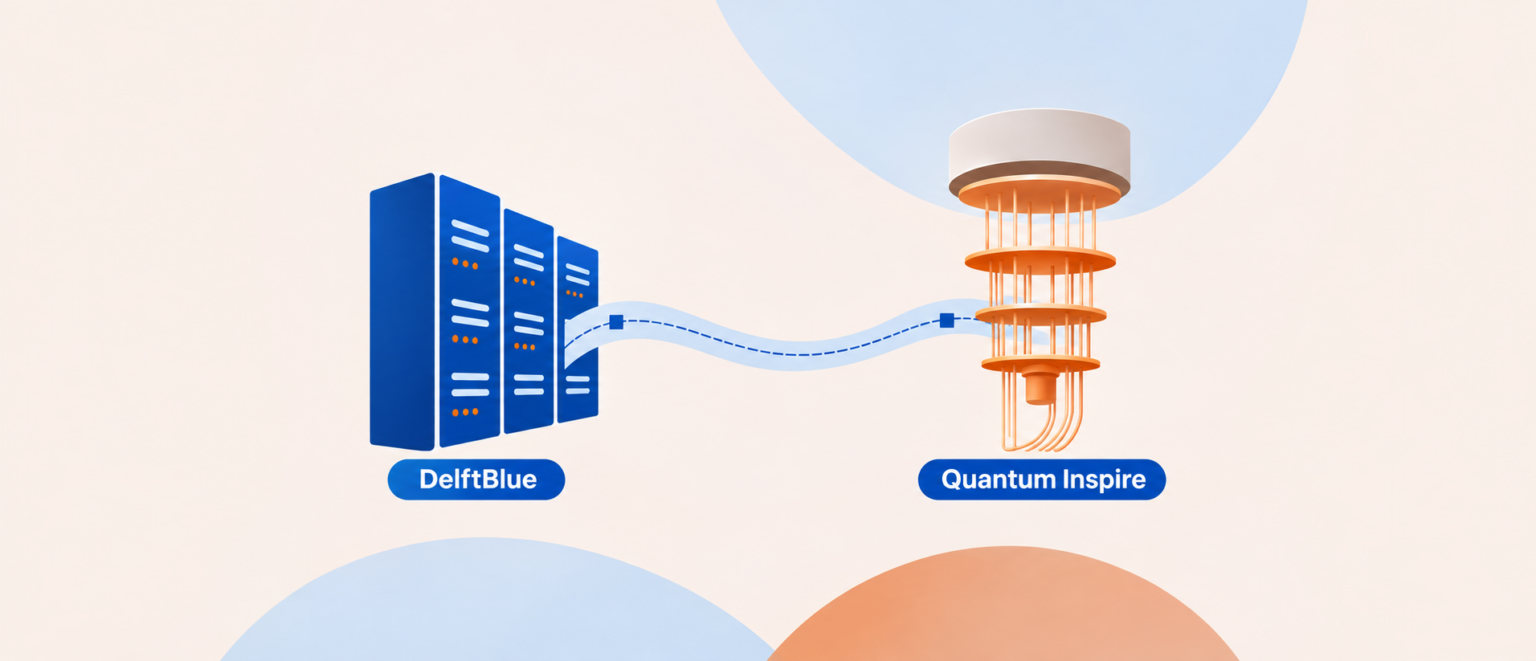
First Hybrid HPC‑Quantum Benchmark at TU Delft
Researchers at TU Delft’s DelftBlue high‑performance computer and QuTech’s cloud‑based Quantum Inspire platform have completed the inaugural user benchmark that couples classical HPC resources with a small‑scale quantum processor. The experiment demonstrates how a conventional supercomputer can formulate and pre‑process a problem, hand off a quantum sub‑routine, and then ingest the quantum results for a final solution.
From Power‑Flow Equations to Quantum Circuits
The test case was an electrical power‑flow calculation, a staple of grid‑management software. DelftBlue generated the mathematical objective and performed a classical optimization of circuit parameters. Those parameters were then encoded into quantum circuits and sent to QuTech’s 17‑qubit Tuna‑17 processor via the Quantum Inspire cloud interface.
Two encodings were explored:
- Four‑qubit encoding – 30 circuit layers, 1,024 measurement shots per run. The optimal candidate state appeared in 21 % of the shots, yielding a power‑flow residual of 0.01053.
- Six‑qubit encoding – 165 circuit layers, same shot count. The deeper circuit reduced the optimal‑candidate sampling frequency to 1.56 %, but the best residual improved to 0.003262.
These numbers establish a baseline for hybrid algorithm performance on the integrated stack, highlighting the trade‑off between circuit depth (and thus noise) and solution quality.
Significance for Hybrid Computing
While the Tuna‑17 processor is modest in size, the workflow showcases a practical pattern that can scale as larger, lower‑error quantum devices become available:
- Classical pre‑processing – Use HPC to formulate large‑scale problems and reduce them to a form suitable for quantum acceleration.
- Quantum acceleration – Run a variational algorithm (here QAOA) on a quantum processor to explore combinatorial spaces.
- Classical post‑processing – Decode measurement bit‑strings back into the original domain and refine the solution.
The experiment also provides a concrete data point for future benchmarking efforts, allowing researchers to compare different quantum hardware, encoding strategies, and shot budgets under a common HPC‑quantum workflow.
Looking Ahead
The authors note that the current results are limited by hardware noise and the relatively shallow qubit count of Tuna‑17. Ongoing work will explore error‑mitigation techniques, alternative encodings, and larger problem instances as more capable quantum processors are integrated into the hybrid stack. The benchmark serves as a template for other institutions seeking to blend classical supercomputing power with emerging quantum resources.
---
This article is based on the announcement from TU Delft and QuTech as reported in the Quantum Computing Report on 27 Nov 2026.
Hype check
PartlyThe benchmark is real and described in detail, but it lacks peer‑reviewed validation and independent replication.
- Peer-reviewed paper, or press release only?Press release only — Only a press announcement is cited, no paper or preprint.
- Error-corrected (logical) qubits, or physical qubits only?Physical only — The claim involves a 17‑qubit physical processor, not logical qubits.
- A new milestone, or a rebrand / restatement?New — First reported hybrid HPC‑quantum workflow benchmark.
- Independent confirmation?Not yet — No external confirmation or replication mentioned.
- Does the headline claim match what the source shows?Matches — Headline accurately reflects the described benchmark.
An editorial assessment of the claim as reported, not a judgment of the company or researchers. How we rate hype →
Source
Read original sourceWhy we picked this
Accepted from curated QuantumUnzipped source (relevance scoring disabled).