Two paths, one flux: Trapped ions simulate Aharonov–Bohm interference in a lattice gauge theory
Researchers used a hybrid trapped‑ion quantum simulator to observe Aharonov–Bohm interference in a Z₂ lattice gauge theory, demonstrating flux‑controlled particle tunneling in a synthetic two‑dimensional loop.
Introduction
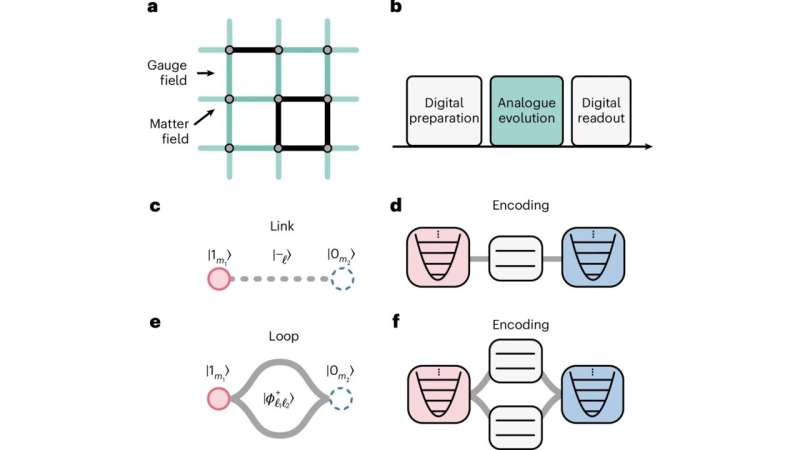
A recent experiment has shown that a small trapped‑ion quantum processor can emulate the Aharonov–Bohm effect inside a lattice gauge theory. By encoding gauge fields in the electronic states of two strontium ions and matter particles in their vibrational modes, the team created a synthetic loop where a magnetic‑like flux—stored in an entangled qubit pair—directly altered the interference of a hopping particle. The result is a clear, controllable demonstration of flux‑dependent tunneling in a Z₂ gauge model, a milestone for quantum simulations of high‑energy physics.
Hybrid trapped‑ion architecture
The experiment exploits two natural degrees of freedom of trapped ions:
- Qubits – two electronic levels of each ion act as the Z₂ gauge field on a lattice link, taking values "present" (+1) or "absent" (‑1).
- Phonons – quantized vibrational excitations serve as matter sites; a single phonon represents a particle that can hop between sites.
Coupling lasers implement state‑dependent forces that simultaneously flip a qubit and move a phonon, reproducing the gauge‑invariant hopping term of the theory. Although the ions sit in a linear chain, the pattern of laser‑induced couplings creates a synthetic loop: two links share the same pair of matter sites, giving the particle two distinct paths.
Encoding flux with entangled qubits
In a Z₂ model, magnetic flux through a plaquette is binary. The researchers prepared the two link qubits in either:
- Zero‑flux state – both qubits aligned, yielding a net phase of +1 for each path.
- Vison state – qubits anti‑aligned, producing a net phase of –1.
These entangled states act as a static flux that the moving phonon experiences. Because the phase is only ±1, the interference manifests as either constructive (enhanced tunneling) or destructive (complete suppression).
Observing Aharonov–Bohm interference
When the loop was initialized with zero flux, the phonon tunneled between the two matter sites at twice the rate observed for a single link, confirming constructive interference from the two identical paths. In the vison configuration, the opposite signs from the two paths cancelled, and the phonon remained localized, demonstrating destructive interference.
The experiment also measured the stability of the encoded flux. Over the observation window the vison persisted, with only a slow decay attributable to known decoherence mechanisms such as phonon heating. Numerical simulations that incorporated these noise sources matched the measured tunneling dynamics, reinforcing the interpretation.
Implications and future directions
This work shows that hybrid ion‑qubit/phonon platforms can capture the essential coupling between matter and gauge fields, something earlier simulations lacking dynamical matter could not achieve. Scaling up the synthetic lattice—adding more ions and links—could quickly push the problem beyond classical tractability, offering a path toward quantum advantage in studying non‑perturbative gauge dynamics.
Two promising extensions are:
- Larger loops and two‑dimensional lattices – increasing the number of sites would allow exploration of confinement, string breaking, and richer topological excitations.
- Beyond Z₂ – moving to Zₙ or continuous U(1) gauge groups would broaden the class of field theories that can be simulated, bringing the platform closer to realistic quantum‑chromodynamics analogues.
Conclusion
By marrying qubit‑based gauge fields with phonon‑based matter, the Oxford team has realized a clean, controllable Aharonov–Bohm experiment inside a lattice gauge theory. The clear flux‑dependent interference observed in a minimal loop validates the hybrid approach and sets the stage for more ambitious quantum simulations of high‑energy physics phenomena.
Source
Read original sourceWhy we picked this
Accepted from curated QuantumUnzipped source (relevance scoring disabled).