University of California, QuEra, and Collaborators Introduce Multi-Agent LLM Compiler Qubrio for Neutral-Atom Processors
Researchers unveil Qubrio, a multi‑agent LLM compiler that speeds up neutral‑atom quantum circuit compilation by up to 4.7× while improving fidelity.
A New LLM‑Powered Compiler for Neutral‑Atom Quantum Processors
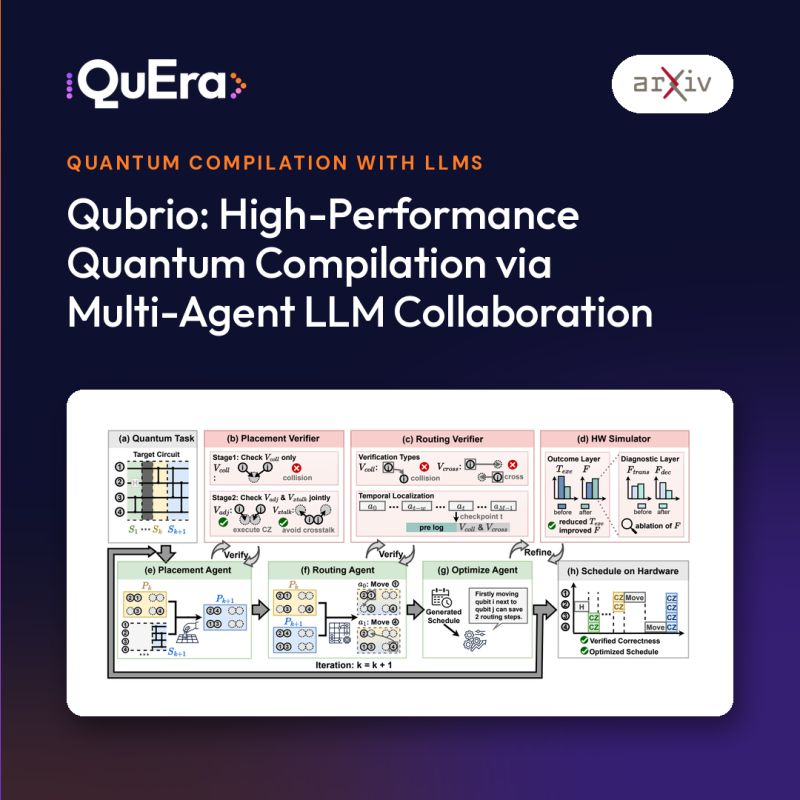
Researchers from UC San Diego, Rice, QuEra Computing, RIT, and UW‑Madison have released Qubrio, a multi‑agent large‑language‑model (LLM) framework designed to compile quantum circuits for neutral‑atom hardware. Accepted to NeurIPS 2026, the system replaces hand‑crafted heuristics with specialized LLM agents that propose placement, routing, and scheduling strategies, which are then vetted by deterministic constraint checkers and a hardware simulator.
How Qubrio Works
- Agent‑Based Proposal – Separate LLMs generate suggestions for qubit placement, acousto‑optic deflector (AOD) routing, and schedule refinement.
- Constraint Verification – Deterministic verifiers ensure each proposal respects hardware limits such as laser power, crosstalk, and movement speed.
- Physical Simulation – A fast simulator evaluates the impact of each candidate on execution time and circuit fidelity.
- Three‑Level Decomposition – Circuits are broken into CZ‑gate stages, spatial placement, and temporal routing, allowing the system to recover from single‑pass failures.
Reported Performance Gains
| Benchmark | Qubrio vs. PowerMove (baseline) | Fidelity Gain | |-----------|--------------------------------|---------------| | QFT, QAOA, GHZ, Ising (up to 78 qubits) | 4.7× average runtime reduction (5.9× at ~60 qubits) | 1.3× average (9.9× for QFT‑63) | | Convoy‑style shuttling (GHZ‑78) | Packs up to 30.3 qubits per AOD move | – | | Zoned‑array QFT‑63 | 2,263× fidelity improvement after adaptation | – |
The authors also compared three LLM backbones (GPT‑5.4, DeepSeek‑V3.2, Qwen‑3.5). GPT‑5.4 delivered the strongest speedup (4.7×) at an API cost of roughly $0.29–$0.59 per compilation stage. By distilling the discovered heuristics into the existing PowerMove compiler, they recovered about 38 % of the runtime savings, demonstrating that the LLM insights are transferable.
Practical Implications
- Hardware‑Agnostic Adaptability – Qubrio can re‑configure itself for different neutral‑atom layouts (single‑AOD, multi‑AOD, zoned arrays) without rewriting code.
- Rapid Turn‑around – Full compilation of a 78‑qubit workload completes in roughly five minutes, suitable for batch processing in research labs.
- Open‑Source Availability – The codebase and the accompanying arXiv paper are publicly released, enabling the community to benchmark and extend the approach.
Looking Ahead
If the reported speedups hold across a broader set of algorithms and larger qubit counts, Qubrio could become a standard tool for neutral‑atom platforms, reducing the engineering overhead that currently limits rapid experimentation. Future work will likely explore tighter integration with error‑mitigation pipelines and scaling to the next generation of neutral‑atom processors that target thousands of physical qubits.
--- The article is based on the press release and the linked arXiv preprint; no external replication has been reported yet.
Hype check
RealThe headline accurately reflects a new compiler framework with reported speedup and fidelity gains, backed by an arXiv preprint.
- Peer-reviewed paper, or press release only?Paper — arXiv preprint linked in the input
- Error-corrected (logical) qubits, or physical qubits only?Logical / not a qubit claim — claim is about compilation, not qubit counts
- A new milestone, or a rebrand / restatement?New — introduces a novel multi‑agent LLM compiler with performance data
- Independent confirmation?Not yet — no external validation mentioned in the input
- Does the headline claim match what the source shows?Matches — headline matches the described Qubrio introduction
An editorial assessment of the claim as reported, not a judgment of the company or researchers. How we rate hype →
Source
Read original sourceWhy we picked this
Accepted from curated QuantumUnzipped source (relevance scoring disabled).