University of California’s Martinis to discuss qubit scaling
John Martinis will discuss the path from early qubits to scalable quantum computers, highlighting hardware, architecture, and algorithmic challenges.
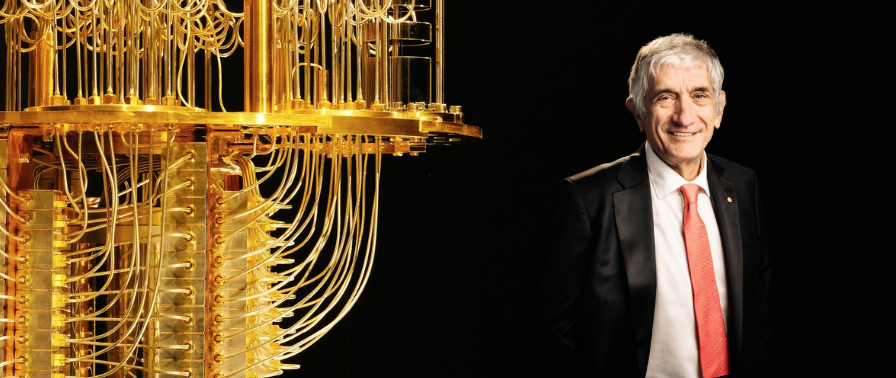
Introduction
John M. Martinis, Nobel laureate for his work on macroscopic quantum behaviour in superconducting circuits, will deliver a public lecture titled “From prehistoric qubits to building a useful quantum computer” at the York Theatre, Seymour Centre on October 25, 2026. Open to anyone who registers, the talk will trace the evolution of superconducting qubits, celebrate the breakthroughs that made them a leading platform, and confront the remaining obstacles to large‑scale, fault‑tolerant quantum machines.
---
From Macroscopic Quantum Tunnelling to Superconducting Qubits
Martinis’ 2025 Nobel Prize recognised the demonstration that quantum tunnelling and discrete energy levels could be observed in electrical circuits large enough to fabricate and control. This insight overturned the prevailing view that quantum effects were confined to atomic‑scale systems and laid the groundwork for today’s superconducting qubits. The lecture will revisit the key experiments—macroscopic quantum tunnelling, energy‑level quantisation, and the first coherent qubit designs—that turned theoretical possibilities into a practical hardware platform.
---
Scaling Challenges: Fabrication, Architecture, and Algorithms
Despite impressive progress, building a useful quantum computer still faces three intertwined hurdles:
- Hardware fabrication – Variability in Josephson junctions, dielectric loss, and crosstalk limit coherence times as qubit counts grow. Martins will discuss how adapting mature semiconductor manufacturing techniques—such as advanced lithography, wafer‑scale integration, and 3‑D packaging—could improve uniformity and yield.
- System architecture – Connecting hundreds or thousands of qubits demands low‑latency control electronics, cryogenic interconnects, and error‑correcting codes that fit within realistic hardware budgets. The talk will outline emerging modular approaches, including quantum interposers and cryogenic processors that co‑locate control logic with the qubits.
- Algorithm development – Even with error‑corrected hardware, useful applications require algorithms that can tolerate residual noise and make efficient use of limited qubit resources. Martins will highlight variational quantum algorithms, hybrid quantum‑classical workflows, and the role of classical machine‑learning tools in calibrating and optimizing noisy devices.
---
The Human Story: From Google to Australia
Martinis’ career mirrors the field’s trajectory. After pioneering superconducting qubits at the University of California, Santa Barbara, he joined Google Quantum AI in 2014, where his team built a 53‑qubit processor that demonstrated quantum supremacy. Leaving Google in 2020, he moved to Australia, contributing to Silicon Quantum Computing and co‑founding Qolab, where he now serves as CTO. This cross‑continental experience informs his perspective on how academic research, industry development, and government investment can synergise to accelerate scaling.
---
Why the Lecture Matters
The event, hosted by Petra Andrén of Quantum Australia and introduced by Professor David Reilly (University of Sydney) and the CEO of Emergence Quantum, offers a rare opportunity for researchers, engineers, and policy makers to hear directly from a leading figure about the practical steps needed to move from laboratory‑scale prototypes to commercial‑grade quantum processors. Attendees will gain:
- A concise historical context for superconducting qubits.
- Insight into concrete engineering pathways for scaling.
- An appreciation of the algorithmic innovations required to exploit larger machines.
---
Closing Thoughts
Martinis’ lecture underscores that quantum computing’s next milestone is not a single breakthrough but a coordinated effort across materials science, device engineering, system architecture, and software. By adapting proven semiconductor practices and leveraging sophisticated error‑correction strategies, the community can bridge the gap between today’s noisy intermediate‑scale quantum devices and the fault‑tolerant machines promised by theory. The talk serves as both a celebration of past achievements and a roadmap for the collaborative work that lies ahead.
Source
Read original sourceWhy we picked this
Accepted from curated QuantumUnzipped source (relevance scoring disabled).