University of Cologne Uncovers Spectroscopic Evidence of Topological Superconductivity in TI Josephson Junctions
University of Cologne’s tunneling spectroscopy of TI Josephson junctions directly observes phase‑controlled gap closing, bolstering the Fu‑Kane route to topological superconductivity without large magnetic fields.
Introduction
A team at the University of Cologne, together with theorists from RWTH Aachen, has reported the first local spectroscopic evidence that a topological insulator (TI) Josephson junction can host a phase‑tuned topological superconducting state. By performing tunneling spectroscopy on exfoliated BiSbTeSe₂ flakes contacted with aluminum, the researchers observed the superconducting gap close and reopen as the superconducting phase difference across the junction was varied, a hallmark of the Fu‑Kane model for Majorana zero‑mode formation.
---
Phase‑controlled gap dynamics in a short‑junction TI device
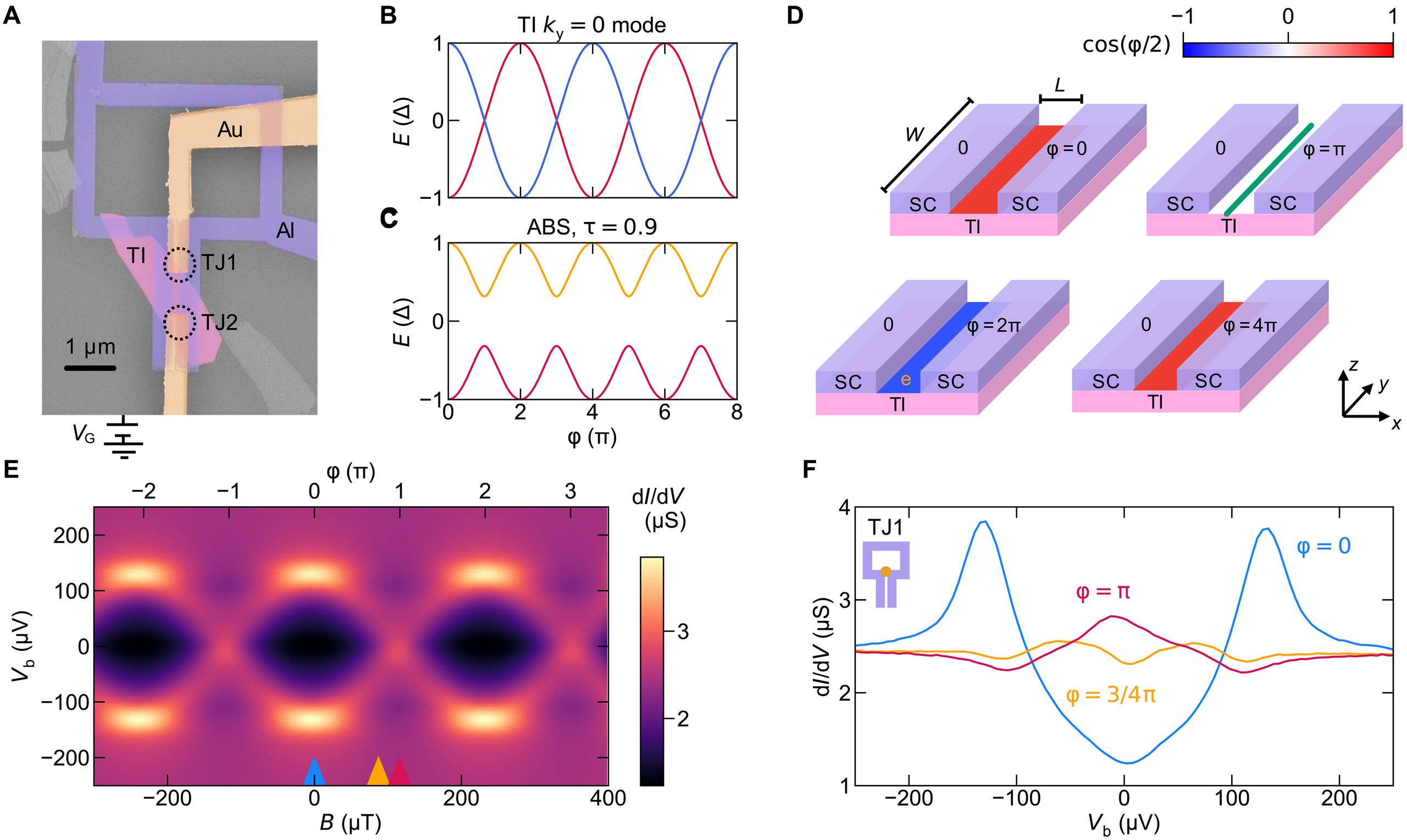
- Device architecture – A 50 nm planar junction was fabricated on a bulk‑insulating 3D TI flake and embedded in an RF‑SQUID loop. Dual Au/Al‑Al₂O₃ tunnel probes measured the local density of states at 50 mK.
- Spectroscopic signature – At zero phase (φ = 0) the induced gap measured ~130 µeV. As the out‑of‑plane flux tuned φ toward π, the coherence peaks merged into a zero‑bias feature, indicating gap closure. Further increase of φ reopened the gap, reproducing the expected 2π‑periodic evolution of Andreev bound states in a topological channel.
- Vortex imaging – In magnetic fields of 5–6 mT, individual Josephson vortices entered the junction. The two tunnel contacts recorded distinct periodicities (≈230 µT vs. 200 µT), confirming that the zero‑energy mode follows the spatial phase gradient associated with vortex cores.
---
Why this matters for topological quantum computing
Traditional platforms—semiconductor nanowires with strong Rashba spin‑orbit coupling—require large in‑plane magnetic fields to break time‑reversal symmetry, which can suppress superconductivity and generate spurious zero‑bias peaks. The Cologne experiment sidesteps this limitation by exploiting the intrinsic spin‑momentum locking of the TI surface state, which naturally forbids back‑scattering for perpendicular trajectories. This yields near‑perfect Andreev transmission (τ ≈ 1) and enables a topological superconducting phase driven solely by the superconducting phase difference, without any destructive Zeeman field.
---
Remaining engineering challenges and next steps
- Energy resolution – The current measurement resolution (~30 µeV) limits the ability to confirm a truly gapless transition; the observed closure sets a lower bound τ ≥ 0.95 rather than a definitive proof of a zero‑energy mode.
- Soft gap – Long quasi‑classical trajectories produce a partially proximitized “soft gap,” which could mask the ideal hard gap needed for robust Majorana modes.
- Materials upgrade – Switching to high‑critical‑field niobium electrodes is proposed to increase the induced gap and improve resilience against magnetic fields.
- Parity detection – Implementing charge‑sensing electrometry would allow direct observation of the expected 4π‑periodic fermion‑parity flip, a smoking‑gun signature of Majorana physics.
---
Outlook
The spectroscopic results provide the first concrete, phase‑resolved validation of the Fu‑Kane proposal in a planar TI Josephson junction. By demonstrating controllable gap closing and reopening, the work opens a realistic pathway toward braiding experiments that rely on phase engineering rather than strong magnetic fields. Continued improvements in device materials, measurement precision, and parity‑sensitive readout will be essential to translate these findings into functional topological qubits.
---
The study appears in Science Advances and is part of the Matter and Light for Quantum Computing (ML4Q) Cluster of Excellence at the University of Cologne.
Source
Read original sourceWhy we picked this
Accepted from curated QuantumUnzipped source (relevance scoring disabled).