University of Innsbruck, ParityQC, and QuEra Turn Rydberg Array Embeddings into Intrinsic Error-Correcting Codes
Innsbruck, ParityQC, and QuEra show that auxiliary qubits in Rydberg arrays can form an intrinsic error‑correcting code with high thresholds.
Intrinsic Error‑Correction in Rydberg Atom Arrays
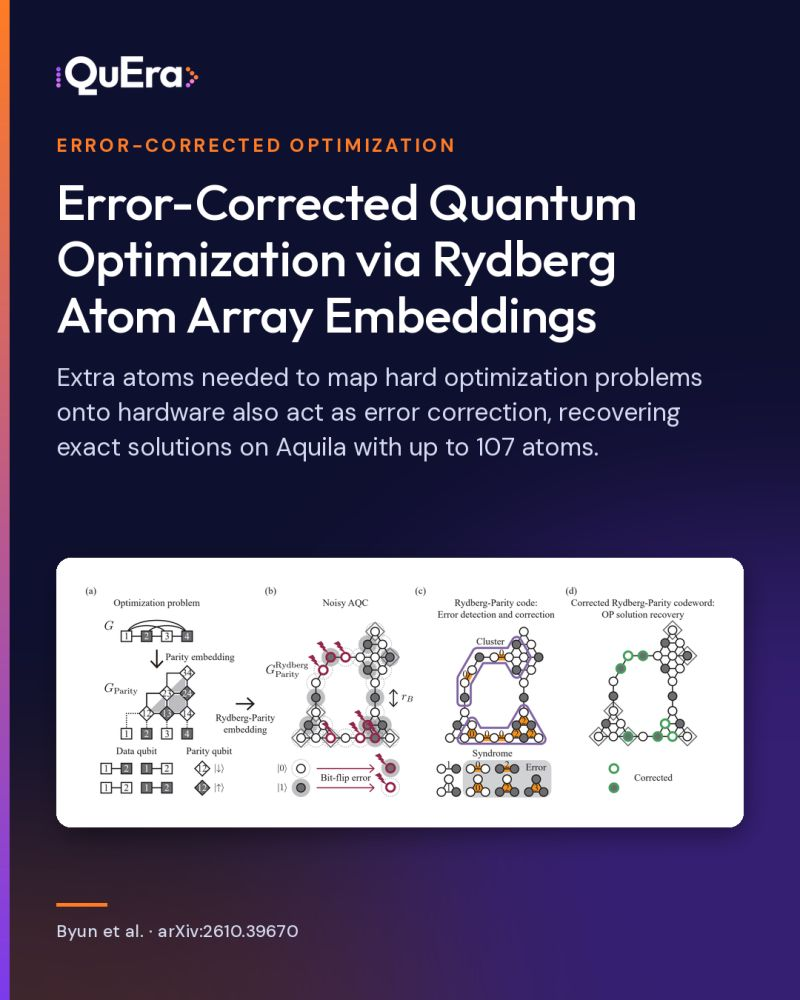
Researchers from the University of Innsbruck, Parity Quantum Computing (ParityQC), and QuEra Computing have unveiled a novel way to turn the extra qubits needed for embedding combinatorial optimization problems on neutral‑atom processors into a built‑in classical error‑correcting code. The work focuses on the so‑called Rydberg‑Parity embedding, where problem constraints are mapped onto Rydberg‑blockade gadgets that naturally enforce a single‑excitation rule.
From Embedding to Code
In a typical embedding, auxiliary qubits enforce logical constraints but are otherwise idle. The team observed that the LINK and 3‑BODY gadgets decompose into overlapping dimer and trimer superatoms. Because each superatom can host at most one Rydberg excitation, counting excitations directly yields a syndrome for errors. This “number‑check” syndrome is intrinsically nonlinear, meaning standard linear decoders cannot be applied.
The Cluster Decoder
To handle the nonlinear syndrome, the authors designed an iterative Cluster decoder. The decoder groups violated superatoms into local clusters, resolves each cluster’s configuration via a lookup table that respects frozen boundary atoms, and then merges unresolved clusters dynamically. This approach allows the decoder to operate purely on measurement outcomes—no extra hardware or ancilla qubits are required.
Reported Thresholds
Under an independent bit‑flip noise model, the combined Rydberg‑Parity code and Cluster decoder achieve impressive error‑correction thresholds:
- 27.5 % on complete graphs
- 26.3 % on bipartite graphs
- 23.5 % on crossing‑lattice embeddings
- 24.1 % on 3‑D quantum‑wire embeddings
These thresholds indicate the fraction of faulty qubits the decoder can tolerate before the logical error rate exceeds the physical error rate.
Experimental Validation on Aquila
The researchers tested the scheme on QuEra’s Aquila neutral‑atom processor, running adiabatic optimization for QUBO instances up to 107 atoms. For the largest bipartite layout, the Cluster decoder recovered exact optimal solutions with an average success rate above 8 %, whereas raw hardware readouts and the standard GreedyMIS post‑processing returned zero valid solutions. This demonstrates a clear practical advantage of the intrinsic code.
Implications and Next Steps
Turning embedding overhead into a useful error‑correcting resource could simplify the architecture of future neutral‑atom quantum computers. By avoiding dedicated syndrome‑extraction hardware, the approach may lower the engineering barrier for scaling up to thousands of atoms, as seen in recent neutral‑atom platforms. Future work will need to explore robustness under more realistic noise (e.g., correlated dephasing) and to integrate the decoder into real‑time control loops.
---
The full pre‑print is available on arXiv (link provided in the original report). The findings represent a promising step toward practical error mitigation on neutral‑atom quantum processors.
Hype check
PartlyThe paper reports new error‑correction thresholds on a neutral‑atom platform, but it is only a pre‑print and lacks independent verification.
- Peer-reviewed paper, or press release only?Press release only — Only a press release and arXiv pre‑print are mentioned.
- Error-corrected (logical) qubits, or physical qubits only?Logical / not a qubit claim — The story is not a qubit‑count claim.
- A new milestone, or a rebrand / restatement?New — Introduces intrinsic error‑correcting code with high thresholds.
- Independent confirmation?Unclear — No external replication or third‑party confirmation cited.
- Does the headline claim match what the source shows?Matches — Headline accurately reflects the reported intrinsic code result.
An editorial assessment of the claim as reported, not a judgment of the company or researchers. How we rate hype →
Source
Read original sourceWhy we picked this
Accepted from curated QuantumUnzipped source (relevance scoring disabled).