University of Osaka Integrates Domestic Superconducting Quantum Processors with OCTOPUS Supercomputer via SEAFOOD Platform
Osaka University has linked its home‑grown superconducting quantum processors to the OCTOPUS supercomputer using the new SEAFOOD hybrid platform.
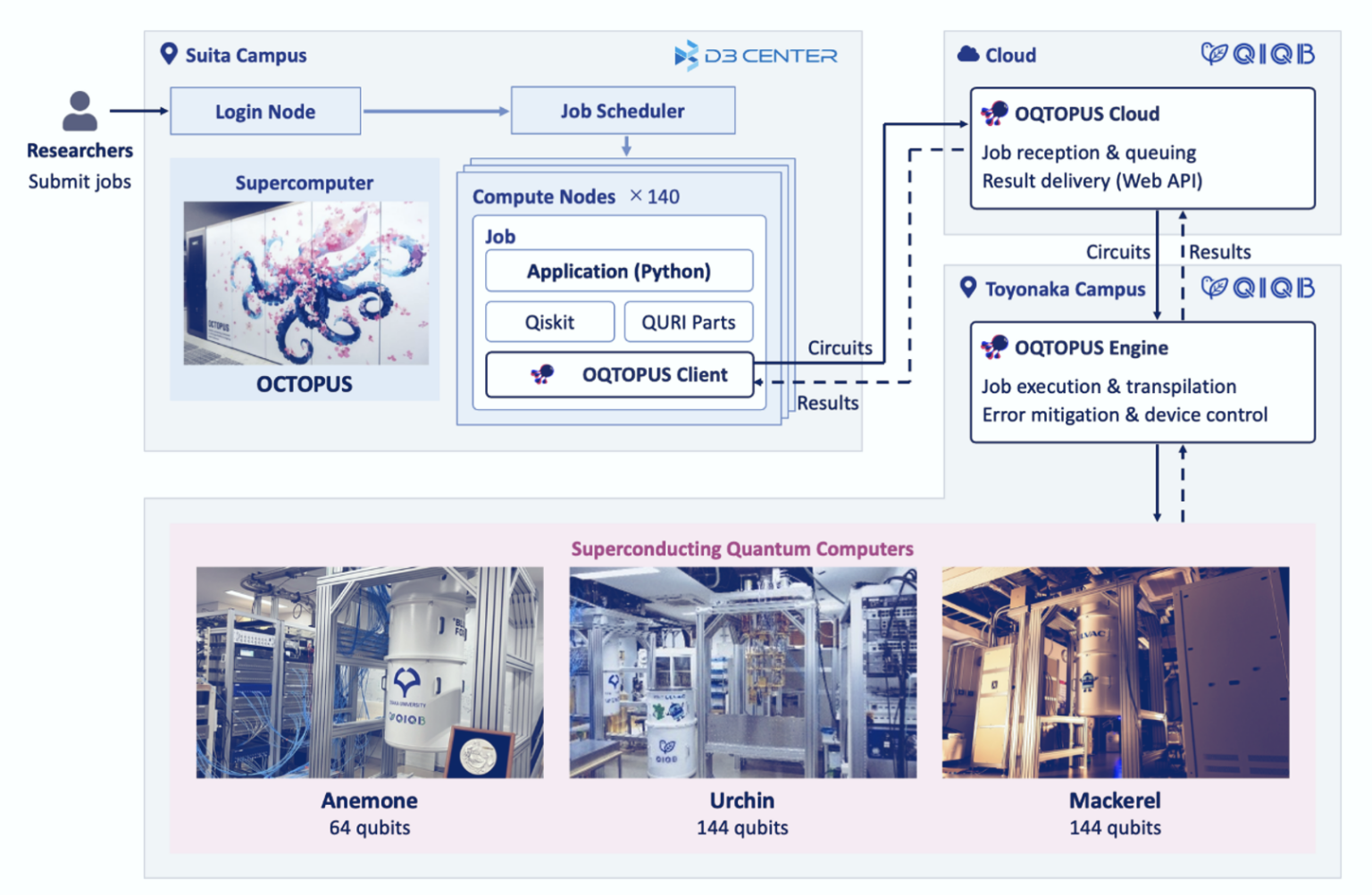
Osaka University launches SEAFOOD: a hybrid quantum‑classical computing stack
University of Osaka’s D3 Center and the Center for Quantum Information and Quantum Biology (QIQB) announced the SEAFOOD platform – a middleware‑driven bridge that couples the campus‑scale OCTOPUS supercomputer (2.293 PFLOPS) with domestically fabricated superconducting quantum processors located on a separate campus. The integration, slated for formal operation in December 2026, marks Japan’s first on‑site pairing of a home‑grown quantum processor with an academic high‑performance computing (HPC) system.
Architecture and workflow
SEAFOOD (Supercomputing Entangled by Ambitious Fusion of OQTOPUS and OCTOPUS at D3C) is organized into three layers:
- Classical HPC layer – OCTOPUS runs batch jobs written in Qiskit, QURI‑Parts, and the `oqtopus-client`. It handles large‑scale linear‑algebra tasks such as matrix diagonalization.
- Quantum execution layer – QIQB’s superconducting QPUs, supplied by RIKEN Center for Quantum Computing (including the “Urchin” chip), perform circuit transpilation, pulse‑level control, and readout.
- Middleware & API layer – The open‑source OQTOPUS stack, co‑developed with Fujitsu, SEC, and TISI, routes quantum circuit jobs and bit‑string results between the HPC nodes and the QPUs, providing a unified job‑scheduling interface.
Demonstration: Quantum‑Selected Configuration Interaction (QSCI)
The first proof‑of‑concept run used the quantum processor to sample dominant electron configurations of a four‑hydrogen (H₄) molecule. After 1,000 measurement shots on the Urchin chip, the quantum‑derived subspace Hamiltonian was handed to OCTOPUS, which constructed and diagonalized it classically. The resulting ground‑state energy (‑2.1147334880 Hartree) matched the reference CASCI calculation, illustrating how SEAFOOD can off‑load the most quantum‑intensive sub‑tasks while leveraging the supercomputer’s massive memory and compute bandwidth for the remaining linear‑algebra workload.
Outlook and access program
In fiscal year 2027, up to ten research teams at Osaka University will receive trial access through a proposal‑based program managed by the D3 Center. The goal is to refine hybrid job‑scheduling policies and prepare for broader external use under Japan’s nationwide JHPC‑quantum initiative. Funding comes from multiple national programs, including JST Moonshot Goal 6, MEXT Q‑LEAP, and NEDO’s Post‑5G quantum‑supercomputer hybrid platform.
Why the integration matters
Hybrid quantum‑classical workflows are widely recognized as the most practical path to useful quantum advantage in the near term. By tightly coupling a high‑performance classical engine with a low‑noise superconducting processor, Osaka University provides a testbed for algorithms that require iterative quantum sampling and classical post‑processing—such as quantum chemistry, materials design, and optimization problems. The open‑source OQTOPUS stack also lowers the barrier for other institutions to adopt similar architectures.
---
The SEAFOOD platform showcases a concrete step toward scalable quantum‑HPC ecosystems, offering researchers a ready‑made environment to explore hybrid algorithms while the underlying hardware continues to mature.
Hype check
RealThe article documents a concrete integration of a superconducting QPU with an HPC system and a benchmarked chemistry demo, backed by a Physical Review Research paper.
- Peer-reviewed paper, or press release only?Paper — Methodology published in Physical Review Research
- Error-corrected (logical) qubits, or physical qubits only?Logical / not a qubit claim — Claim does not involve qubit‑count metrics
- A new milestone, or a rebrand / restatement?New — First Japanese university‑level quantum‑HPC integration
- Independent confirmation?Not yet — No external verification mentioned
- Does the headline claim match what the source shows?Matches — Headline accurately reflects the integration described
An editorial assessment of the claim as reported, not a judgment of the company or researchers. How we rate hype →
Source
Read original sourceWhy we picked this
Accepted from curated QuantumUnzipped source (relevance scoring disabled).