University of Stuttgart Deploys Quantum Dot QKD Link Using Frequency Conversion Over Campus Fiber
Stuttgart’s campus‑scale QKD test shows that quantum‑dot photon sources combined with frequency conversion can reliably deliver entanglement‑based keys over standard telecom fiber.
Introduction
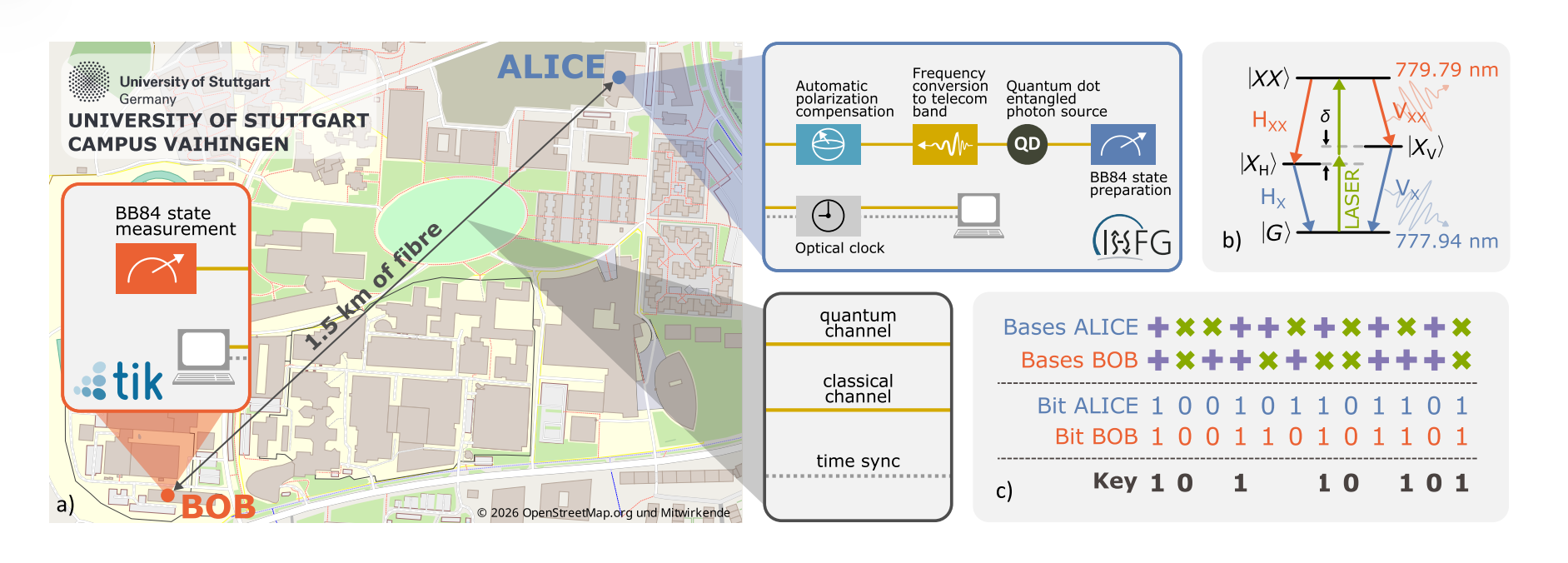
A collaborative team led by the University of Stuttgart has demonstrated a field‑deployed, entanglement‑based quantum key distribution (QKD) link that uses an epitaxial quantum‑dot photon source together with a broadband frequency‑conversion stage. Operating on a 1.59 km campus fiber at a 1 GHz excitation rate, the system produced 14.2 Mbit of secure key material and successfully encrypted an image with a one‑time pad. The experiment provides a concrete proof‑of‑concept that deterministic quantum‑dot emitters, once shifted into the telecom C‑band, can serve as practical transmitters for metropolitan quantum networks.
From Quantum Dot to Telecom Wavelength
The core emitter is a droplet‑etched GaAs quantum dot that emits polarization‑entangled photon pairs at 779.8 nm via the biexciton‑exciton (XX–X) cascade. A fine‑structure splitting of 2.1 ± 0.3 µeV yields a Bell‑state fidelity of 91.4 % within a 275 ps coincidence window. Because this wavelength suffers high loss in standard silica fiber, the team employed a Sagnac interferometer‑based quantum‑frequency converter (QFC) to shift one photon of each pair to 1515 nm, the low‑loss C‑band. The converter achieved up to 50 % internal efficiency while preserving the polarization state, a critical requirement for entanglement‑based protocols.
Network Architecture and Performance
The converted photons traveled through a 1.59 km installed fiber link on the Stuttgart‑Vaihingen campus, incurring only 1.09 dB total loss. At the receiver, a 19‑inch rack housed automated motorized waveplates that performed continuous polarization tracking, keeping Stokes parameters above 0.995 over 19 hours of operation. The BBM92 protocol was implemented with passive 50:50 beam splitters to select the Z and X measurement bases, and a multi‑photon squashing model mitigated side‑channel risks.
Key performance figures include:
- Raw detection rate: 504 Hz
- Secure key rate: 206 Hz (after error correction and privacy amplification)
- Quantum bit error rate (QBER): 4.70 % (well under the 11 % BBM92 security threshold)
- Error‑correction retention: 40.87 % using 5,000‑bit LDPC blocks and Toeplitz hashing
The system generated 14.2 Mbit of secure key material, which was used to encrypt a test image via a one‑time pad, demonstrating end‑to‑end confidentiality.
Significance for Metropolitan Quantum Networks
Most deployed QKD networks rely on Poisson‑distributed sources such as heavily attenuated lasers or spontaneous parametric down‑conversion (SPDC). These sources trade brightness for low multi‑photon probabilities, limiting key rates and increasing vulnerability to photon‑number‑splitting attacks. In contrast, epitaxial quantum dots emit deterministic, sub‑Poissonian photon streams, offering higher brightness without the multi‑photon penalty.
The Stuttgart experiment shows that the native wavelength limitation of quantum dots can be overcome with efficient, polarization‑preserving frequency conversion. By integrating the converter directly with the quantum‑dot antenna, the team maintained high entanglement fidelity while exploiting the low‑loss telecom window. The successful deployment over a real‑world campus fiber link, complete with automated polarization stabilization, demonstrates that quantum‑dot‑based transmitters are ready for integration into larger metropolitan quantum‑key networks.
Practical Outlook
Future work will likely focus on scaling the link length, improving conversion efficiency beyond the current 50 %, and integrating on‑chip frequency converters to reduce system footprint. Combining deterministic emitters with advanced error‑correction codes could push secure key rates into the megabit‑per‑second regime, making quantum‑dot QKD a competitive alternative to laser‑based systems for city‑wide secure communications.
--- The results are described in a preprint titled “Deployed entanglement‑based BBM92 quantum key distribution using frequency‑converted photons emitted by a quantum dot.”
Source
Read original sourceWhy we picked this
Accepted from curated QuantumUnzipped source (relevance scoring disabled).