Unusual magnetism revealed in a simple metal's electron spins
Researchers have experimentally demonstrated p‑wave magnetism in the simple metallic compound EuSi, revealing a novel spin‑momentum coupling.
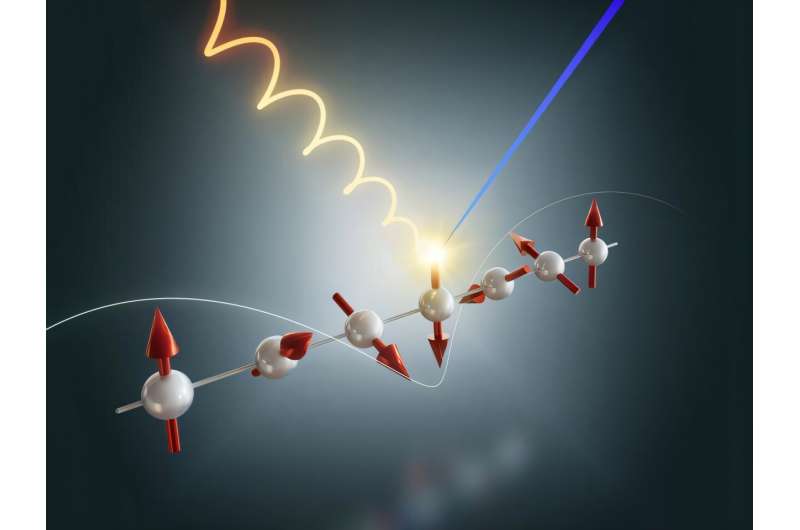
Unusual Magnetism in a Simple Metal
A collaborative team led by Dr. Erjian Cheng at the Max Planck Institute for Chemical Physics of Solids has provided the first experimental evidence for p‑wave magnetism in europium silicide (EuSi), a chemically simple metallic crystal. Published in Nature (2026), the work combines crystal growth, neutron diffraction, angle‑resolved photoemission spectroscopy (ARPES), and spin‑resolved photoemission to show that EuSi hosts a spiral magnetic order that produces an odd‑parity spin texture—electrons moving in opposite directions carry opposite spin polarizations.
---
A Spiral Without Net Magnetization
Between roughly 33 K and 62 K the Eu atoms in EuSi arrange in an ordered spiral. Although each atom carries a sizable magnetic moment, the spiral geometry cancels the net magnetization, yielding a phase with no overall magnetic field. Despite this, the electronic band structure is dramatically reshaped: ARPES reveals energy splittings exceeding 100 meV that are directly tied to the magnetic order. The key signature of p‑wave magnetism appears in spin‑resolved photoemission, where the spin polarization flips sign across successive magnetic Brillouin zones and vanishes where the predicted p‑wave texture goes to zero.
---
Linking Chirality and Electronic Structure
The spiral order can adopt two opposite handednesses (chirality). Using magnetic force microscopy and spatially resolved photoemission with circularly polarized light, the team mapped magnetic domains about 10 µm wide. Each domain’s handedness correlates with distinct electronic responses, confirming that magnetic chirality directly controls the electronic spin texture. This coupling opens a pathway to manipulate electronic properties via domain engineering, a prospect that could be valuable for spintronic devices.
---
Why EuSi Matters
Finding a material that cleanly exhibits p‑wave magnetism has been a major challenge. Prior candidates were either insulating, required ultra‑low ordering temperatures, or suffered from complex crystal symmetries. EuSi offers several practical advantages:
- Stoichiometric metallic composition – easy to synthesize and handle.
- High‑quality single crystals – grown reproducibly at MPI CPfS.
- Robust spiral phase – stable over a convenient temperature window.
These traits make EuSi an attractive platform for testing theoretical predictions such as spin‑polarized transport without external fields, strong current‑induced spin torques, and the emergence of unconventional superconductivity.
---
Outlook
The discovery expands the toolbox of quantum materials by showing that magnetic symmetry and chirality can generate exotic electronic spin structures even in simple metals. Future work will likely explore transport measurements, domain‑controlled device concepts, and the interplay between the p‑wave magnetic order and possible superconducting phases. As experimental techniques continue to improve, EuSi could become a benchmark system for studying how unconventional magnetism influences electronic functionality.
---
The findings were reported by Erjian Cheng et al., “Evidence for p‑wave magnetism in electronic band structure of metallic EuSi,” Nature (2026).
Hype check
RealThe headline accurately reflects a peer‑reviewed Nature paper that presents experimental evidence for p‑wave magnetism; the claim is well supported by multiple techniques.
- Peer-reviewed paper, or press release only?Paper — Published in Nature, a peer‑reviewed journal
- Error-corrected (logical) qubits, or physical qubits only?Logical / not a qubit claim — Not a qubit‑count claim
- A new milestone, or a rebrand / restatement?New — First experimental demonstration of p‑wave magnetism in EuSi
- Independent confirmation?Not yet — No external replication mentioned in the input
- Does the headline claim match what the source shows?Matches — Headline matches the reported discovery
An editorial assessment of the claim as reported, not a judgment of the company or researchers. Checked against: phys.org. How we rate hype →
Source
Read original sourceWhy we picked this
Accepted from curated QuantumUnzipped source (relevance scoring disabled).