Upgraded microscope can now watch individual quantum particles in motion
Columbia’s upgraded stroboSCAT microscope can now resolve individual quantum particles moving through materials.
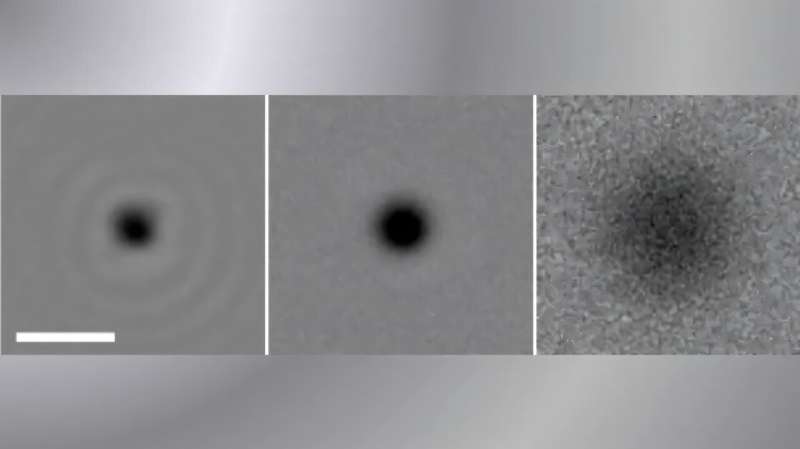
Watching Quantum Particles One by One
A new version of the stroboSCAT microscope, developed by Milan Delor’s lab at Columbia University, can finally image single quantum energy carriers—electrons, excitons, magnons and other quasiparticles—as they travel through a material. The breakthrough, reported in Nature Materials, comes from an intensity‑cycling technique that dramatically improves signal‑to‑noise, allowing researchers to isolate the motion of individual particles that were previously lost in collective background signals.
From Bulk Transport to Single‑Particle Precision
Traditional transport measurements give only averaged information about many carriers, while earlier stroboSCAT images could resolve ensembles at high density. By cycling the intensity of the stroboscopic light pulses, the team creates a sparse population of excitations and then tracks each one with nanometer spatial and femtosecond temporal resolution. This “intensity‑cycling” approach lets the microscope separate the trajectory of a single electron in a two‑dimensional semiconductor from the surrounding sea of carriers.
Multi‑Particle Dynamics Made Visible
Beyond single electrons, the upgraded system can follow two‑ and three‑particle states. The authors demonstrated:
- Direct observation of exciton‑exciton interactions in a van der Waals semiconductor.
- Mapping of how crystal defects locally modify the electronic landscape.
- Real‑time monitoring of a light‑induced phase transition in a super‑atomic solid.
These capabilities open a path to routine measurements of many‑body effects without the ambiguities that arise from ensemble averaging.
Impact and Outlook
The authors are releasing the instrument’s blueprints and analysis software, encouraging other groups to adopt the technique. Potential applications include probing the formation of Cooper pairs in superconductors, studying condensates of quasiparticles, and exploring transport in emerging quantum materials. By turning a previously bulk‑only probe into a single‑particle microscope, stroboSCAT promises to become a standard tool for condensed‑matter and quantum‑physics laboratories.
---
The article is based on the authors’ Nature Materials paper (Delor et al., 2026) and associated press release.
Hype check
RealThe paper in Nature Materials provides concrete experimental data showing single‑particle resolution, backed by peer‑reviewed evidence; no external replication is cited but the claim matches the reported results.
- Peer-reviewed paper, or press release only?Paper — Nature Materials paper cited in the brief
- Error-corrected (logical) qubits, or physical qubits only?Logical / not a qubit claim — Not a qubit‑count claim
- A new milestone, or a rebrand / restatement?New — First demonstration of single‑particle stroboSCAT imaging
- Independent confirmation?Not yet — No outside confirmation mentioned
- Does the headline claim match what the source shows?Matches — Headline accurately reflects the paper’s findings
An editorial assessment of the claim as reported, not a judgment of the company or researchers. Checked against: phys.org. How we rate hype →
Source
Read original sourceWhy we picked this
Accepted from curated QuantumUnzipped source (relevance scoring disabled).