Using a microwave link to transfer a three-level quantum state
Researchers demonstrated the transfer of a three‑level quantum state (qutrit) between superconducting chips via a one‑meter microwave link with ≈ 84% fidelity.
Microwave‑Link Transfer of a Superconducting Qutrit
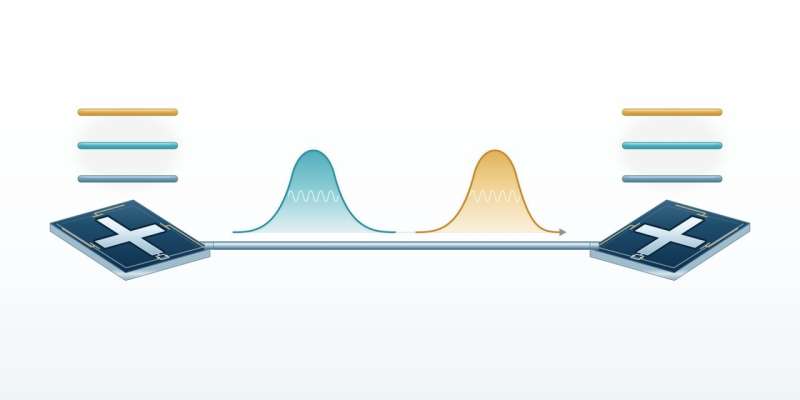
A team led by Xiang Li at the Chinese Academy of Sciences has shown that a quantum state encoded in three energy levels—known as a qutrit—can be moved between two separate superconducting processors using a simple one‑meter microwave cable. The experiment, reported in Physical Review Letters (2026), marks the first demonstration of high‑dimensional quantum communication over a microwave link and opens a path toward richer quantum‑network architectures.
From Qubits to Qutrits
Superconducting transmons naturally possess multiple excited states beyond the usual two‑level qubit. By deliberately using the three lowest levels, the researchers created artificial atoms that store information in a three‑dimensional Hilbert space. This extra dimension can increase the information capacity of each carrier photon and enable more robust entanglement structures.
The Experimental Set‑up
Two packaged transmon chips were placed at opposite ends of a coaxial cable about one metre long. Each node contained:
- a transmon qutrit,
- a resonator for photon exchange, and
- a tunable Purcell‑filter interface to shape the emitted microwave pulses.
Control pulses mapped the qutrit state onto a superposition of three time‑bin photon modes (vacuum, early‑bin, late‑bin). Matching capture pulses at the remote node reconverted the photon back into a qutrit state. By preparing a set of known input states and performing qutrit quantum process tomography, the team quantified how faithfully the link transmitted the information.
Performance Metrics
After correcting for independently calibrated readout errors, the experiment achieved:
- Mean qutrit‑transfer fidelity: 83.68 %
- Remote entangled‑state fidelity: 81.21 %
Both figures surpass the best classical strategies and the corresponding qubit benchmarks, demonstrating that the three‑level encoding provides a genuine advantage over binary encoding for this link.
Implications for Quantum Networks
The ability to move high‑dimensional states through microwave hardware suggests several future directions:
- Scalable quantum‑internet nodes that exploit qutrits or higher‑dimensional qudits to increase channel capacity without adding more physical links.
- Hybrid protocols that combine time‑bin and photon‑number encoding, potentially improving resilience against loss and noise.
- Multiplexing strategies such as time‑division or frequency‑division to pack multiple logical channels onto a single microwave waveguide.
The authors note ongoing work on transferring states through a heated microwave channel, which could further test the robustness of high‑dimensional links under realistic conditions.
Looking Ahead
While the result is a clear experimental milestone, broader adoption will require independent replication and integration with larger‑scale superconducting processors. Nonetheless, this study provides a concrete proof‑of‑concept that high‑dimensional quantum information can be distributed using existing microwave technology, a step that may accelerate the development of more capable quantum communication networks.
--- For the full paper, see Xiang Li et al., “Superconducting Qutrit Link beyond the Qubit Limit,” Phys. Rev. Lett. (2026).
Hype check
RealThe paper presents a peer‑reviewed experimental demonstration with clear fidelity numbers, directly supporting the headline claim of transferring a three‑level state.
- Peer-reviewed paper, or press release only?Paper — Published in Physical Review Letters (2026)
- Error-corrected (logical) qubits, or physical qubits only?Logical / not a qubit claim — Claim is about qutrit transfer, not qubit count
- A new milestone, or a rebrand / restatement?New — First demonstration of qutrit transfer over microwave link
- Independent confirmation?Not yet — No external replication mentioned in the input
- Does the headline claim match what the source shows?Matches — Headline accurately describes the reported experiment
An editorial assessment of the claim as reported, not a judgment of the company or researchers. Checked against: phys.org. How we rate hype →
Source
Read original sourceWhy we picked this
Accepted from curated QuantumUnzipped source (relevance scoring disabled).