Variational Perturbation Theory in Open Quantum Systems for Efficient Steady State Computation
Variational perturbation theory and clever numerical tricks let researchers compute steady states of open quantum systems across many parameters without costly pseudo‑inverses.
Introduction
Open quantum systems—those that exchange energy or information with an environment—are at the heart of modern quantum technologies, from superconducting circuits to photonic lattices. A central task is to determine the system's steady state, the long‑time solution of the Lindblad master equation, because it encodes observable properties such as photon statistics, transport coefficients, and phase‑transition signatures. While a single steady‑state calculation is already demanding for many‑body models, practical investigations often require scanning a multidimensional parameter space (drive strength, detuning, dissipation rates, etc.). Naïvely repeating the full calculation for each parameter set quickly becomes intractable.
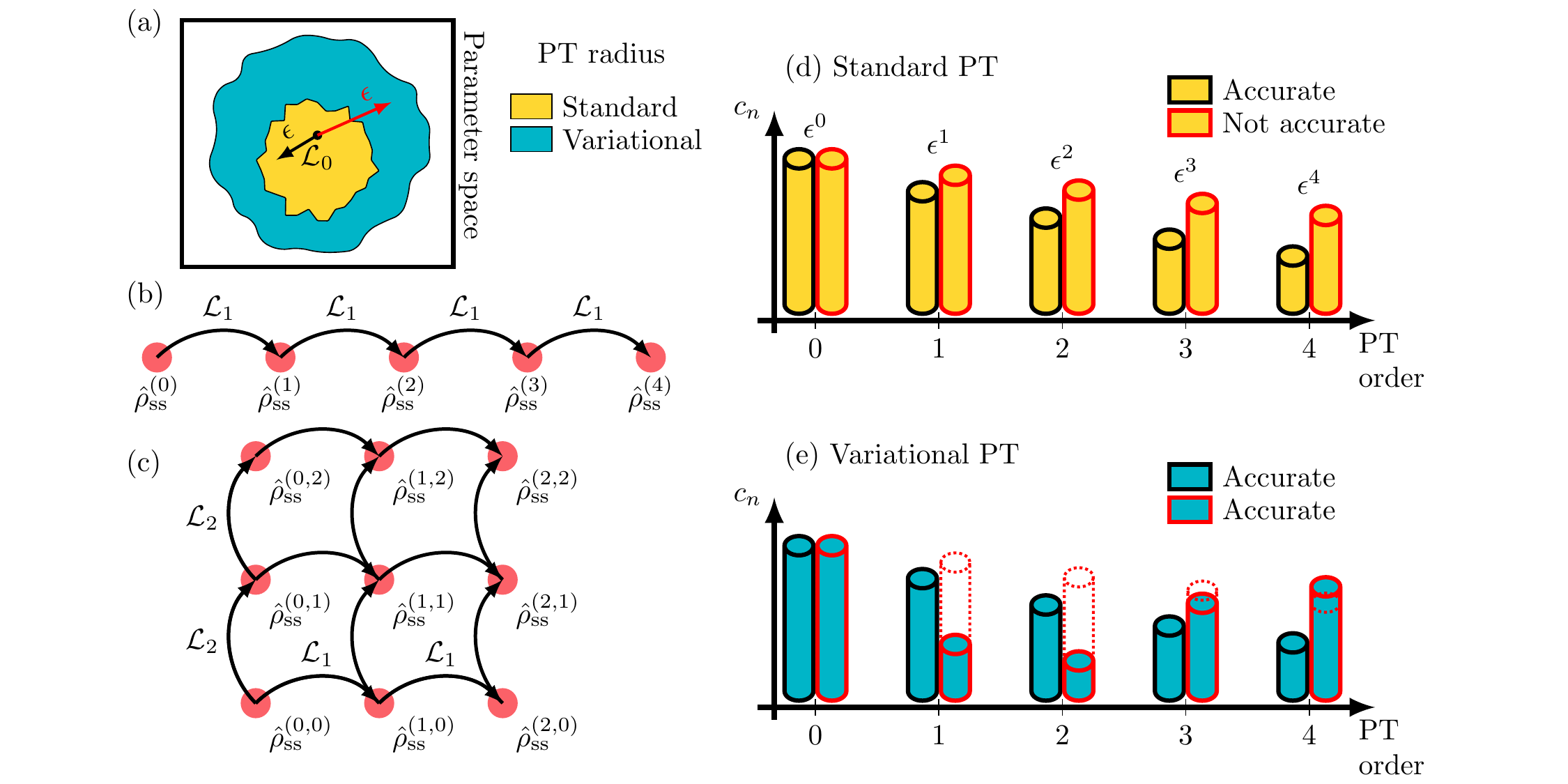
Traditional perturbation theory (PT) offers a partial remedy by expanding the steady state around a reference point, but two obstacles limit its usefulness: the need for a pseudo‑inverse of the Liouvillian (an expensive operation that scales poorly with system size) and a narrow radius of convergence that fails near non‑analytic features such as dissipative phase transitions. Recent work introduces variational perturbation theory (VPT) and two complementary numerical strategies that overcome both hurdles, enabling efficient, accurate steady‑state computation across broad parameter regimes.
---
Variational Perturbation Theory and Multipoint Generalization
VPT reformulates the perturbative expansion as a variational problem. Instead of solving a linear system involving the Liouvillian pseudo‑inverse, one minimizes a functional that measures the deviation of a trial density matrix from satisfying the steady‑state condition. This approach inherits the systematic improvability of PT while dramatically extending the convergence radius. The key insight is that the variational parameters can be tuned to capture non‑analytic behavior, allowing the series to remain accurate even when the underlying physics undergoes a dissipative phase transition.
The multipoint VPT further enhances flexibility by constructing a single expansion that interpolates between several reference points. By stitching together local expansions around a set of strategically chosen parameter values, the method yields a global approximation that remains reliable throughout the entire domain of interest. This is especially valuable for mapping phase diagrams, where abrupt changes in the steady state would otherwise require many separate PT calculations.
---
Numerical Strategies that Avoid Pseudo‑Inverses
Two practical algorithms translate the VPT formalism into scalable computations:
- Single LU Decomposition – The Liouvillian matrix is factorized once using an LU decomposition. Subsequent VPT corrections are obtained by forward‑backward substitution, which is orders of magnitude cheaper than recomputing a pseudo‑inverse for each parameter set. The method works best when the Liouvillian is well‑conditioned within the convergence region of the VPT series.
- Krylov‑Space Recycling with Preconditioned Iteration – Here the VPT problem is cast as a sequence of linear solves that share a common Krylov subspace. By reusing the subspace across parameter points and applying an appropriate preconditioner, the algorithm converges rapidly with only a few matrix‑vector products per step. This approach is particularly suited to large many‑body systems where direct LU factorization would be prohibitive.
Both strategies preserve the systematic error control of VPT while delivering substantial speed‑ups compared with standard PT. Benchmarks on driven‑dissipative Kerr resonators, Bose‑Hubbard lattices, and spin‑model arrays show reductions in wall‑time by factors of 10–100, with errors remaining well below the intrinsic model uncertainties.
---
Practical Implications and Outlook
The combination of VPT and pseudo‑inverse‑free solvers opens new avenues for exploring open‑quantum‑system physics:
- Parameter‑space mapping becomes feasible for high‑dimensional scans, enabling detailed studies of critical phenomena, bistability, and quantum‑optical switching.
- Model‑agnostic applicability: because the methods rely only on the Liouvillian representation, they can be plugged into existing simulation pipelines for cavity QED, circuit QED, cold‑atom platforms, and emerging quantum‑photonic processors.
- Integration with tensor‑network and neural‑network ansätze: VPT can serve as a preconditioner or initial guess for more sophisticated variational representations, potentially accelerating convergence of state‑of‑the‑art many‑body algorithms.
Future work may extend VPT to non‑Markovian environments, incorporate stochastic unravelings, or combine it with adaptive basis‑reduction techniques. As quantum hardware scales up, the ability to compute steady states efficiently across many operating conditions will be essential for device calibration, error mitigation, and the design of robust quantum simulators.
---
Closing Thoughts
Variational perturbation theory reshapes the landscape of steady‑state computation for open quantum systems. By turning a traditionally costly pseudo‑inverse problem into a tractable variational one and by providing robust numerical tools that recycle matrix factorizations, researchers can now explore rich parameter spaces with confidence and speed. This methodological advance not only streamlines existing workflows but also paves the way for deeper investigations into dissipative quantum phase transitions and the engineering of novel quantum devices.
Source
Read original sourceWhy we picked this
Accepted from curated QuantumUnzipped source (relevance scoring disabled).