What Makes Up the Cosmos? A 20-Year Survey Hints That Something Is Missing.
Two decades of Dark Energy Survey data, combined with DESI measurements, reveal cracks in the standard ΛCDM cosmological model.
Dark Energy Survey Wrap‑Up: A New Puzzle for Cosmology
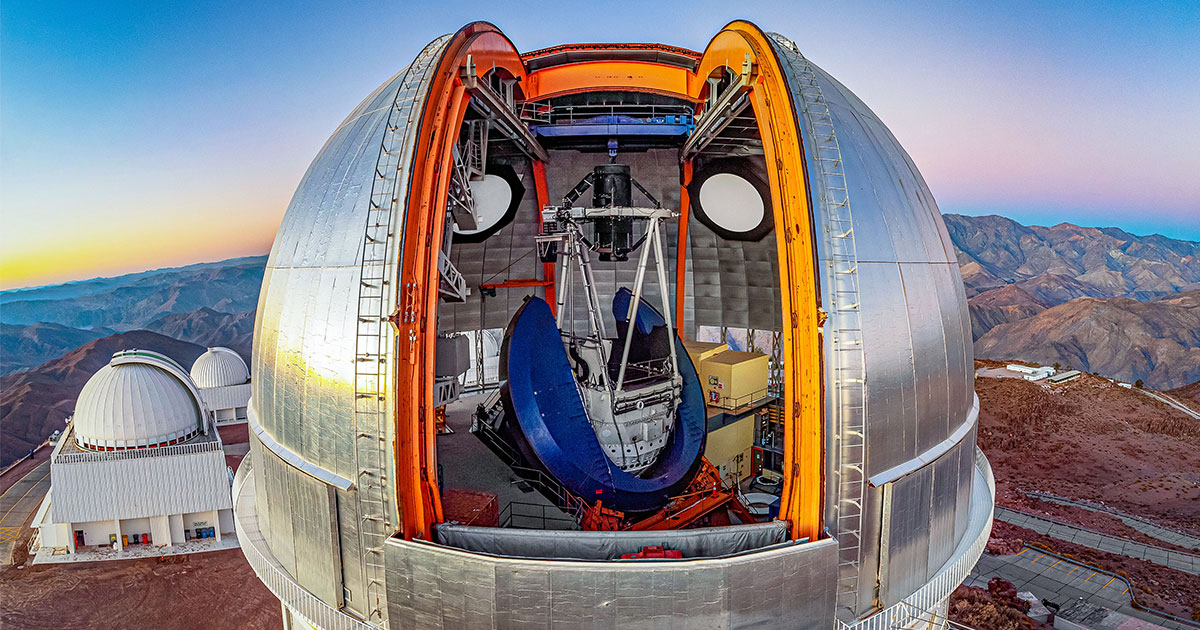
The Dark Energy Survey (DES) has finally released its full‑science results after a 20‑year effort to map the universe with a 570‑megapixel camera on the Blanco telescope in Chile. While the survey confirmed many expectations of the ΛCDM model—about 30 % matter (mostly dark) and 70 % dark energy—it also uncovered subtle tensions when its data are combined with the latest observations from the Dark Energy Spectroscopic Instrument (DESI).
A Two‑Decade Journey from Supernovae to Cosmic Clustering
In the late 1990s, supernova measurements first hinted that the universe’s expansion was accelerating, leading to the introduction of “dark energy” as a mysterious repulsive component. DES was launched in 2003 to measure that component more precisely by cataloguing hundreds of millions of galaxies and thousands of supernovae over 758 nights of observation (2013‑2019). The survey’s massive imaging dataset allowed researchers to track how structures grew over billions of years, offering a direct probe of the tug‑of‑war between gravity (which pulls matter together) and dark energy (which pushes it apart).
Combining DES with DESI: A Stress Test for ΛCDM
DESI, operating from Kitt Peak, adds a complementary spectroscopic view by measuring redshifts of millions of galaxies with thousands of fiber‑fed “eyes.” By comparing the distances inferred from the characteristic “sound‑wave” shells imprinted in the early universe with the clustering of matter seen by DES, cosmologists can reconstruct the expansion history with unprecedented precision.
When the DES team merged their full photometric catalog with DESI’s spectroscopic distances and the latest cosmic‑microwave‑background maps, the combined dataset no longer fit the simple ΛCDM picture as cleanly as before. The best‑fit model favored a form of dark energy that weakens over time, rather than a constant vacuum energy (the cosmological constant, Λ). Independent researchers, such as Simone Ferraro at Lawrence Berkeley National Laboratory, echo the sentiment that “there appear to be cracks in that model.”
What the Tension Means for the Future
The discrepancy is modest—on the order of a few percent in key parameters—but it is statistically significant enough to spark renewed debate. If dark energy evolves, it could point to new physics beyond the standard model, such as quintessence fields or modifications to general relativity. However, the community remains cautious: the result hinges on complex analyses of galaxy clustering, weak lensing, and supernova light curves, each with its own systematic uncertainties.
Future surveys—like the Vera C. Rubin Observatory’s Legacy Survey of Space and Time (LSST) and the Euclid mission—will provide deeper, wider data to test whether the DES‑DESI tension persists. Until then, cosmologists are left with a familiar mix of excitement and unease, reminiscent of the early days when dark energy was first discovered.
Bottom Line
The Dark Energy Survey’s final release does not overturn ΛCDM, but it adds a compelling hint that the universe’s composition may be more nuanced than the simple two‑component model. As more data pour in, the field may soon transition from a period of “stability” back into the exploratory phase that defined its early breakthroughs.
--- This article synthesizes the key points from the Quanta Magazine report by Charlie Wood (Nov 16 2026) and related commentary from participating scientists.
Hype check
PartlyThe headline reflects a genuine new analysis of DES+DESI data, but the claim lacks a peer‑reviewed paper and independent confirmation, so the significance is not fully established.
- Peer-reviewed paper, or press release only?Press release only — No peer‑reviewed paper or preprint is cited in the input.
- Error-corrected (logical) qubits, or physical qubits only?Logical / not a qubit claim — The story is about cosmology, not qubit counts.
- A new milestone, or a rebrand / restatement?New — Final DES results combined with DESI data present a new tension.
- Independent confirmation?Unclear — Only a comment from Ferraro is given; no external replication mentioned.
- Does the headline claim match what the source shows?Matches — Headline accurately reflects the reported DES findings.
An editorial assessment of the claim as reported, not a judgment of the company or researchers. How we rate hype →
Source
Read original sourceWhy we picked this
Accepted from curated QuantumUnzipped source (relevance scoring disabled).