Work statistics of sudden quantum quenches: A random matrix theory perspective on Gaussianity and its deviations
Sudden quantum quenches in translationally invariant fermionic chains map work statistics to weighted sums of random unitary matrix traces, yielding Gaussian distributions under broad conditions and pinpointing when non‑Gaussian tails emerge.
Introduction
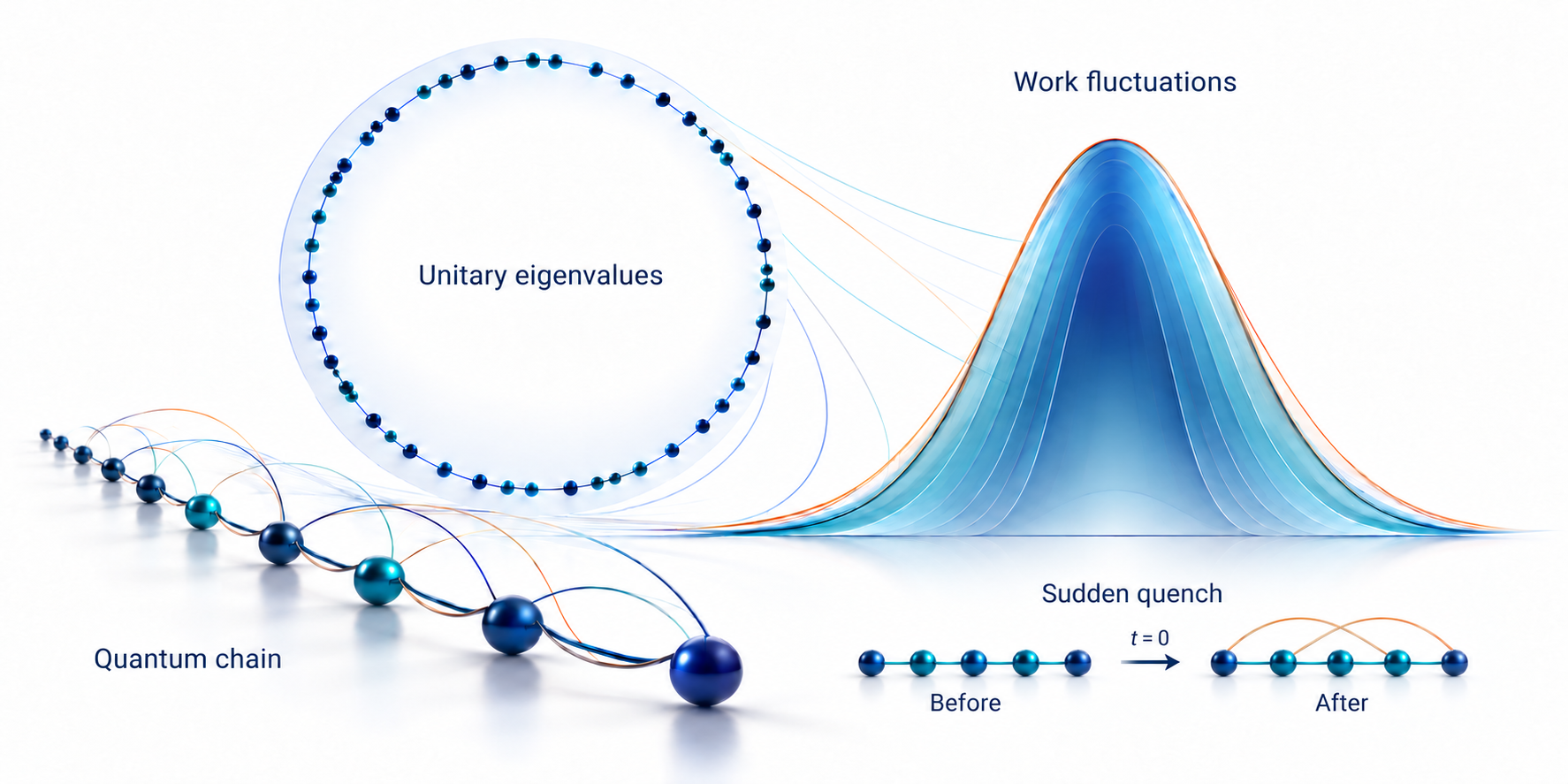
When a quantum many‑body system is driven abruptly— a sudden quench— the work performed fluctuates from run to run. The probability distribution of this work, \(P(W)\), encodes rich information about nonequilibrium dynamics, thermodynamic fluctuation theorems, and universal features of quantum criticality. In the recent study by Tierz, the work statistics of translationally invariant quadratic fermionic chains (including the XY spin chain) are shown to be mathematically equivalent to weighted sums of traces of powers of Haar‑distributed unitary matrices. This random‑matrix perspective provides a clean route to Gaussian behaviour via multivariate central‑limit theorems, while also revealing precise mechanisms that generate non‑Gaussian deviations.
---
Random‑matrix mapping of the Loschmidt amplitude
For a sudden quench the Loschmidt amplitude \(\mathcal{G}(t)=\langle\psi0|e^{-iHt}|\psi0\rangle\) governs the work characteristic function. In the class of models considered—periodic chains with quadratic fermionic Hamiltonians and interactions extending up to \(m\) neighbours—the amplitude can be expressed as a Toeplitz determinant. By diagonalising the underlying single‑particle problem, the determinant reduces to a unitary matrix model where the unitary \(U\) is drawn uniformly from the group \(U(N)\) (the Haar measure). Consequently the work variable takes the linear form \[ W = \sum{r\le m} ar\,\Re\!\operatorname{Tr}U^r \;+\; \sum{r\le m} br\,\Im\!\operatorname{Tr}U^r , \] with coefficients \(ar,br\) determined by the pre‑ and post‑quench couplings. The problem is thus reduced to the statistics of the vector \((\operatorname{Tr}U,\operatorname{Tr}U^2,\dots,\operatorname{Tr}U^m)\).
---
Gaussian limit from multivariate CLT
A classic result by Diaconis–Shahshahani and its multivariate extensions (Johansson & Lambert, 2021) state that, as the matrix size \(N\) grows, the properly normalised traces \(\operatorname{Tr}U^r/\sqrt{r}\) become independent Gaussian variables with zero mean and unit variance. Applying this theorem to the linear combination above yields a Gaussian work distribution: \[ P(W)\approx \frac{1}{\sqrt{2\pi\,\mathrm{Var}(W)}}\exp\!\Bigl[-\frac{(W-\langle W\rangle)^2}{2\,\mathrm{Var}(W)}\Bigr], \] where the variance follows directly from the coefficients: \[ \mathrm{Var}(W)=\frac12\sum{r\le m} r\,(ar^2+b_r^2). \] This expression makes transparent how the microscopic couplings control the width of the work fluctuations. Importantly, the Gaussian shape survives after rescaling by the standard deviation, even when the variance itself grows with system size.
---
When and why non‑Gaussian tails appear
The Gaussian limit relies on two key assumptions: (i) a finite number \(m\) of interaction terms with coefficients that do not grow too fast, and (ii) sufficiently rapid decay of the couplings with distance. Violations of either condition generate correlations among the traces that persist in the large‑\(N\) limit.
- Many interaction terms – If the Hamiltonian contains a large (e.g., extensive) set of non‑zero \(ar,br\), the central‑limit scaling can break down, leading to heavy‑tailed distributions. The work variance may then scale super‑linearly with \(N\), and higher cumulants remain finite.
- Slowly decaying couplings – Power‑law decay \(a_r\sim r^{-\alpha}\) with \(\alpha\le 1\) yields divergent sums in the variance, signalling the onset of Lévy‑stable behaviour. In this regime the work distribution retains a Gaussian core after appropriate scaling but develops algebraic tails.
- Fisher–Hartwig singularities – Certain critical or boundary choices of the symbol in the Toeplitz representation produce Fisher–Hartwig singularities. These modify the asymptotics of the determinant, imprinting logarithmic corrections on \(P(W)\) and generating non‑Gaussian features even for modest system sizes.
Numerical simulations on the XY chain confirm these predictions: for short‑range couplings the work histogram collapses onto a bell curve, while long‑range interactions or quenches across critical points produce noticeable skewness and excess kurtosis.
---
Practical implications and outlook
The random‑matrix mapping offers a powerful diagnostic tool for experimental and theoretical studies of quantum work:
- Predictive variance – By measuring the post‑quench couplings one can immediately estimate the work variance without full diagonalisation.
- Design of protocols – Engineers of quantum simulators can tailor interaction ranges to either suppress fluctuations (Gaussian regime) or deliberately explore rare‑event statistics (non‑Gaussian regime).
- Connection to dynamical quantum phase transitions – The same Toeplitz structure underlies Loschmidt‑echo singularities, suggesting a unified framework for work statistics and dynamical phase transitions.
Future work may extend the approach to interacting (non‑quadratic) models, finite‑time ramps, and open‑system settings where the unitary ensemble is replaced by non‑Hermitian random matrices.
---
Closing remarks
By translating the problem of work fluctuations in sudden quenches into the language of random matrix theory, Tierz’s analysis clarifies when the familiar Gaussian description is justified and precisely how deviations arise. The resulting formulas link microscopic Hamiltonian parameters to macroscopic thermodynamic fluctuations, providing both conceptual insight and practical guidance for probing nonequilibrium quantum thermodynamics.
Source
Read original sourceWhy we picked this
Accepted from curated QuantumUnzipped source (relevance scoring disabled).