World’s smallest engines need an entropy accountant
Accurately separating heat and work in quantum light engines resolves thermodynamic inconsistencies and reveals hidden quantum signatures.
Introduction
Quantum heat engines—tiny devices where atoms interact with light inside optical cavities—are poised to bridge the gap between classical thermodynamics and quantum mechanics. Recent work by Patrick Potts and his team at the University of Basel shows that the way we account for entropy, heat, and work in these systems dramatically affects our interpretation of their performance. By treating the coherent part of the emitted light as work and the fluctuating part as heat, the authors reconcile quantum‑mechanical predictions with classical thermodynamic expectations, highlighting the importance of a correct entropy accountant for future quantum technologies.
From Classical Engines to Quantum Light Engines
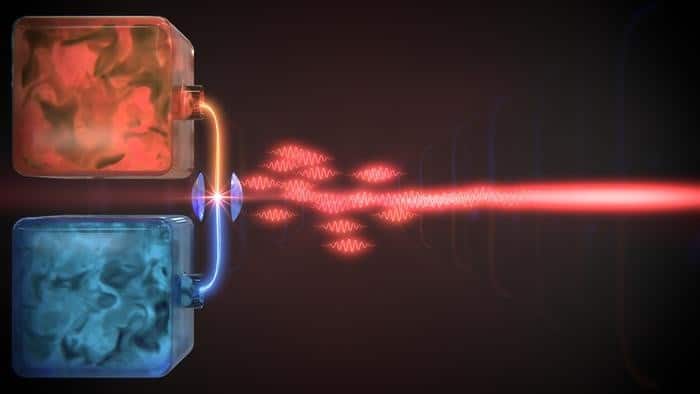
Traditional thermodynamics deals with large ensembles where heat and work are well‑defined: a wind turbine converts kinetic energy (work) while a hot gas stores energy as heat. In a quantum light engine, an atom sits between two partially reflective mirrors. A laser drives the atom, causing it to emit photons that bounce inside the cavity before leaking out through the mirrors. The system continuously absorbs energy from the laser (the input) and dissipates energy via the escaping photons (the output), mirroring the intake‑exhaust cycle of a macroscopic engine.
The Entropy Accounting Problem
The central challenge is deciding how to classify the escaping light. The standard approach lumps all emitted photons into waste heat, which aligns with a purely classical view but clashes with a fully quantum description. Potts’ group built a quantum‑mechanical model of the atom‑cavity system and gradually increased the laser power to approach the semi‑classical limit where the laser is treated classically while the atom remains quantum. In this limit, the predictions of the classical heat‑only model diverge from the quantum model, exposing a fundamental inconsistency.
Splitting Light into Work and Heat
The breakthrough comes from recognizing that the output light has two components:
- Coherent (mean) field – a laser‑like, phase‑stable component that carries directed energy.
- Fluctuations – random deviations around the mean that embody genuine thermal noise.
By assigning the coherent part to work and the fluctuations to heat, the authors restore agreement between quantum calculations and classical thermodynamics. This refined bookkeeping not only resolves the entropy mismatch but also aligns with the classical definition where ordered energy can be harnessed for useful tasks.
Why Accurate Accounting Matters
Correctly distinguishing heat from work is crucial for evaluating thermodynamic uncertainty relations (TURs), which quantify the trade‑off between precision and dissipation in small systems. TURs are often used as markers of quantumness; an erroneous entropy ledger can mask these signatures, leading researchers to overlook the very quantum advantages they seek.
Atom‑cavity platforms already underpin precision measurement technologies—such as atomic clocks and quantum sensors—where exploiting quantum correlations yields superior sensitivity. Misclassifying the energy flow could therefore diminish the perceived performance of these devices and impede the development of next‑generation quantum metrology.
Practical Takeaways for Researchers
- Model the output field explicitly: Separate the coherent amplitude from its noise envelope when analyzing cavity‑based engines.
- Use the work/heat split: Treat the mean photon flux as extractable work; treat the variance as thermal heat.
- Re‑evaluate TURs: Apply the revised entropy accounting to recalculate uncertainty bounds and verify quantum enhancements.
- Design experiments with diagnostics: Implement homodyne or heterodyne detection schemes that can resolve the coherent and fluctuating components of the emitted light.
Closing Thoughts
The study by Potts and colleagues demonstrates that the bridge between thermodynamics and quantum mechanics is not merely conceptual—it hinges on meticulous entropy accounting. As quantum technologies shrink toward the single‑atom and single‑photon regime, embracing this nuanced view of heat and work will be essential for unlocking the full potential of quantum engines and the precision tools they power.
Source
Read original sourceWhy we picked this
Accepted from curated QuantumUnzipped source (relevance scoring disabled).