Your beer can only cool so fast. Blame quantum mechanics
Quantum mechanics sets a universal speed limit on how quickly any object can reach thermal equilibrium.
Why Your Beer Can’t Chill Instantly – A Quantum Speed Limit
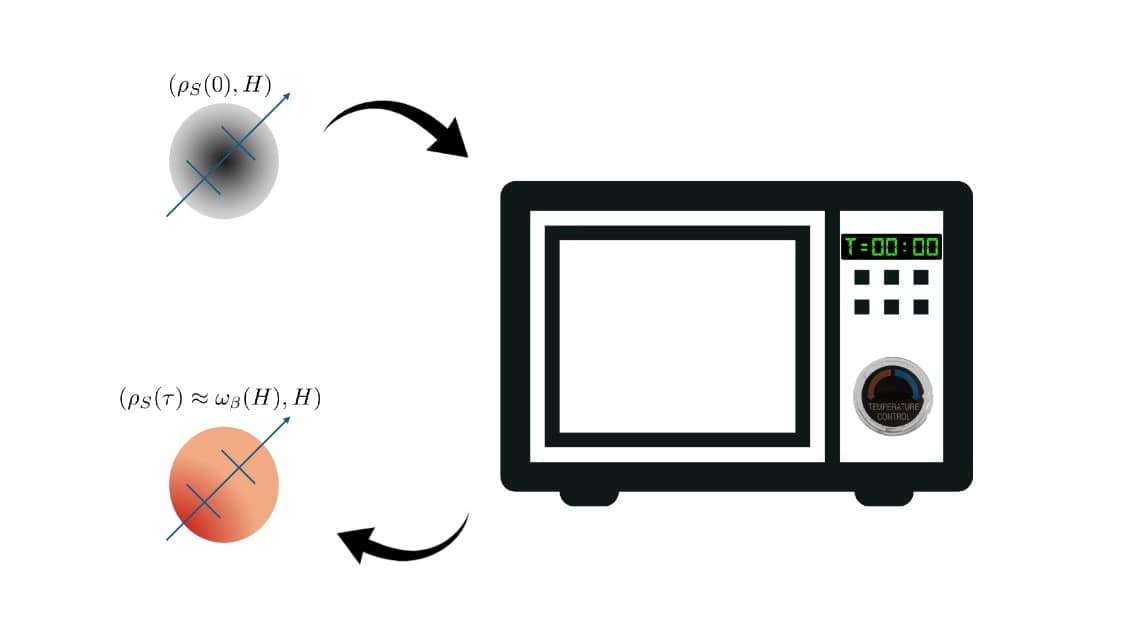
When you pop a warm beer into the fridge, you expect it to cool down as fast as the appliance can push cold air around. In practice, there’s a deeper, fundamental bound that no refrigerator—or any thermal‑machine—can beat: a limit imposed by quantum mechanics. Recent theoretical work shows that, away from absolute zero, the fastest possible thermalisation time is set by the ratio \(\hbar/(2k{B}T)\), where \(\hbar\) is the reduced Planck constant, \(k{B}\) Boltzmann’s constant, and \(T\) the target temperature. This insight reframes everyday cooling as a quantum‑constrained process.
---
1. Thermalisation as a Machine
Physicists model a refrigerator, a kettle, or any device that brings a system to a desired temperature as a thermalisation machine. The machine takes an arbitrary initial state of a quantum system and evolves it into a thermal state—one that no longer exchanges net heat with its surroundings. Crucially, the definition used in the recent study forbids “cheating” tricks such as swapping a hot cup of coffee for a pre‑cooled one. The machine must work for a whole family of similar systems, not just a single, finely tuned instance.
To formalise this, the researchers describe the system’s possible energies with a Hamiltonian. The thermalisation machine must succeed for any Hamiltonian that is close to the one it was designed for, ensuring robustness against small variations (e.g., a beer with a slightly different sugar content). This requirement eliminates instantaneous swap protocols and forces the machine to respect the underlying quantum dynamics.
---
2. Deriving the Quantum Speed Limit
Starting from the weak assumptions that:
- The machine obeys the laws of quantum mechanics, and
- It works for a neighbourhood of Hamiltonians,
the authors prove a universal lower bound on the time \(\tau\) needed to reach thermal equilibrium:
\[ \tau \gtrsim \frac{\hbar}{2k_{B}T} \]
The bound is independent of the details of the device—its size, power consumption, or engineering—so long as it operates above absolute zero. At room temperature (≈300 K), this translates to a minimum thermalisation time on the order of a few femtoseconds, far shorter than everyday cooling times but still non‑zero. As the target temperature drops, the bound grows, reflecting the increasing difficulty of extracting heat near absolute zero.
---
3. Connections to Computer Science
The problem of preparing a thermal state is closely related to two tasks in quantum computing:
- Gibbs state sampling (GSS) – given a known Hamiltonian, generate its thermal state. This can be done arbitrarily fast because the Hamiltonian is already known.
- Hamiltonian learning (HL) – infer the Hamiltonian from measurements before preparing the thermal state. HL has its own time constraints.
The thermalisation scenario studied sits between these extremes: the Hamiltonian is unknown, but the system itself is accessible. This intermediate difficulty yields the quantum speed limit above, offering a bridge between physics and algorithmic complexity.
---
4. Why It Matters for Everyday Cooling
While the femtosecond scale is far beyond the seconds‑to‑minutes we experience with a fridge, the result tells us that no clever engineering can make a beer reach its desired temperature instantaneously. The bound is a reminder that thermalisation is a physical process governed by quantum uncertainty, not merely a matter of heat‑transfer efficiency.
Moreover, the framework may guide the design of future quantum‑enhanced refrigerators, where controlling microscopic degrees of freedom could push practical cooling times closer to the quantum limit. Understanding these constraints also informs the fundamental limits of the second and third laws of thermodynamics, an active area of research.
---
5. Takeaway
Your next cold beer will still need patience, but now you know why: quantum mechanics sets a hard floor on how fast any system can shed heat and settle into equilibrium. The limit is tiny, yet it is universal, reminding us that even the most mundane cooling tasks are rooted in the deepest laws of physics.
Source
Read original sourceWhy we picked this
Accepted from curated QuantumUnzipped source (relevance scoring disabled).