Zapata Quantum and University of Maryland Launch ForShor.ai Formal Verification Challenge for AI-Assisted Quantum Algorithm Design
Zapata Quantum and the University of Maryland have launched the ForShor.ai challenge to combine formal verification with AI for designing quantum factoring algorithms.
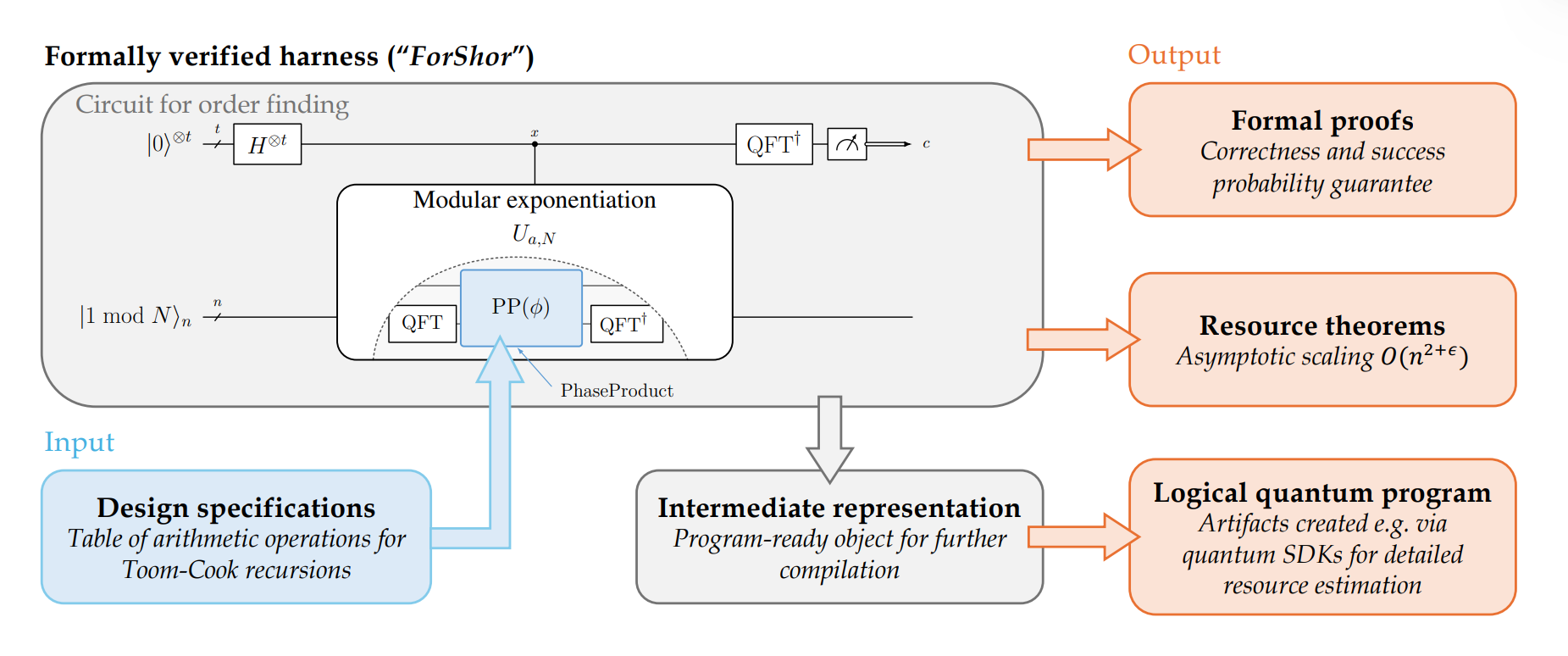
Formal Verification Meets AI in Quantum Algorithm Design
Zapata Quantum (OTCQB: ZPTA) and the University of Maryland’s Joint Center for Quantum Information and Computer Science have announced ForShor.ai, an open research challenge that blends formal theorem proving with artificial‑intelligence‑driven optimization. The goal is to accelerate the design of quantum factoring subroutines—most notably those used in Shor’s algorithm—while guaranteeing mathematical correctness through machine‑checked proofs.
How the Challenge Works
Participants, whether human researchers or autonomous AI agents, submit recursive arithmetic schedules that describe how to split and multiply large integers using Toom–Cook and Cooley–Tukey techniques. Each submission is evaluated by an automated Lean 4 harness that:
- Verifies end‑to‑end order‑finding correctness.
- Checks four decidable conditions ensuring the policy’s validity.
- Estimates asymptotic gate complexity, confirming the claimed O(n^{2+ε}) scaling.
- Translates the verified schedule into a Qualtran representation for logical resource estimation.
Successful policies are posted on a public leaderboard, providing a transparent benchmark for AI‑generated quantum circuits.
Technical Highlights
- Lean 4 verification harness: ~180 files, ~3,500 declarations, formalizing recursive Toom‑Cook PhaseProduct and Cooley‑Tukey QFT.
- Resource estimation: For a 2048‑bit integer, the harness reports roughly 1.7 × 10¹² T‑gates using optimized arities, comparable to state‑of‑the‑art discrete‑log factoring estimates.
- Search bottleneck: Exhaustive search for optimal policies at arity k = 8 would require >7.5 TB of memory and astronomically large compute time, motivating AI‑guided heuristics.
Why Formal Verification Matters
Traditional AI‑generated quantum circuits are often treated as black boxes, making it difficult to trust their correctness or reuse their components. By coupling AI‑driven search with machine‑checked proofs, ForShor.ai ensures that any performance gains are provably sound and can be integrated into larger fault‑tolerant software stacks, such as Zapata’s Quantum Pilot platform.
Getting Involved
The challenge runs for six weeks, focusing on two core benchmarks:
- PhaseProduct (Shor) – the core multiplication step in Shor’s algorithm.
- PhaseTripleProduct (Regev) – a related lattice‑based primitive.
Interested participants can join the community Discord, explore the interactive Lean proof map, and submit policies via the challenge platform. Detailed documentation, the preprint on arXiv, and related press releases are linked in the original announcement.
---
The ForShor.ai challenge represents a collaborative effort to bring rigor to AI‑assisted quantum algorithm design, offering a concrete venue for researchers to test and showcase provably correct optimizations.
Hype check
Not a research claimThe piece announces a research challenge, not a concrete result; there is no experimental data or paper to evaluate.
We rate research and technical results only. How we rate hype →
Source
Read original sourceWhy we picked this
Accepted from curated QuantumUnzipped source (relevance scoring disabled).