Pavia Team Models How Shaped Lasers Improve Ion Quantum Gates
Shaped laser gradients that excite axial phonons can cut crosstalk and spectral crowding, offering a clearer path to scalable trapped‑ion quantum gates.
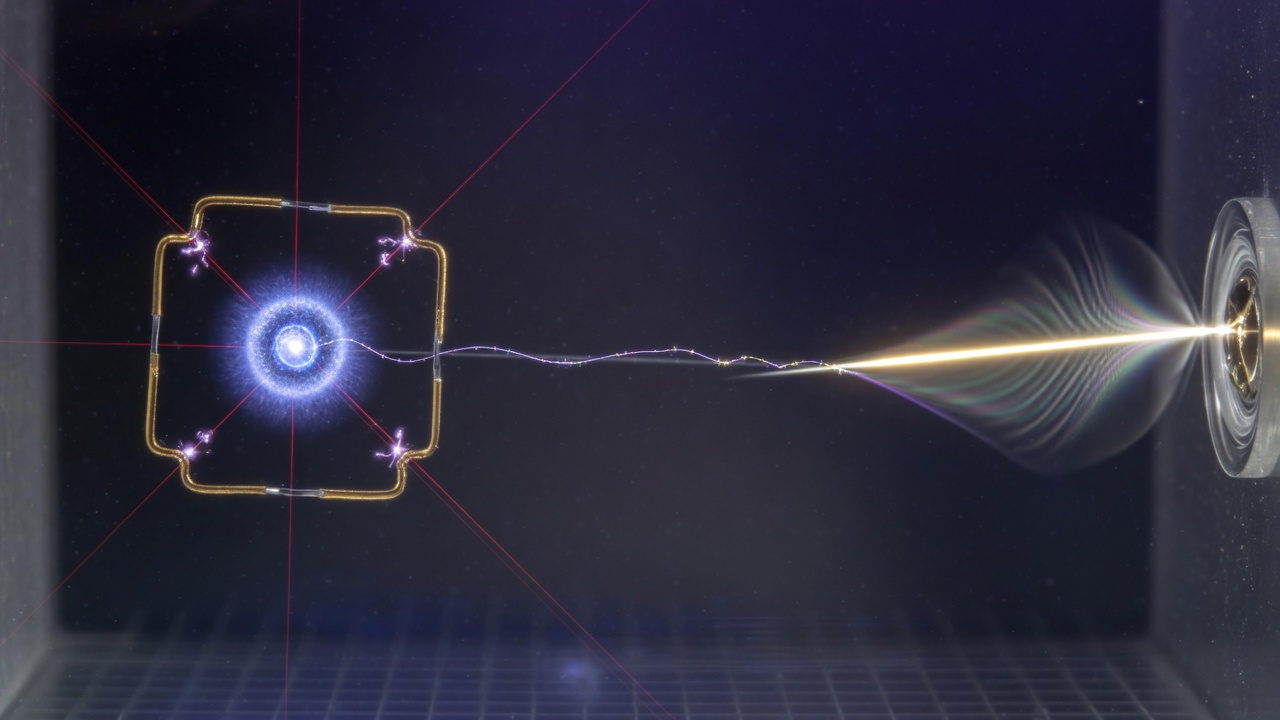
Shaped laser gradients that excite axial phonons can cut crosstalk and spectral crowding, offering a clearer path to scalable trapped‑ion quantum gates.
Dayalbagh researchers have devised compact triorthogonal qudit error‑correction codes that cut resource overhead for quantum computing, especially qutrit magic‑state distillation, by up to an order of magnitude.
A proposed Andreev‑qubit design reads quantum states via an oscillating supercurrent detected by a SQUID, offering a near‑nondestructive alternative to ancilla‑based readout.
A new study shows that an intrinsic “quantum charge” in wavefunctions, revealed through Uv‑invariance of the Weyl‑Heisenberg group, cleanly separates particles from antiparticles and resolves long‑standing negative‑probability paradoxes in first‑quantized relativistic models.
Binary quadrature encoding on Quantinuum’s 56‑qubit trapped‑ion chip offers a compact, low‑depth approach to boson‑matter simulations, outperforming unary and Dicke methods while highlighting noise‑sensitivity challenges.
US defence quantum spending is verifiable at a few hundred million dollars a year, while broader market estimates vary wildly and should not be combined.
Defence quantum‑computing funding jumped roughly two‑ to three‑fold in 2026, driven almost entirely by two newly announced DARPA deals, while obligated spending actually fell.
John Martinis will discuss the path from early qubits to scalable quantum computers, highlighting hardware, architecture, and algorithmic challenges.
New mathematical bounds show the Thomas‑Fermi‑von Weizsäcker kinetic energy approximation becomes exact on a defined “Poincaré density manifold” and converges at an optimal N⁻² rate.
Harvard researchers have introduced a polylogarithmic‑depth quantum circuit for port‑based teleportation, simplifying its implementation and offering a new proof of parallelizable multi‑qubit operations.
A single non‑Hermitian defect in one‑dimensional quantum walks triggers scale‑free localisation and two distinct phase transitions, revealing how minimal imperfections can dramatically reshape quantum dynamics.
An oral‑history interview reveals how Yakir Aharonov’s decades‑long collaborations shaped foundational quantum concepts such as the two‑state vector formalism, weak values, and protective measurements.
A new distributed dual‑comb spectroscopy scheme uses a single squeezed‑light source to entangle multiple sensors, promising scalable broadband measurements but still lacking experimental proof.
A theoretical study shows that vibrating optomechanical membranes can imprint force information onto free‑electron recoil spectra, offering a potentially higher‑sensitivity alternative to conventional optical force sensors.
A new quantum‑field formalism lets researchers predict exact axion‑induced count distributions in cavity haloscopes, revealing non‑Poissonian signatures that could distinguish Gaussian, coherent or Bose‑Einstein‑condensate dark‑matter states, though current detectors lack the sensitivity to observe these effects.
A new molecular‑dynamics code enables semiclassical simulations of electromagnetically induced transparency cooling for ion crystals up to 500 ions, advancing quantum‑sensor design while highlighting remaining modeling challenges.
Nagoya University researchers show that diverse quantum f‑divergences can be treated uniformly through a retrodictive‑test variational principle, enabling simultaneous optimisation across all operator‑convex functions.
A team classified 371 five‑particle orthogonal product state configurations, showing that local operations and classical communication can perfectly distinguish 355 of them, while 16 remain indistinguishable.
California’s Workforce Development Board is investing $5.74 million in five partnerships to create sub‑doctoral training pipelines for quantum hardware technicians and related deep‑tech roles.
Andreev qubits can encode their state in an intrinsic supercurrent, enabling a near‑non‑destructive readout that avoids ancillary qubits.
OSU physics professor Yingmei Liu was named a 2026 APS Fellow for pioneering work on spinor Bose‑Einstein condensates, quantum walks, and Oklahoma’s only programmable quantum simulator that advances quantum sensing.
NowSecure’s benchmark shows that roughly 97% of mobile apps still lack any post‑quantum cryptography, exposing a major security gap as regulatory deadlines approach.
Free weekly email
Every Monday, the week’s quantum briefings in one short email: what happened, why it matters, and the source. Unsubscribe anytime.